10 fun facts about Phu Quy, Vietnam
History
Hon Hai, a rock islet off Phu Quy, is point A6 of the straight baseline from which Vietnam has measured its territorial sea since its declaration of 12 November 1982.
The baseline is a chain of straight lines joining headlands and outlying islets along the coast, and the waters Vietnam claims are counted outward from it. Hon Hai is the point between Bay Canh off Con Dao and Hon Doi off Khanh Hoa. Tuoi Tre's reporter needed a permit and two days at sea, waiting out the waves, to reach it.
Source: LuatVietnam, What is a baseline (with the 1982 declaration's points), Tuoi Tre, Vietnam's eleven markers at sea. Checked October 2026.
From 2015 until September 2020, foreign visitors needed a police permit and a sponsor to visit Phu Quy, an island that hosts several military bases.
The permit took three to four days, and the head of the island's tourism association said foreign guests at his resort fell by half once it began. Binh Thuan dropped it on 1 September 2020, with the border guard saying foreigners would still be watched closely. In 2019 the island had about 42,000 visitors, mostly Vietnamese.
Source: VnExpress International, Foreigners exempt from travel permits to visit Phu Quy island, 4 September 2020. Checked October 2026.
Phu Quy means "island of riches", and it also goes by two older names, Cu Lao Thu and Khoai Xu.
A Bao Da Nang reporter thought the island, seen from above, looked like a giant mackerel rising from the sea, and wondered whether that explains the name. VnExpress gives both old names in its guides, in Vietnamese and in English. Since July 2025 the island has been a special zone of Lam Dong province, no longer a district of Binh Thuan.
Source: Vietnam National Authority of Tourism, Phu Quy: Vietnam's up-and-coming island destination, VnExpress, Phu Quy travel guide (Vietnamese, updated May 2026), VnExpress International, Phu Quy travel guide, Bao Da Nang, Pearl island in the middle of the ocean, 11 October 2026 (English edition on Vietnam.vn), Official Gazette, Resolution 1671/NQ-UBTVQH15 on Lam Dong's commune-level units, 16 June 2025. Checked October 2026.
By the numbers
From January to September 2026, 169,266 visitors came to Phu Quy, 5,076 of them from abroad, 16% more than in the same months of 2025.
All of them came by sea. Five fast passenger boats made 864 trips on the Phan Thiet route in those nine months and carried 386,455 passenger journeys, islanders included, without an accident, says the port management board's report to the Ministry of Construction. The crossing takes about two hours on the fastest boats.
Source: Ministry of Construction, Phu Quy port keeps traffic safe in the first nine months of 2026, 8 October 2026, Phu Quoc Express, Phan Thiet to Phu Quy fares and schedule. Checked October 2026.
Nature

Image: Theodore Nguyen / Pexels An engineer from EVN's design consultancy called Phu Quy the best island in Vietnam for wind power, with the country's highest average wind speed, over 10 metres a second.
PV Power, the state oil group's power company, put three turbines of 6 MW in all on the island and started selling their electricity on 25 August 2012. Before that, a 3 MW diesel plant ran only 16 hours a day. A year later EVN reported islanders still had power for 16 hours, and an expert it quoted thought the turbines too big for the island's demand.
Source: EVN (Vietnam Electricity), Wind power on the islands, 4 July 2013, PV Power, Phu Quy wind farm starts commercial operation, 27 August 2012. Checked October 2026.
Phu Quy was built by a volcano, and Cao Cat, one of its three peaks at 106 m, is cut into grey horizontal ledges that islanders compare to the Grand Canyon.
Lava and sea sediment formed the island, and the old craters still show in its three hills, Cam, Ong Dun and Cao Cat. Weathering has carved Cao Cat's dark rock into deep grooves and rings. Linh Son pagoda sits on its slope, and from there a path climbs to the summit, where the whole island spreads out below.
Source: Vietnam National Authority of Tourism, Phu Quy: Vietnam's up-and-coming island destination, Bao Da Nang, Pearl island in the middle of the ocean, 11 October 2026 (English edition on Vietnam.vn), VnExpress International, Phu Quy travel guide. Checked October 2026.
Food
Phu Quy's "hot beef", bo nong, is not spicy: the cattle are raised on the island and the meat is sold and cooked the same day.
The tourism authority says the island's cows are reared organically, and that the hot in the name refers to how fast the beef goes from the butcher to the table, within a day. VnExpress names a handful of restaurants that serve it. Bao Da Nang's reporter rated it among the dishes worth trying, beside squid cakes and fish noodle soup.
Source: Vietnam National Authority of Tourism, Phu Quy: Vietnam's up-and-coming island destination, VnExpress International, Phu Quy travel guide, Bao Da Nang, Pearl island in the middle of the ocean, 11 October 2026 (English edition on Vietnam.vn). Checked October 2026.
The moon crab, a Phu Quy speciality, is named for the round dark red spots on its shell, and hides in the crevices of the coral rock.
It is hard to catch, which keeps it dear, and some say it tastes sweetest when caught as the moon rises. The king crab is the island's other prized crab. VnExpress advises ordering both a day ahead through your guesthouse, and the raft restaurants moored off the island cook whatever the boats bring in.
Source: Vietnam National Authority of Tourism, Phu Quy: Vietnam's up-and-coming island destination, VnExpress International, Phu Quy travel guide, VnExpress, Phu Quy travel guide (Vietnamese, updated May 2026). Checked October 2026.
Culture
Islanders gave a full funeral to a whale that washed up on Phu Quy in 1941, and its skeleton, about 20 m long, is kept at the Van An Thanh whale temple.
Fishermen along this coast worship the whale as a protector, and islanders still tell of whales guiding boats through storms. Van An Thanh, near the main port, is one of Phu Quy's two national historical and cultural relics, with Linh Quang pagoda, among 34 places of worship on the island. It is not always open, so the tourism authority suggests phoning ahead.
Source: Vietnam National Authority of Tourism, Phu Quy: Vietnam's up-and-coming island destination, VnExpress, Phu Quy travel guide (Vietnamese, updated May 2026), Bao Lam Dong, Tourism in the marine protected areas. Checked October 2026.
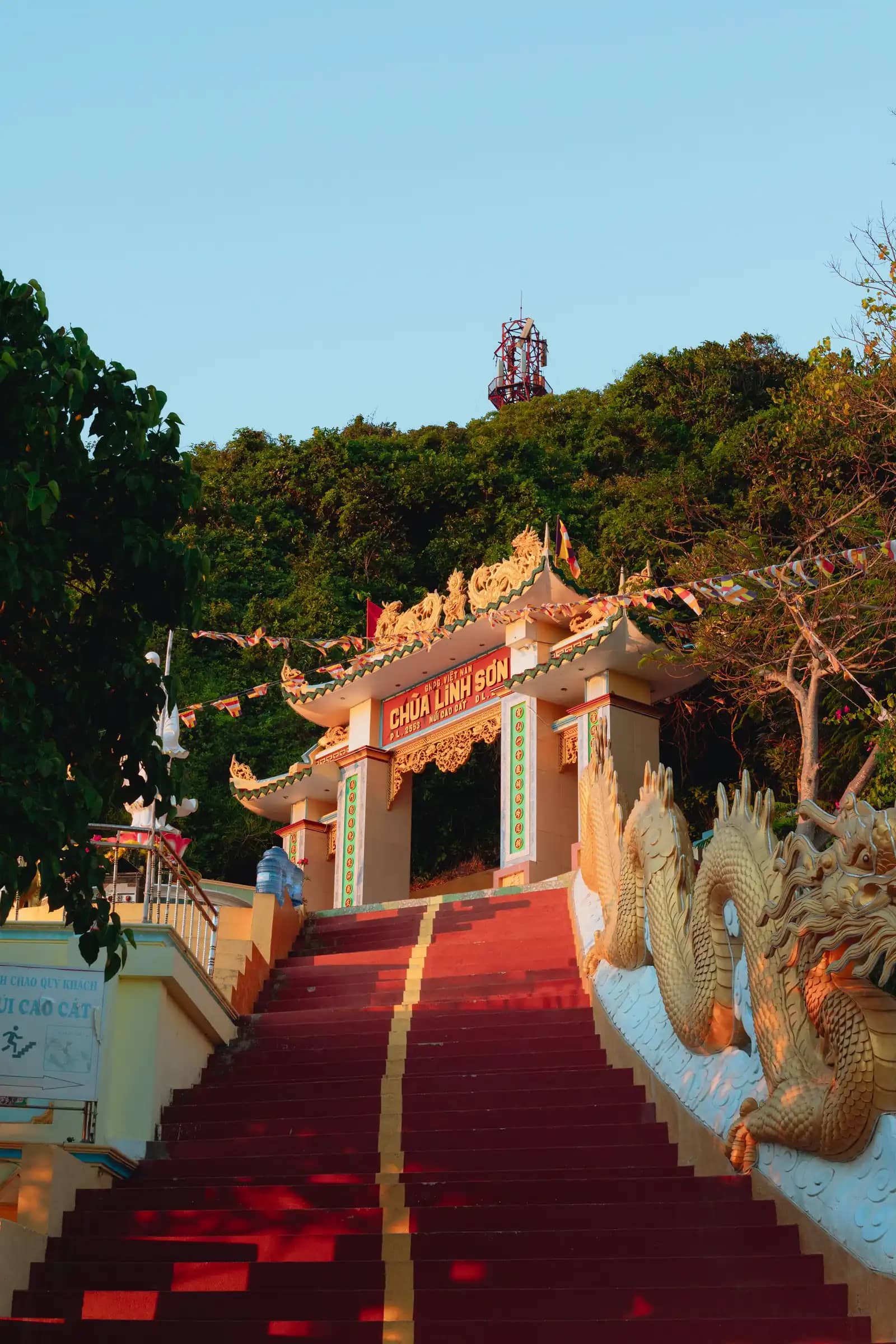
Image: Theodore Nguyen / Pexels Linh Son pagoda on Cao Cat's slope was founded in 1848, and from its dragon-lined red steps a path climbs on to the summit, a place islanders and visitors go for the sunset.
A reporter for Bao Da Nang walked up from the pagoda as the sun set, in a strong wind, to see three white wind turbines and the diesel plant below. The tourism authority describes the pagoda's large Buddha statue and the benches and lookouts above it. Islanders come here to pray for peace as well as for the view.
Source: Bao Da Nang, Pearl island in the middle of the ocean, 11 October 2026 (English edition on Vietnam.vn), Vietnam National Authority of Tourism, Phu Quy: Vietnam's up-and-coming island destination. Checked October 2026.
Climate, airports and UNESCO status for Phu Quy are on its destination page. More places are on the fun facts index.