Vietnam vaccinations: shots you need and the optional ones
Four governments agree on the basics and split on typhoid, hepatitis B and malaria tablets.
VerdictHepatitis A, routine shots and usually typhoid; see a clinician about Japanese encephalitis, rabies and malaria, rabies first for Cambodia.
Vietnam vaccinations are a short list for most travellers and a longer one for some. None of the official pages we read makes a vaccine certificate a condition of entry to Vietnam. The US CDC, the UK's TravelHealthPro and Canada's travel advice all recommend hepatitis A and up-to-date routine vaccines; the US and UK pages add typhoid for most travellers, while Canada says it may be recommended for some. We set those pages beside Australia's government sources on 24 October 2026 and added what changes if Cambodia is on the same trip. This summarises what they say and is not medical advice.

The UK and Australian entry advice adds one thing: travellers to or through Vietnam may have to complete a health declaration that may include proof of vaccination. Vietnam's Ministry of Health said on 30 June 2026 that this declaration, set by Decree 165/2026/ND-CP from 1 July 2026, is not required of every traveller at all times: the health minister switches it on for a given disease when there's a risk, and the ministry will announce its own system then. The entry checklist has the rest of the arrival steps.
Sometimes the appointment comes mid-trip. In July 2026 a traveller on r/VietNam got out of the car on the drive to the Ha Giang loop, and a woman's pet dog mouthed their hand, leaving a small red mark. The owner said the dog was vaccinated; there was no paperwork to see. They had wiped it with alcohol straight away, their travel group said not to bother, and almost every reply said go. A clinic was a five-minute bike ride away. They got the shot and kept up the course, which they wrote barely touched their travel plans. TravelHealthPro says a pre-trip rabies course shortens that treatment after a bite; it doesn't replace it.
Where the lists agree
The Australia column is from the Australian Immunisation Handbook's chapter on international travellers, which advises by region and doesn't name Vietnam or Cambodia. Smartraveller, Australia's travel advice site, doesn't list vaccines one by one: its Vietnam page says to get vaccinated before you travel, keep vaccinations up to date because measles and diphtheria are a risk, and ask your doctor.
| Vaccine | CDC (US) | TravelHealthPro (UK) | Canada | Australia (Handbook) |
|---|---|---|---|---|
| Hepatitis A | Unvaccinated travellers aged one or older | All previously unvaccinated travellers | All travellers to areas where it is present | From age 1, for moderately or highly endemic countries |
| Tetanus and routine vaccines | Up to date before every trip | A full tetanus course; a booster after ten years if care may be limited | Up to date before you travel, wherever you go | Tetanus before departure, especially if care could be delayed |
| Measles (MMR) | Fully vaccinated, with an early dose for infants of 6 to 11 months | Up to date; an early dose from six months for infants mixing with local people | Part of the routine schedule; ask if unsure you're protected | Two doses if born in or after 1966; infants of 6 to 12 months where measles is endemic |
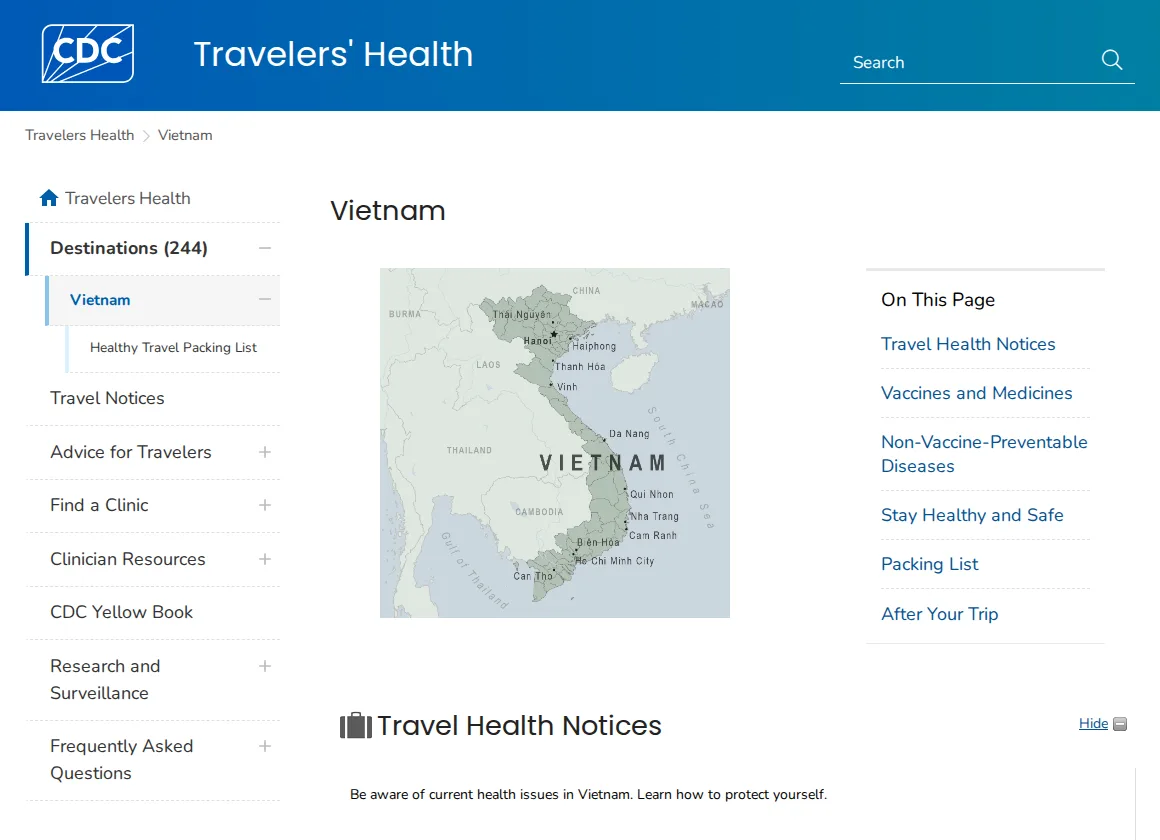 Screenshot: US CDC Travelers' Health, Vietnam page, captured 8 October 2026
Boots UK, the pharmacy chain, made this short video on Vietnam travel vaccines; it's general advice.

Where they differ or depend on your trip
| Vaccine | CDC (US) | TravelHealthPro (UK) | Canada | Australia (Handbook) |
|---|---|---|---|---|
| Typhoid | Most travellers; not 100% effective, so food and water habits still matter | Most travellers, especially long or frequent stays | Risk low for most; may be recommended for some | May be recommended from age 2 for most Southeast Asian countries |
| Hepatitis B | Unvaccinated travellers of all ages | Could be considered for all; recommended if activities or health raise the risk | All travellers | Long-term or frequent travellers to Asia |
| Japanese encephalitis | A month or more; consider for shorter rural trips | Can be considered for a month or more in season; peaks May to October, especially in the north | Risk very low for most; consider for over 30 days, repeat trips or long rural stays | A month or more in season; consider for shorter wet-season or outdoor trips |
| Rabies | Weigh your activities against how fast you could reach treatment | Higher-risk activities, limited treatment access, stays over a month | Ask; may suit children, cave explorers and people close to animals | Weigh exposure against access to treatment; a lower threshold for children |
| Chikungunya | Generally not recommended | May be considered from age 12 for an outbreak region or long-term travel | Vaccine approved in Canada; discuss it | No vaccine listed |
| Dengue | No vaccine listed; prevent mosquito bites | Can be considered from age 4 for people who have had dengue | No vaccine available in Canada | No vaccine listed |
| Tuberculosis (BCG) | No vaccine listed | Unvaccinated children under 16 living there over 3 months; some workers | Risk low for most; high-risk travellers should ask | Children under 5 staying 3 months or more in high-risk countries |
| Yellow fever | Not recommended, not required for entry | No certificate requirements | Proof not required; not recommended | Occurs only in parts of Africa and South America |
| COVID-19 | All eligible travellers up to date | Not listed | Talk to a provider before travelling | All travellers age-appropriately vaccinated |
| Mpox (CDC: monkeypox) | Adults expecting certain kinds of intimate contact | Not listed | Get vaccinated if eligible | Australian risk groups, or sexual risk in a clade I region |
Canada is softer than the US and UK on typhoid and, like the CDC, recommends hepatitis B for every traveller; the Handbook keeps it for long or frequent trips.
Malaria: the pages disagree on tablets
The CDC and UK pages both say the big cities carry no malaria risk. The CDC names Da Nang, Hai Phong, Hanoi, Ho Chi Minh City, Nha Trang and Quy Nhon; the UK adds the Red River delta, the coast north of Nha Trang and Phu Quoc.
Outside the cities they differ. The CDC recommends prescription tablets for areas with malaria transmission, naming ten provinces, among them Khanh Hoa and Lam Dong; the Mekong and Red River deltas get bite precautions only. Its malaria entry was updated on 23 April 2025. The UK page describes a low risk in Tay Ninh, Lam Dong, Dak Lak, Gia Lai, Kon Tum and other rural areas, advises bite avoidance, and says tablets may be considered only in exceptional circumstances, for example for older people, pregnant women or young children.
Canada says antimalarials may be recommended depending on itinerary and time of year; Smartraveller says to consider taking medicine to prevent malaria. Neither names an area.
If your route includes the Central Highlands or the rural south, take this section to a clinician. Da Lat is in Lam Dong, which both pages name without a separate answer for the city.
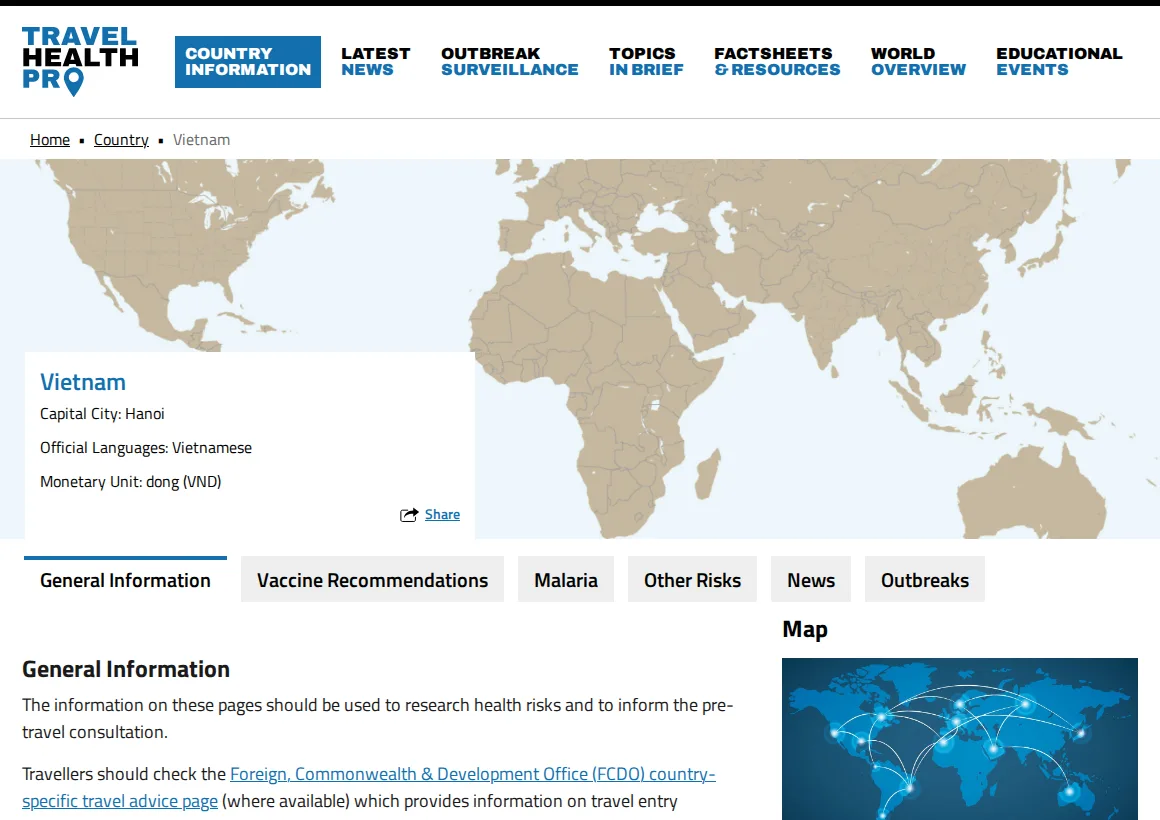 Screenshot: TravelHealthPro (NaTHNaC), Vietnam country page, captured 8 October 2026
Vietnam and Cambodia on one trip
The CDC, TravelHealthPro and Canadian pages for Cambodia match their Vietnam advice on hepatitis A, typhoid, Japanese encephalitis and routine vaccines. These lines change:
| Vietnam | Cambodia | |
|---|---|---|
| Yellow fever certificate | Not required | Required from age 1 if you arrive from a country with yellow fever risk, including an airport transit there of over 12 hours (CDC, UK) |
| Malaria tablets (CDC) | Ten named provinces and other rural areas | Rural and forested areas; none in Phnom Penh, Siem Reap or the main Angkor Wat temple complex |
| Malaria (UK) | Low risk in five named provinces and rural areas | Low risk; very low at Angkor and around Tonle Sap, including Siem Reap; none in Phnom Penh |
| Hepatitis B (CDC) | Unvaccinated travellers of all ages | Unvaccinated travellers under 60; 60 and over may get it |
| Rabid dogs (CDC) | "Sometimes found" | "Commonly found" |
| Ambulance (UK FCDO) | 115 | 119 |
Canada words the yellow fever rule more widely, with no 12-hour cut-off: proof is required if you come from, or have transited through an airport of, a country where yellow fever occurs. Arriving from or via Africa or South America is the case to check. Canada's Cambodia page also adds a flu shot at least 2 weeks before travelling.
Smartraveller doesn't list vaccines one by one for Cambodia either, but on rabies it is direct: "Consider getting pre-travel vaccination for rabies." For treatment it names the Institute Pasteur Rabies Clinic in Phnom Penh, and it says malaria is common in some regions, especially along borders in the mountains.
With Cambodia on the route, we'd raise rabies first at the clinic: the CDC finds rabid dogs more common there, and every page leaves the pre-trip shot to you and a clinician.
How early to ask
Four sources give four lead times: the CDC at least a month before the trip, TravelHealthPro ideally four to six weeks, Canada preferably 6 weeks, the UK Foreign Office at least 8 weeks. TravelHealthPro and Canada both say a late appointment is still worthwhile. Planning for the longest covers all of them.
Medicines and emergencies
Dial 115 for an ambulance in Vietnam, says the UK health page; the CDC adds 114 for the fire department and 113 for the police.
Some medicines can be hard to find in Vietnam, and the UK page says many are fake. Vietnam restricts medicines it classes as addictive or psychotropic, including some treatments for anxiety, depression and insomnia, and it is illegal to carry more than 7 days of them. Carry the prescription and a doctor's letter, which can be in English, with your name and age, the medicine's name, volume and dosage, and the doctor's signature and address. For more than the usual amount, contact a Vietnamese embassy before you travel.
The same page says altitude sickness is a risk in parts of Vietnam, which matters for the route from Hanoi to Sa Pa.
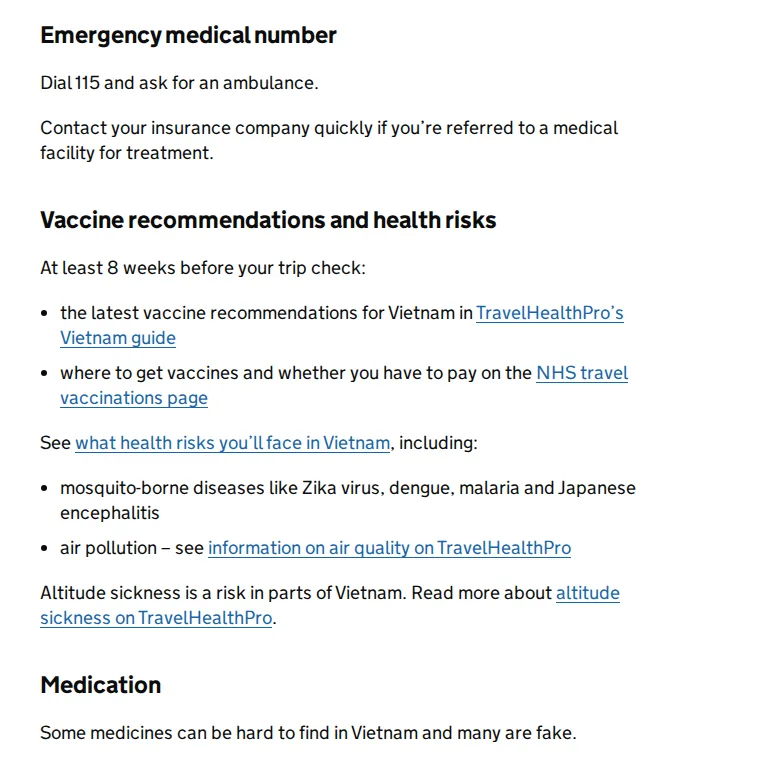 Screenshot: UK FCDO travel advice for Vietnam, health (gov.uk), captured 8 October 2026
In a thread from a visitor worried about rabies after a dog encounter, the top reply was:
"Just go to your nearest VNVC and get the vaccines. Low price to not worry."
u/Koronag on r/VietNam
Our take
Hepatitis A and routine vaccines are the baseline for almost every traveller, and typhoid for most. The decisions that need a clinician are Japanese encephalitis for long or rural stays, rabies if you will be far from treatment, and malaria tablets for the Central Highlands, where the pages disagree most. Cambodia moves rabies up the list and adds a yellow fever paper check only if you arrive from a risk country. If you take any regular medicine, the 7-day rule may matter more than any vaccine, so sort out the doctor's letter early.
How we checked this
We compared the CDC, TravelHealthPro and UK FCDO pages for Vietnam on 8 October 2026 and again on 21 October. On 24 October 2026 we re-read them (the rows we use were unchanged) and added the same three for Cambodia, Canada's advice for both countries (updated 19 and 14 October 2026), Smartraveller for both ("still current at" 24 October 2026) and the Handbook's travellers chapter (updated 19 January 2026). The Australia column uses only those two government sources, no clinic lists. Last reviewed: 24 October 2026.
What this does not tell you
The Handbook advises by region, so its column is our reading for Vietnam and Cambodia, not a country ruling. NHS Fit for Travel did not load from our server. Both TravelHealthPro pages show a last update of 29 January 2021; the CDC pages were last reviewed on 25 August 2026. If you're pregnant, have a health condition or travel with children, ask a health professional: every page has extra advice for those groups. Wider advice: our health and safety page and Is Vietnam safe for Americans?.
References
All read on 24 October 2026.
- US CDC, Travelers' Health: https://wwwnc.cdc.gov/travel/destinations/traveler/none/vietnam and https://wwwnc.cdc.gov/travel/destinations/traveler/none/cambodia
- TravelHealthPro (NaTHNaC): https://travelhealthpro.org.uk/countries/vietnam and https://travelhealthpro.org.uk/countries/cambodia
- UK FCDO travel advice, health: https://www.gov.uk/foreign-travel-advice/vietnam/health and https://www.gov.uk/foreign-travel-advice/cambodia/health
- Government of Canada travel advice: https://travel.gc.ca/destinations/vietnam and https://travel.gc.ca/destinations/cambodia
- Smartraveller (Australia): https://www.smartraveller.gov.au/destinations/asia/vietnam and https://www.smartraveller.gov.au/destinations/asia/cambodia
- Australian Immunisation Handbook, Vaccination for international travellers: https://immunisationhandbook.health.gov.au/contents/vaccination-for-special-risk-groups/vaccination-for-international-travellers
Photo (cover): Bernd Dittrich / Unsplash
Data checked: October 2026.
About the author

Pen name for the getting-around beat: trains, flights, airports, visas and entry rules, health and safety. Journeys are computed from the operator's own timetable.
Keep reading
North vs south Vietnam weather: Hanoi and the Mekong Delta
Guides · 5 min
Vietnam ATM fees: what each bank charges a foreign card
Guides · 5 min
My Son Sanctuary ticket price in 2026 and the planned rise
Guides · 5 min
Is there an airport in Hue? Phu Bai, and when Da Nang wins
Guides · 5 min

The coldest places in Vietnam, and when nights turn cold
Guides · 5 min
Vietnam rainy season: the wettest month in each place
Guides · 5 min
Trang An boat tour price, plus Tam Coc and Ninh Binh tickets
Guides · 5 min
Hoi An lantern festival dates: every full moon to 2027
Guides · 5 min
Disclaimer
This article is general information, not legal, immigration, medical or financial advice. Prices, visa rules and transport schedules change, and each figure shows the month we last verified it. Confirm anything that affects your trip (entry requirements, fees, health rules) with the official government or provider source before you book or travel. The site has no affiliate links today; our affiliate disclosure explains what we will do if that changes.