Vietnam ATM fees: what each bank charges a foreign card
Every Vietnamese bank charges your foreign card a different fee, and one of them nearly triples its fee at exactly 5 million dong.
VerdictUse a Shinhan ATM for its flat 50,000 dong fee; at TPBank, keep each Visa withdrawal under 5 million dong.
Vietnam ATM fees for a card issued abroad are set by the bank that owns the machine, and they run from a small flat fee at Shinhan to as much as 5% at BIDV. So the decision is which machine to walk to, and how much to take out each time. Shinhan charges a flat fee, BIDV and ACB charge a percentage with a high minimum, and TPBank's Visa fee nearly triples once you ask for 5 million dong.
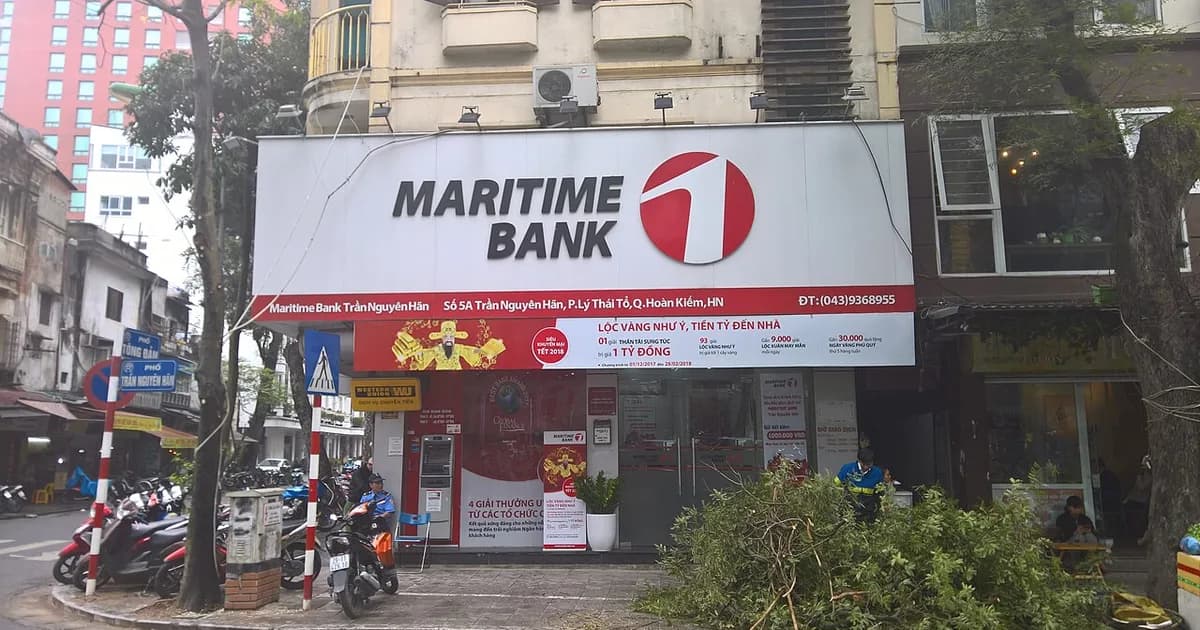
You're about to draw cash in Vietnam from a US bank account, and you've heard a rumour. A traveler on r/VietNam put it this way in October 2026: TPBank had "silently introduced fees" at its ATMs, so which bank now? The replies came in over four days. One person had just been charged 308,000 dong at TPBank. The poster said TPBank had worked fine for them the day before. A Shinhan machine didn't work for them at all, though it did prompt a 50,000 dong fee. Someone suggested VPBank. Someone else asked the poster to delete the post, "golden goose and all that", so VPBank wouldn't start charging too.
What each bank charges a card issued abroad
These are the fees each bank's own tariff sets for a Visa or Mastercard from a foreign bank, used at that bank's ATM. Your own bank can add a fee and its exchange rate on top (step 6).
| Bank | Fee on a foreign Visa or Mastercard | VAT | Tariff in force from | 3 million dong | 5 million dong |
|---|---|---|---|---|---|
| Shinhan | 50,000 dong per withdrawal, flat | included | 25 June 2026 | 50,000 | 50,000 |
| TPBank, Visa | 55,000 dong under 5 million; 3.08% from 5 million | included | 15 November 2025 | 55,000 | 154,000 |
| TPBank, Mastercard | 3.3%, minimum 77,000 dong | included | 15 November 2025 | 99,000 | 165,000 |
| BIDV | 4.5% to 5% by region, minimum 90,000 dong | not included | 6 January 2026 | 135,000 to 150,000 | 225,000 to 250,000 |
| Agribank | 4%, minimum 70,000 dong | not included | undated sheet | 120,000 | 200,000 |
| ACB | 4.4%, minimum 100,000 dong; free for Visa cards issued in Europe | included | 30 August 2025 | 132,000 | 220,000 |
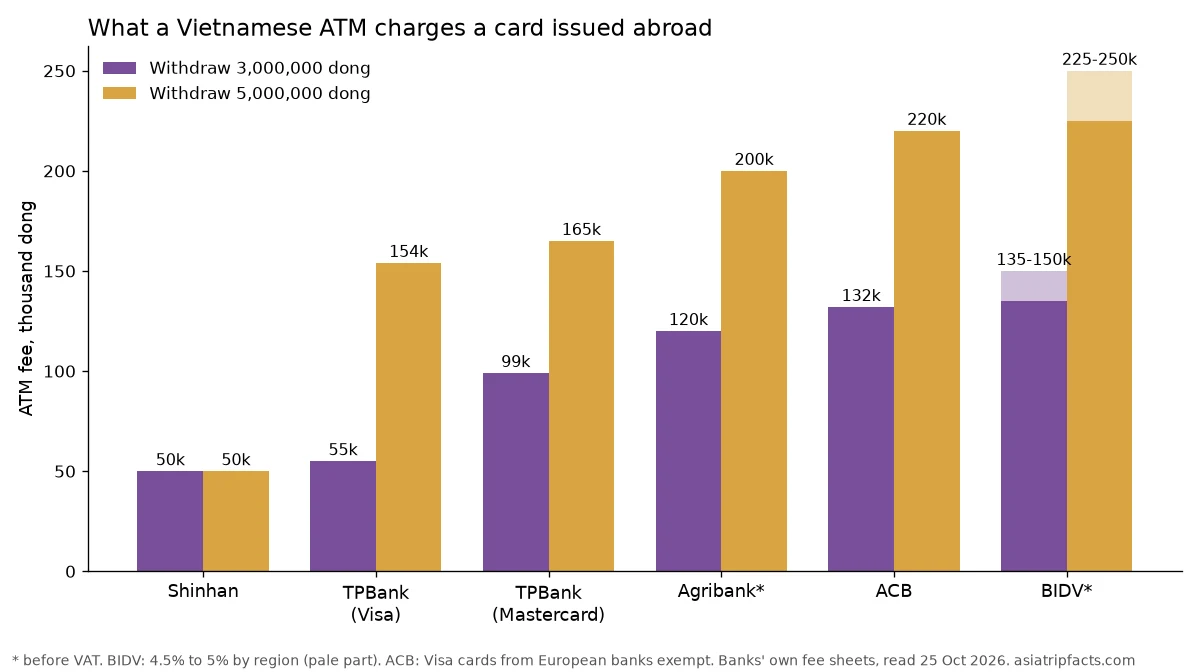
Desk note: that 308,000 dong charge on Reddit matches 3.08% of a 10 million dong withdrawal, TPBank's Visa rate from 5 million up; the commenter didn't give the amount or the card. On a Visa, 4.9 million costs the flat 55,000 and 5 million costs 154,000. Withdrawing 100,000 dong less saves about 100,000 dong in fees, the rare ATM deal that pays for itself.
For one bank's dong exchange rates, see our Vietnam money and eSIM page; our Vietnam costs page lists the entry fees that cash will go on.
Steps
1. Pick the bank before you need cash. Shinhan's flat fee is the lowest on the sheets we read, and it gets better the more you take out. One commenter on the October thread called Shinhan machines rare, so note one near your hotel rather than hunting for it with an empty wallet. If you're still choosing where to fly in, our Vietnam airports by destination guide matches airports to places; the Viettel eSIM guide covers the other counter you'll queue at on arrival.
2. At TPBank, stop just under the 5 million line with a Visa. Below it the fee is fixed; from it, the percentage starts. Mastercard holders don't get the flat band at all: the 3.3% applies from the first dong, with a minimum.
3. Skip BIDV with a foreign card. Its current tariff charges the highest percentage we found, before VAT. An older, undated BIDV sheet also caps each Visa, Mastercard or JCB withdrawal at 5 million dong, so a larger sum would mean paying that fee twice.
4. Read the fee prompt, then decide. The Reddit poster's Shinhan machine put its fee on screen as a prompt. If a machine asks for a charge you didn't plan for, cancel and walk on.
5. Decline the conversion offer. Some ATMs offer to bill you in your home currency instead of dong. Visa's own advice is to decline it, and it says ATMs should give you the choice and must not make it for you.
6. Ask your own bank what it adds. BIDV's tariff states that its fee does not include what your card's bank charges. That second fee, and your bank's exchange rate, is a question for your bank before you fly, not for the ATM.
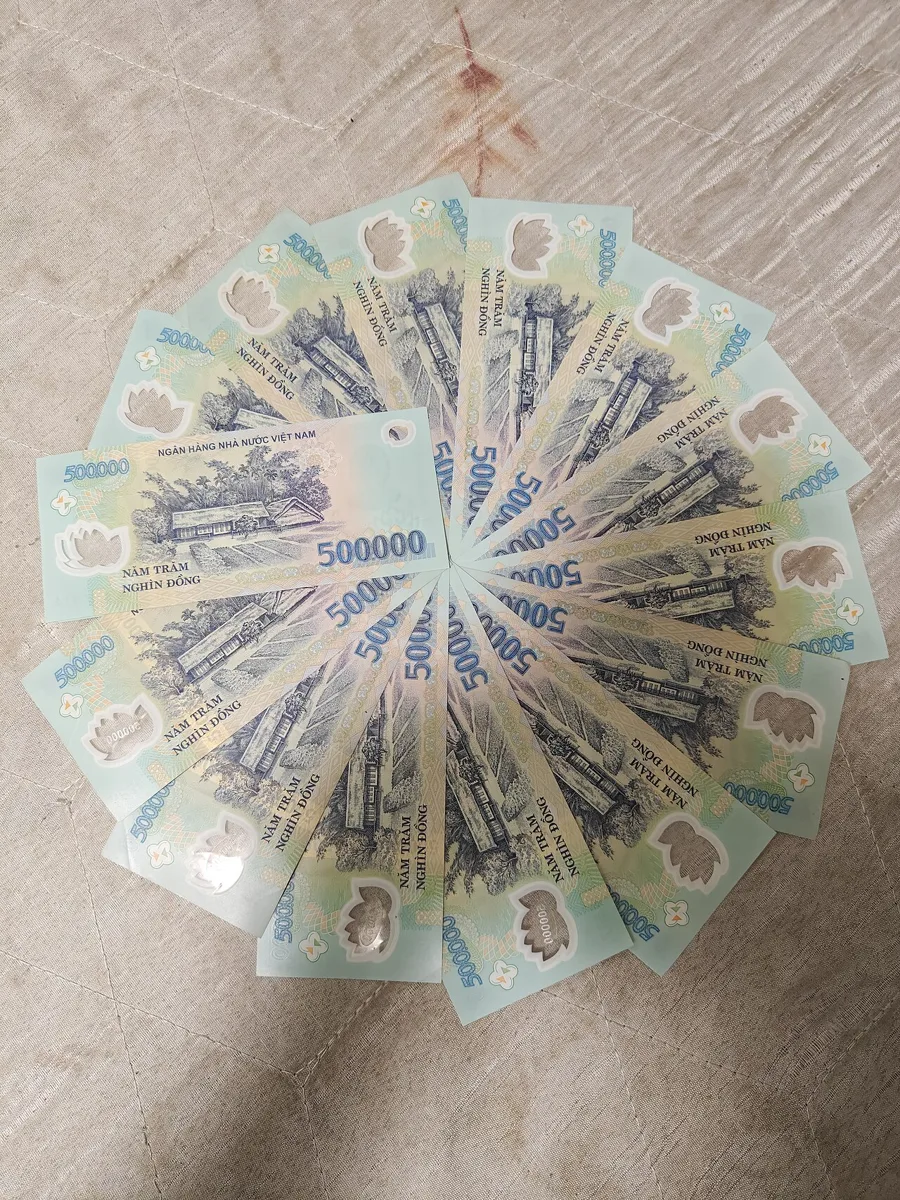
7. Keep cash under the customs threshold, or declare it. You must declare more than 15 million dong, or more than 5,000 US dollars in foreign cash, on entry or exit, under the State Bank of Vietnam's Circular 15; the UK government's travel advice gives the same figures. Bank cards don't count toward that total. The rest of the entry paperwork is in our Vietnam entry checklist.
What trips people up
The European exemption at ACB. ACB's notice charges foreign cards its 4.4% but exempts Visa cards issued by banks in Europe, Mastercard issued in Vietnam and JCB. So a Visa card from a European bank pays no ACB surcharge, while one from an American bank pays the full 4.4%.
Fees change. TPBank's current sheet has applied since November 2025, and ACB's surcharge since the end of August 2025. Reddit advice from a year ago may describe a different fee, so check the sheet's date before you trust a tip.
Big amounts mean big cash. The customs thresholds aren't limits on what you may carry, as a Tuoi Tre News report of September 2026 explains, but failing to declare can bring a fine under a decree in force since July 2026: 1 to 2 million dong when the undeclared amount is from 5 million to under 50 million. Theft and scam advice is in our health and safety page and our Vietnam safety guide for Americans.
Entry fees are priced in dong. Our ticket guides for the My Son sanctuary and Hue's Imperial City give their prices in dong, so keep some dong on you from the first day.
Our take
Find a Shinhan ATM and take out larger amounts there. Its flat fee works out to about one percent on 5 million dong, a third of TPBank's Visa rate at that amount. No Shinhan nearby? Use TPBank with a Visa and stay under 5 million, or ACB if your Visa card was issued in Europe. Skip BIDV and Agribank, and ACB with an American card, unless nothing else is open. Always say no to being billed in dollars.
How we checked this
Each fee comes from the bank's own published sheet, read on 25 October 2026: TPBank's international debit card tariff (item 18), Agribank's card fee sheet, BIDV's card tariff of August 2026 (section 7), ACB's surcharge notice and Shinhan's personal banking tariff (section 12). We computed the 3 and 5 million dong columns from those rates. The customs rule is from Circular 15/2011/TT-NHNN and the UK government's Vietnam travel advice, updated September 2026. The traveler reports are from one r/VietNam thread of 16 to 20 October 2026.
What we could not confirm
- Vietcombank's and VPBank's fee for a card issued abroad: we found only what they charge their own cardholders. Reddit commenters in October 2026 named VPBank as free; we couldn't check that against a tariff.
- Which cards pay 4.5% and which pay 5% at BIDV: the tariff says only "by region". Agribank's sheet carries no date.
- Whether BIDV still caps foreign-card withdrawals at 5 million dong: that limit is on an undated ATM sheet whose fee BIDV has since replaced.
- Whether ACB counts UK-issued Visa cards as European: the notice says only "khu vực Châu Âu", the Europe region.
- Daily limits: BIDV leaves them to the card's own bank, and we found none for foreign cards on the other sheets, so ask your bank before you travel.
Photo (cover): Donald Trung / Wikimedia Commons, CC BY-SA 4.0
About the author

Pen name for the getting-around beat: trains, flights, airports, visas and entry rules, health and safety. Journeys are computed from the operator's own timetable.
Keep reading

Hoi An lantern festival dates: every full moon to 2027
Guides · 5 min
Hoi An ancient town ticket: 2026 fee, old tiers and validity
Guides · 5 min
North vs south Vietnam weather: Hanoi and the Mekong Delta
Guides · 5 min
My Son Sanctuary ticket price in 2026 and the planned rise
Guides · 5 min
Is there an airport in Hue? Phu Bai, and when Da Nang wins
Guides · 5 min

The coldest places in Vietnam, and when nights turn cold
Guides · 5 min

Vietnam rainy season: the wettest month in each place
Guides · 5 min

Trang An boat tour price, plus Tam Coc and Ninh Binh tickets
Guides · 5 min
Disclaimer
This article is general information, not legal, immigration, medical or financial advice. Prices, visa rules and transport schedules change, and each figure shows the month we last verified it. Confirm anything that affects your trip (entry requirements, fees, health rules) with the official government or provider source before you book or travel. The site has no affiliate links today; our affiliate disclosure explains what we will do if that changes.