The coldest places in Vietnam, and when nights turn cold
Sa Pa isn't just the coldest place in Vietnam, it's in a class of its own: the only January mean under 10°C.
VerdictWant real cold? Sa Pa. Just want out of the heat? Da Lat, which is cool and far drier in January.
The coldest places in Vietnam by station temperature start with Sa Pa, followed by Ha Giang and Da Lat. All fifteen place records reach their lowest monthly mean in January, and these station averages describe a typical month, not a forecast.

January ranking by mean temperature
This ranking uses the lowest monthly mean temperature in each place's table. The last column shows station altitude. Altitude is not the whole story: Da Lat's station sits at 1,513 m and is still no colder than Ha Giang's at 118 m.
| Rank | Place | January mean C | Station altitude m |
|---|---|---|---|
| 1 | Sa Pa | 8.6 | 1570 |
| 2 | Ha Giang | 15.6 | 118 |
| 3 | Da Lat | 15.9 | 1513 |
| 4 | Ha Long Bay | 16.2 | 87 |
| 5 | Hanoi | 16.6 | 5 |
| 5 | Ninh Binh | 16.6 | 2 |
| 7 | Phong Nha | 18.8 | 7 |
| 8 | Hue | 19.9 | 17 |
| 9 | Hoi An and Da Nang | 21.5 | 6 |
| 10 | Quy Nhon | 23.3 | 5 |
| 11 | Nha Trang | 24 | 5 |
| 12 | Con Dao | 25.3 | 7 |
| 13 | Mekong Delta | 25.4 | 3 |
| 14 | Phu Quoc | 25.9 | 2 |
| 15 | Ho Chi Minh City | 26.8 | 5 |
Hanoi and Ninh Binh share the same January mean, so they share rank 5. Sa Pa is the clear outlier at 8.6°C. Ha Giang and Da Lat are close to each other in mean temperature, but their stations sit at very different altitudes. For where to go in that month, see Vietnam weather in January.
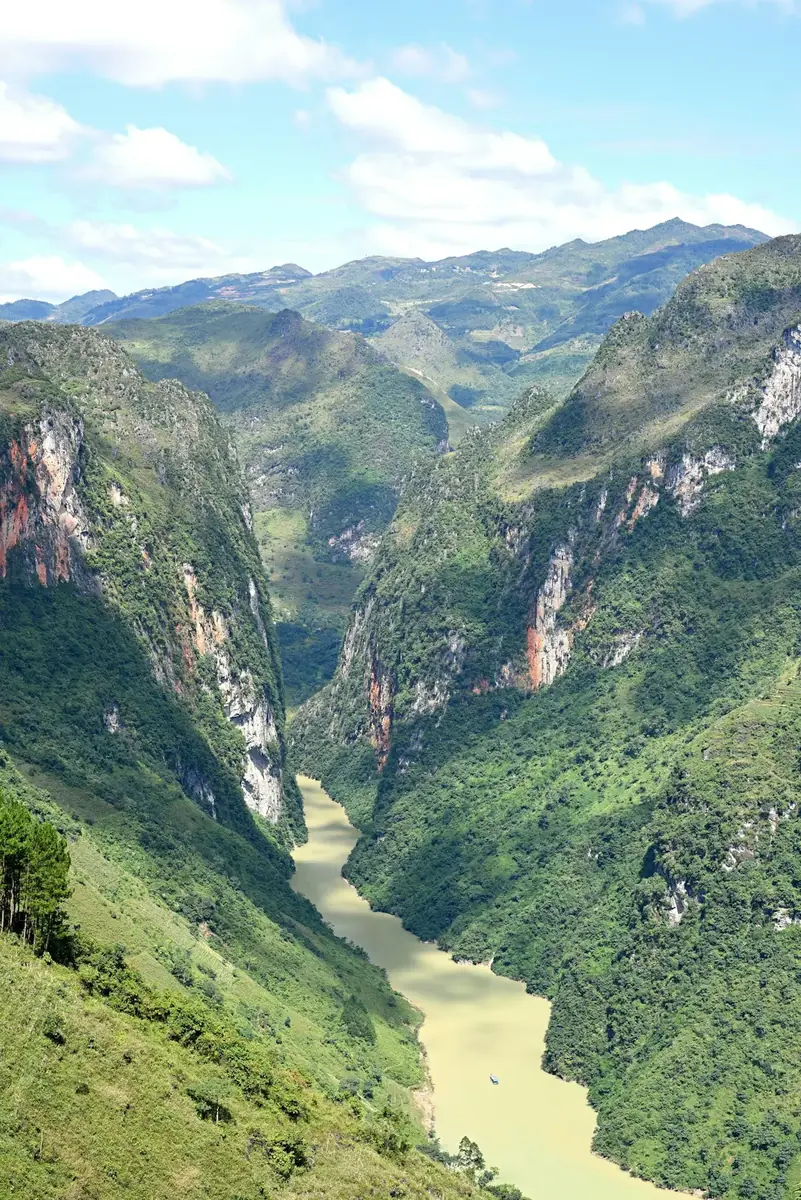
Coldest places in Vietnam by record low
The record low for each station gives a different order. This table ranks the 14 places with a QCVN station by the lowest temperature in the record. Ho Chi Minh City is left out because its JMA table has no extremes.
| Rank | Place | Record low °C | Month of the record |
|---|---|---|---|
| 1 | Sa Pa | -4.2 | Jan |
| 2 | Ha Giang | 1.5 | Jan |
| 3 | Ha Long Bay | 1.7 | Dec |
| 4 | Da Lat | 4.5 | Jan |
| 5 | Hanoi | 5 | Feb |
| 6 | Ninh Binh | 5.4 | Jan |
| 7 | Phong Nha | 6.7 | Jan |
| 8 | Hoi An and Da Nang | 9.2 | Dec |
| 9 | Hue | 9.5 | Feb |
| 10 | Mekong Delta | 14.8 | Jan |
| 11 | Nha Trang | 15.4 | Jan |
| 12 | Quy Nhon | 15.5 | Dec |
| 13 | Phu Quoc | 16 | Jan |
| 14 | Con Dao | 17.7 | Feb |
Sa Pa is the only station with a record below freezing. Ha Long Bay moves up to third: its station sits at 87 m on the coast, yet its record low is colder than Da Lat's at 1,513 m. Da Lat's record low is 4.5°C, and its January average low is 11.7°C, so its cold is steadier and less extreme.
VTV's weather channel (in Vietnamese) forecast one such spell, with severe cold across the north for several days.

How long the cold lasts
This table adds December and February for the five lowest ranks, which is six places because Hanoi and Ninh Binh tie.
| Place | January mean C | December mean C | February mean C |
|---|---|---|---|
| Sa Pa | 8.6 | 9.4 | 10.4 |
| Ha Giang | 15.6 | 16.9 | 17.2 |
| Da Lat | 15.9 | 16.4 | 16.9 |
| Ha Long Bay | 16.2 | 17.9 | 17 |
| Hanoi | 16.6 | 18.3 | 17.7 |
| Ninh Binh | 16.6 | 18.3 | 17.5 |
Sa Pa stays below 11°C mean across these three months. Ha Giang, Da Lat, and Ha Long Bay stay below 18°C in the same comparison. Hanoi and Ninh Binh are at 18.3°C in December, fall to 16.6°C in January and recover to 17.7°C and 17.5°C in February.
What the numbers mean for packing
Sa Pa's January mean is 8.6°C, with a minimum of 6.2°C. The station also records 70.2 mm of rain, 16.3 rain days, and 17.4 fog days in January. A warm layer and a rain-ready outer layer make sense for those conditions.

Da Lat's January mean is 15.9°C, with a minimum of 11.7°C, 9.1 mm of rain, and 2.2 rain days. That points to lighter layers than Sa Pa, while evenings can still feel cool. The Da Lat dry-season article gives the full month-by-month context.

Hanoi's average January low is 14.5°C and Ha Giang's 13.3°C. For a city trip in the north, that is jacket weather at night rather than winter-coat weather, but the record lows of 5°C and 1.5°C show that cold spells do reach both.
The Sa Pa winter article explains why the lowest rainfall total does not remove fog or drizzle. The Vietnam travel hub links the destination pages for the warmer coastal and southern records.
Asked whether December is a good month to travel in Vietnam, one r/VietNam user replied:
"Sapa will be cool/cold, and Hanoi might be cool as well, everywhere else the weather will be nice."
u/The_Cruncher88 on r/VietNam
Our take
Sa Pa is in a different class from the rest of Vietnam in winter. It is the only place with a January mean under 10°C and the only record below freezing. Ha Giang, Da Lat, Ha Long Bay, Hanoi and Ninh Binh form a second group with January means of 15.6°C to 16.6°C. Everything from Hoi An south stays mild. If you want cold-weather scenery, plan for Sa Pa. If you only want to avoid the heat, Da Lat gives cool weather with far less rain in January.
How we checked this
The means, lows and record lows come from tables A.1, A.2, A.4, A.6, A.25, A.28 and A.32 of QCVN 02:2022/BXD, one station per place, and the Ho Chi Minh City mean from JMA ClimatView. We recomputed both rankings and matched each value against the sources on 8 October 2026. We removed the straight-line distances we had computed ourselves. On 23 October we read the station rows in the regulation and the JMA normals again; none had changed. Last reviewed: 23 October 2026.
What this does not tell you
The ranking compares station means, not every elevation in a destination. Sa Pa's station is listed at 1,570 m and Da Lat's at 1,513 m. The table does not measure wind chill, room temperature, or weather on a chosen day. The regulation does not state the observation period of its tables.
References
- QCVN 02:2022/BXD, National technical regulation on natural physical and climatic data for construction: https://datafiles.chinhphu.vn/cpp/files/vbpq/2022/10/02-bxd.pdf. Checked 2026-10-08.
- JMA ClimatView monthly normals, station 48900 Tan Son Hoa: https://ds.data.jma.go.jp/tcc/tcc/products/climate/climatview/graph_mkhtml_nrm.php?n=48900&y=2026&m=8&e=7&r=1&s=1&k=0. Checked 2026-10-08.
Photo (cover): Vivu Vietnam / Unsplash
Data checked: October 2026.
About the author

Pen name for the weather and climate beat: rain, temperature, typhoons and when to go. Every comparison is built from official station records.
Keep reading

Tet 2027 in Vietnam: dates, closures and when to book
Guides · 5 min
Vietnam travel requirements for US, UK and EU passports
Guides · 5 min

Vietnam weather in November: dry places and wet places
Guides · 5 min

Is Vietnam safe for Americans? Drugs, storms, scams, roads
Guides · 5 min

Vietnam typhoon season 2026: which months hit which coast
Guides · 5 min

International driving permit in Vietnam: who is covered
Guides · 5 min

Vietnam airports by destination: the closest airport to each
Guides · 5 min

Where fog days matter in Vietnam: Sa Pa, Ha Giang, Ha Long
Guides · 5 min
Disclaimer
This article is general information, not legal, immigration, medical or financial advice. Prices, visa rules and transport schedules change, and each figure shows the month we last verified it. Confirm anything that affects your trip (entry requirements, fees, health rules) with the official government or provider source before you book or travel. The site has no affiliate links today; our affiliate disclosure explains what we will do if that changes.