Vietnam e-visa for US citizens: the fee and the limits
For most US visitors the only real choice is single or multiple entry.
VerdictGet the USD 25 single-entry e-visa unless you'll leave and re-enter; then the USD 50 multiple-entry pays off.
A Vietnam e-visa for US citizens is the way in, because the United States is on neither of Vietnam's 45-day exemption lists. Apply on the official portal only, take the single-entry visa unless you'll leave and come back, and check your passport before you start. In Vietnamese the e-visa is thị thực điện tử, which is why the portal's second address is thithucdientu.gov.vn.
Part 4 of 6The story so far: Vietnam's pre-arrival declaration (PAI) ↓
Part 1 of 3The story so far: Vietnam's visa rules since 2023 ↓
The form is the easy part; the payment screen is where people get rattled. In April 2026 a Redditor who banks with Charles Schwab and had used the official e-visa site many times before filled it in as usual and entered a Visa debit card. The payment was rejected and a screen told them to call a number for verification. The person who answered said they were from Visa on behalf of Schwab, and asked for a full name and all 16 digits of the card. The Redditor said no and called Schwab directly, which said no legitimate caller would ask for the full number. In the end a friend paid through her VNPay account and it went straight through. In the thread, one reply pointed to evisa.gov.vn as the official site, and another read the screen as the bank's own 3-D Secure check blocking the charge. Either way, nobody needs your full card number by phone.
Who can apply and for how long
The portal's FAQ sets the conditions in the words of Vietnam's immigration law: an e-visa goes to foreigners who hold a passport, are not in the diplomatic and official-guest groups of Article 8(1) to (4), and are not barred from entry under Article 21. The visa runs for at most 90 days. The visa-free exemptions work differently. They name specific countries and give 45 days, and the United States is not among them. Our list of the exempt passports shows who is. A visa issued at the border exists only for the cases in Article 18 of the same law, and a sponsor in Vietnam has to file for it first, so there is no walk-up visa on arrival.
VTV4 covered the new visa policy in this Vietnamese-language report.

The two fees
There are two fees:
- Single entry: USD 25.
- Multiple entry, up to 90 days: USD 50.
Both amounts are on the official portal, and the Ministry of Finance sets both in Circular 28/2026/TT-BTC, in force since 1 April 2026.
You pay through the portal's own payment gateway. The fee is not refunded if the visa is refused, so check your details before you submit. The law gives the Immigration Department 3 working days to answer, counted from the day it has your complete application and the fee (Law 51/2019, Article 16a, and the Ministry of Public Security's procedure page for the e-visa).
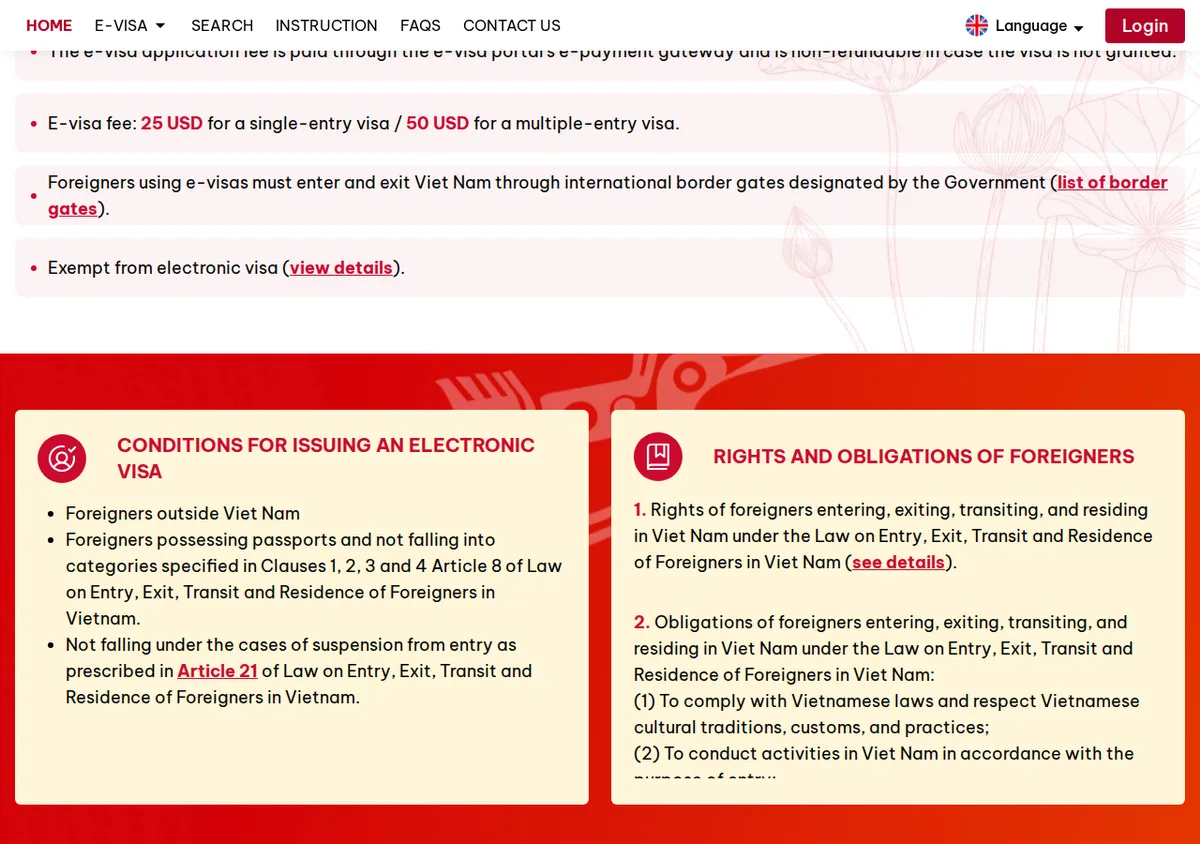 Screenshot: evisa.gov.vn, the official e-visa portal of the Immigration Department, captured 8 October 2026
Pay on the official e-visa portal only. Its FAQ names two official addresses, evisa.gov.vn and thithucdientu.gov.vn, and warns that "unofficial electronic information pages" may charge fees that Vietnam's rules do not allow.
Limits after the visa is issued
The two official sources word the border rule differently. The UK government says "E-visas restrict you to the entry and exit points you select when you apply." The Vietnamese portal's FAQ says you do not have to leave through the same gate you came in by, but you must enter and leave through the international border gates the government has designated.
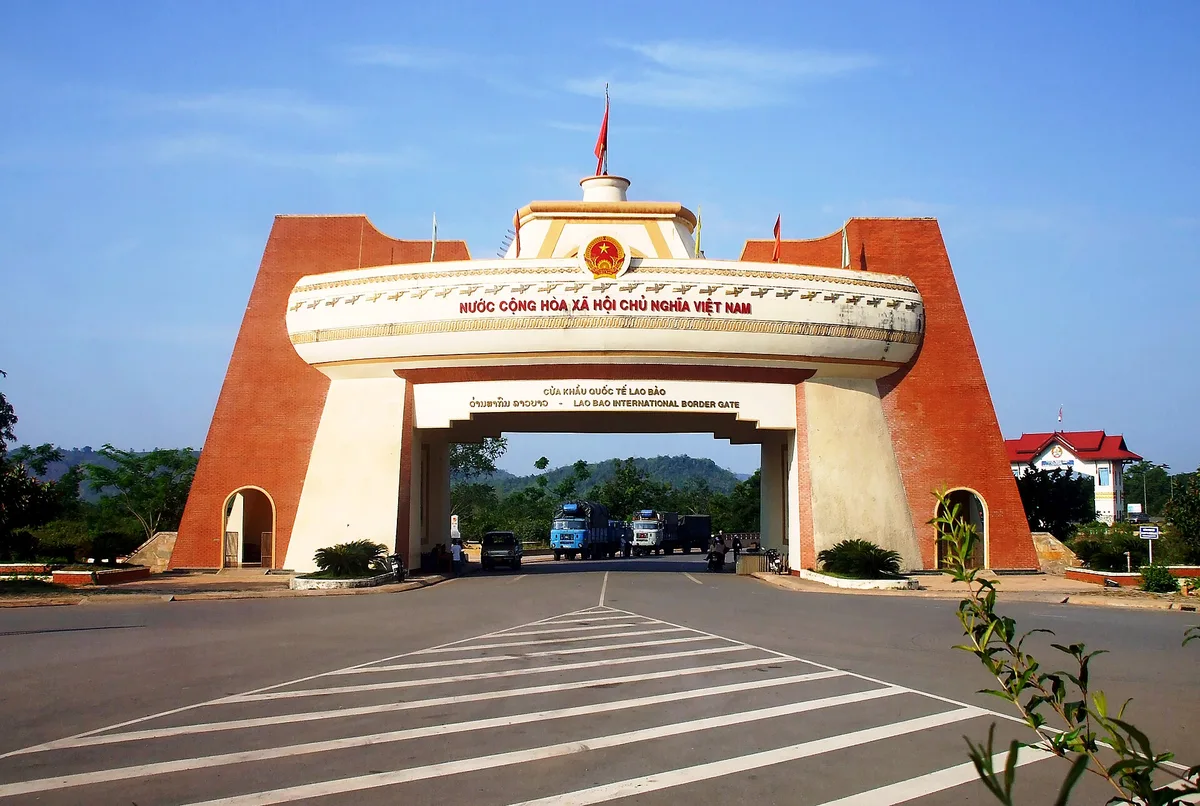
The designated list covers more than airports. Resolution 389/NQ-CP of 2 December 2025 added 41 gates to the 2023 list: 4 airports, 11 land border gates and 26 seaports. That makes 83, by the count of Vietnam's embassy in Washington: 17 airports, 27 land border gates and 39 seaports. Two of the four new airports, Long Thanh and Gia Binh, only count once they are in service, the resolution says. On 30 October 2026 the portal's own list had 15 airports, without those two, plus the same 27 land gates and 39 seaports. Moc Bai in Tay Ninh province, Lao Bao in Quang Tri province and Thanh Thuy, the crossing from Wenshan, Ha Giang's closest airport, are on it.
For an e-visa issued while you are already in Vietnam, the UK government says you must leave and re-enter for it to start. The portal's FAQ says e-visas are not for foreigners currently living in Vietnam, and that you may request one after you have left the country.
What the official portal adds
The portal's FAQ answers several questions that trip people up:
- The e-visa's validity must end at least 30 days before your passport expires.
- Type your full name in capitals, middle name included, letter for letter as the machine-readable (ICAO) line of your passport shows it.
- You can apply up to 1 year before you plan to arrive.
- If you will stay in several places, give the first address on the form. After you arrive, the FAQ says you declare your temporary residence through the manager or operator of each place you stay, every time you move.
- An e-visa is not a work permit. Working in Vietnam needs a work permit, or written confirmation that you are exempt from one.
The FAQ also warns that leaving out past violations from earlier visits can get the application refused.
Passport checks
The UK government's entry page sets these passport rules for entering Vietnam:
- The expiry date must fall 6 months or more after your arrival date.
- It needs at least 2 blank pages.
- It must not be damaged. The UK government notes that British travellers have been refused entry and exit over a damaged passport.
- You must enter and leave Vietnam on the same passport.
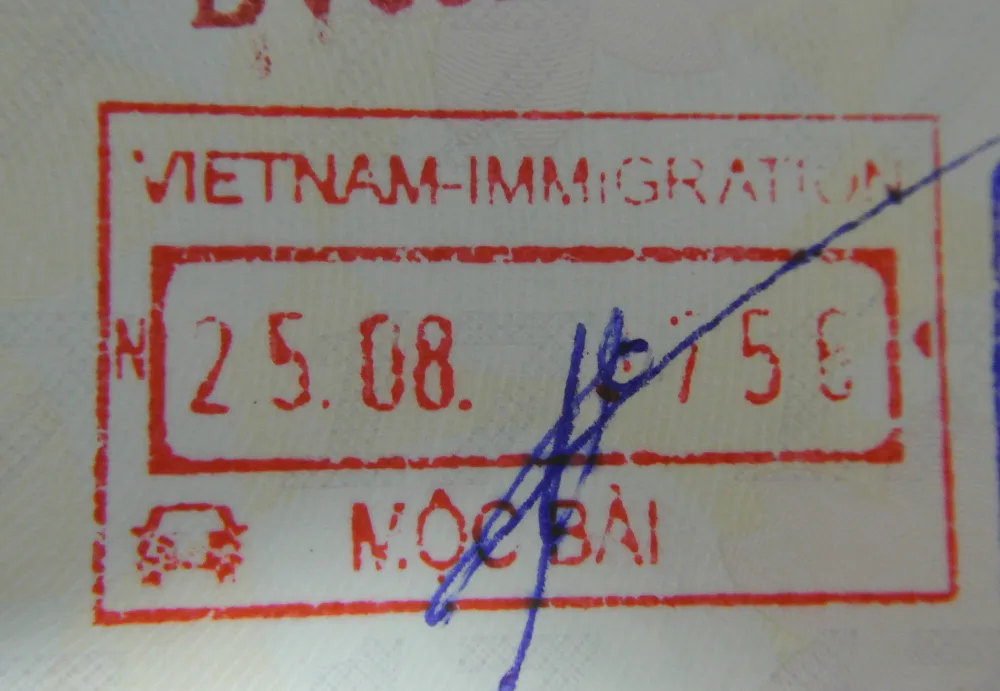
Check the expiry date, the blank pages and the condition of the passport before you copy its details into the application. When you arrive, the FAQ asks you to show the e-visa to the immigration officer, check the temporary residence stamp in your passport and tell immigration control at the border at once if anything on it is wrong.
For where to go once you are in, the Vietnam travel hub has the destination pages, and the Vietnam visa page has a tool that checks entry rules by passport country.
Arrival card and health declaration
Fill in the online pre-arrival declaration (PAI) before you fly, whichever airport you land at. Vietnam's own notices still call it a pilot: the Ministry of Public Security says it started at Tan Son Nhat Airport (SGN) on 15 April 2026, voluntary at first, and Da Nang police said Da Nang joined on 15 June as the fourth airport, after Tan Son Nhat, Phu Quoc and Noi Bai. On 21 October 2026 the form's list of arrival airports also had Cam Ranh, the airport for Nha Trang. A US Embassy notice of 17 June goes further: it calls the declaration mandatory and being extended to all airports, for every passenger without a Vietnamese passport.
You can complete it at prearrival.immigration.gov.vn up to three days before you arrive, or at the airport by QR code or on a paper form, then show its QR code to immigration. The Ministry of Public Security says PAI only collects information before the trip and does not take or decide visa applications. The UK page, last updated on 21 September 2026, still calls it encouraged rather than mandatory at Tan Son Nhat. Until Vietnam publishes a nationwide rule, we'd follow the US notice, the strictest of the three.
The same UK page says that from 1 July travellers "may be required to complete a health declaration, which may include providing proof of vaccinations" (our vaccination guide). Vietnam's Ministry of Health said on 30 June 2026 that the declaration in Decree 165/2026/ND-CP is not required of every traveller: the health minister orders it disease by disease.
Connecting flights and overstaying
The UK government says that a passenger who lands on an international flight and switches to a domestic one in Hanoi or Ho Chi Minh City has to clear immigration and enter Vietnam, even when the final stop is in another country. Ask your airline before you book.
The same page says a valid visa is needed to leave Vietnam at all. Overstay, and the authorities can hold you in the country until the fine is paid; you can also be deported and refused entry later. Vietnamese authorities can also put an exit ban on people tied to an investigation, a civil one such as a business dispute or a road accident included, and in that case, the UK page says, "your passport will be seized until the case is fully investigated."
In a thread from a visitor whose e-visa ran out during a hospital stay, one user replied:
"If its a couple days, you can pay an exit fine at the airport. If its more, you can also go to the immigration office with your medical paperwork, and try for a waiver."
u/jblackwb on r/VietNam
What we have not verified
No official page says how long applications take in practice, so 3 working days is the legal limit, not a measured time. On 30 October 2026 the arrival form's airport list, readable on 21 October, returned an "unauthorised" error, so we could not recheck it.
Our take
Take the single-entry visa. It covers a trip in and out, and paying double for multiple entry only makes sense if you'll leave and come back inside the same visa, say a side trip to a neighbouring country over one of the land gates. Apply on evisa.gov.vn and nowhere else, and if a payment goes wrong, don't read your full card number to anyone on the phone; call your bank on its own number, as the Redditor did. Then hold your passport to the stricter rule: for a short trip, the UK page's 6-month expiry bites before the FAQ's 30-day rule does. If you plan to ride a motorbike, check which international driving permits Vietnam's rules cover before you go, and see what US sources say about safety in Vietnam.
How we checked this
We first checked every fee, date and rule on 8 October 2026 against the portal's home page and FAQ, the UK entry page, the US Embassy's two pre-arrival notices and VnEconomy's e-visa report, and captured the portal screenshot that day. We added the Ministry of Public Security and Da Nang police notices on 14 October, read the signed Circular 28/2026/TT-BTC on 19 October and re-opened every source on 20 October.
On 30 October 2026 we read the signed Resolution 389/NQ-CP (a scanned PDF, page by page), re-read the portal, its FAQ and gate list, the UK page (still last updated 21 September 2026) and the embassy notice, and added Law 51/2019, Law 47/2014 and the ministry's e-visa procedure page. Photo credits come from each photo's Commons or Unsplash page; the payment story and overstay reply from the r/VietNam threads linked above; the VTV4 report from the broadcaster's own channel.
Correction
14 October 2026: the arrival section called the pre-arrival declaration mandatory at all airports, the US Embassy's wording; Vietnam's notices describe a pilot, so both are now given.
19 October 2026: the fees now cite Circular 28/2026/TT-BTC, which replaced Circular 62/2023/TT-BTC on 1 April 2026 with the same amounts.
19 and 30 October 2026: the border section first gave the February 2025 list (16 land gates, 13 airports, 13 seaports), then the embassy's 83 without saying that Long Thanh and Gia Binh count only once in service. The "who can apply" paragraph said any valid passport holder can apply; it now gives the FAQ's conditions. An unsourced "fees can change" line is gone.
References
- Ministry of Public Security, PAI launch (11 May 2026, Vietnamese)
- Da Nang City Police, PAI at Da Nang airport (17 June 2026, Vietnamese)
- US Embassy, pre-arrival declaration notice (17 June 2026)
- US Embassy, Tan Son Nhat notice
- UK FCDO, Vietnam entry requirements
- VnEconomy, Vietnam's e-visa
- Circular 28/2026/TT-BTC (Vietnamese)
- Embassy of Vietnam in the US, 41 gates added (14 May 2026, Vietnamese)
- E-visa portal and FAQ
- Resolution 389/NQ-CP (2 December 2025, Vietnamese)
- Law 47/2014/QH13 (Vietnamese)
- Law 51/2019/QH14 (Vietnamese)
- Ministry of Public Security, e-visa procedure 1.002757 (Vietnamese)
Photo (cover): Kent Lâm / Unsplash
Data checked: October 2026.
The story so far · Part 4 of 6
Vietnam's pre-arrival declaration (PAI)
PAI pilot starts at Tan Son Nhat airport, voluntary in its first weeks
then
US Embassy says every foreign passport holder landing at Tan Son Nhat must file it
then
Da Nang joins as the fourth pilot airport, after Tan Son Nhat, Phu Quoc and Noi Bai
then
You are here
US Embassy calls the declaration mandatory and says it is spreading to all airports
then
then
The form's own list of arrival airports shows a fifth: Cam Ranh, for Nha Trang
The story so far · Part 1 of 3
Vietnam's visa rules since 2023
You are here
Law 23/2023 takes effect: e-visas up to 90 days, visa-free stays up to 45 days
then
then
then
Next
Last day of the Resolution 44 exemption, which the government says it will consider extending
then
Next
Last day of the Resolution 229 exemption
About the author

Pen name for the getting-around beat: trains, flights, airports, visas and entry rules, health and safety. Journeys are computed from the operator's own timetable.
Keep reading
The driest month in Vietnam, from Sa Pa down to Phu Quoc
Guides · 5 min

Where fog days matter in Vietnam: Sa Pa, Ha Giang, Ha Long
Guides · 5 min
Vietnam airports by destination: the closest airport to each
Guides · 5 min

Which passports enter Vietnam visa-free for 45 days
Guides · 5 min
International driving permit in Vietnam: who is covered
Guides · 5 min
Vietnam typhoon season 2026: which months hit which coast
Guides · 5 min

Is Vietnam safe for Americans? Drugs, storms, scams, roads
Guides · 5 min
Vietnam weather in November: dry places and wet places
Guides · 5 min
Disclaimer
This article is general information, not legal, immigration, medical or financial advice. Prices, visa rules and transport schedules change, and each figure shows the month we last verified it. Confirm anything that affects your trip (entry requirements, fees, health rules) with the official government or provider source before you book or travel. The site has no affiliate links today; our affiliate disclosure explains what we will do if that changes.