Best time to visit Hue: dry spring, hot summer, wet autumn
Hue's dry months and its flood months sit back to back. The station draws a hard line between them in September.
VerdictGo February to April, when the station averages about 50 to 65 mm of rain a month; skip October and November unless your dates can move.
The best time to visit Hue, if you can pick, is February to April. Those are the driest months at the city's weather station, with about 9 to 12 rain days a month, and the daytime highs climb from the mid-20s to about 31°C, good weather for the Imperial City and the royal tombs. From September the rain switches on, and October and November together bring nearly half of Hue's year of rain. May to August is the other choice: still fairly dry, much brighter, and hot enough that the national building code calls out the dry west wind on this stretch of coast.

We would send a first visit to February to April, someone who copes well with heat to May or June with early starts, and nobody with fixed dates to October or November.
This is late October 2025, pieced together from people who were there. You reach Hue on 26 October, as Noa, a Frenchman on a north-to-south trip with friends, did that week. The rain is already heavy, and your guide moves the Imperial City visit forward in case the site shuts. "We started our trip with light flooding, but no one expected the situation to escalate so quickly," Noa told VnExpress International. An hour after you leave the citadel, the water is above your knees and the walk back to the hotel is hard going. On r/VietNam the next day, a traveller sitting at Hue's airport asks whether to head for Da Nang or try their luck in Hue. A reply from someone staying just outside the city, heading for the airport the next day, is blunt.
"I would not advise coming to Hue. The flooding is horrendous."
u/X_Ray_Vision_ on r/VietNam, 27 October 2025 (user opinion)
Hue's climate month by month, dry half against wet half
These are the averages for the Huế station, listed at 17 m in Vietnam's building climate code, QCVN 02:2022/BXD. They describe Hue's climate over many years, not a forecast for your week.
| Month | High °C | Low °C | Rain mm | Rain days | Sun hours | Humidity % |
|---|---|---|---|---|---|---|
| Jan | 23.5 | 17.5 | 129.3 | 15.5 | 104 | 89.6 |
| Feb | 24.5 | 18.2 | 63.3 | 11.6 | 110.3 | 89.9 |
| Mar | 27.5 | 20.2 | 51.3 | 10.2 | 140.8 | 87.8 |
| Apr | 31.1 | 22.7 | 58.9 | 9.2 | 175.9 | 84.1 |
| May | 33.5 | 24.5 | 111.3 | 11.7 | 230.9 | 79.1 |
| Jun | 34.7 | 25.3 | 103.4 | 9.3 | 232.5 | 75.4 |
| Jul | 34.7 | 25.2 | 94.6 | 8.5 | 236.7 | 74.1 |
| Aug | 34.2 | 25.1 | 138.8 | 10.7 | 209.9 | 76.4 |
| Sep | 31.7 | 24.1 | 410.7 | 16.3 | 169.2 | 83.6 |
| Oct | 29.0 | 22.8 | 772.7 | 20.8 | 130.6 | 87.7 |
| Nov | 26.5 | 21.0 | 641.7 | 20.9 | 101.2 | 89.1 |
| Dec | 23.8 | 18.6 | 349.9 | 20.2 | 76 | 90.2 |
Read the rain column and the rain-day column together. January has more rain days than any month from February to August, which is why it feels wetter than its rain total suggests; our piece on rain days against millimetres explains why we track both. For sights and where to stay, see our Hue destination page.
Best time to visit Hue for sightseeing: February to April
February to April together get 173.5 mm of rain, under a quarter of what October gets alone. Rain days fall from about 12 in February to about 9 in April. Highs run from about 24.5°C (76°F) in February to 31.1°C (88°F) in April, and nights stay mild. The sun is out about 4 hours a day in February, 4.5 in March and almost 6 in April.
The station sheet adds two caveats. March is the foggiest month, with 4.6 fog days, and February and March each average about two drizzle days, so early mornings can be grey and soft before they clear. And March in a wet year is not March in a typical one. The code also prints the rain each month gets by probability: half of all Marches get less than 36.4 mm, but one March in ten gets more than 111.6 mm.
This is the window for the slow sights, the Imperial City and the tombs along the river. Our Imperial City ticket guide has the combo routes that cover the tombs. One date to plan around: Tet 2027 falls on 6 February, and the government holiday runs seven days from Thursday 4 February. Our Tet 2027 guide covers closures and when to book.
May to August: brighter, drier than autumn, and hot
The summer months are the sunniest in Hue: about 7.5 hours of sun a day or more from May to July. July has the fewest rain days of the year, 8.5, and the lowest humidity, 74.1%. Rain stays between about 95 and 140 mm a month, more than in spring but a fraction of autumn's.
What you pay for that sun is heat. Average highs reach 34.7°C (94°F) in June and July, and the station's record, 41.3°C, was set in May. The building code's climate notes say this region gets the hot, dry west wind known as gió Lào from April to September, when humidity can drop to 30% and the temperature reach 43°C. May also has the most thunderstorm days of the year, 11.6 on average.

On 25 May 2026, in a heatwave, VnExpress photographers found the Ngo Mon area at the Imperial City empty around 1 p.m.; the few foreign visitors bought tickets and hurried inside out of the sun, and residents had strung hammocks under Truong Tien Bridge for a midday nap (VnExpress International). If you go in summer, do the open courtyards early, spend midday indoors, and leave the river for the evening. If you are choosing between bases on the central coast, our Hue or Da Nang comparison sets the two station records side by side.
September to December: Hue's rainy season and its floods
September to December carry about three quarters of the year's rain, and October and November alone nearly half. October averages 772.7 mm on about 21 rain days. December's rain falls back, but it is the dullest month, with under 2.5 hours of sun a day and the highest humidity of the year.
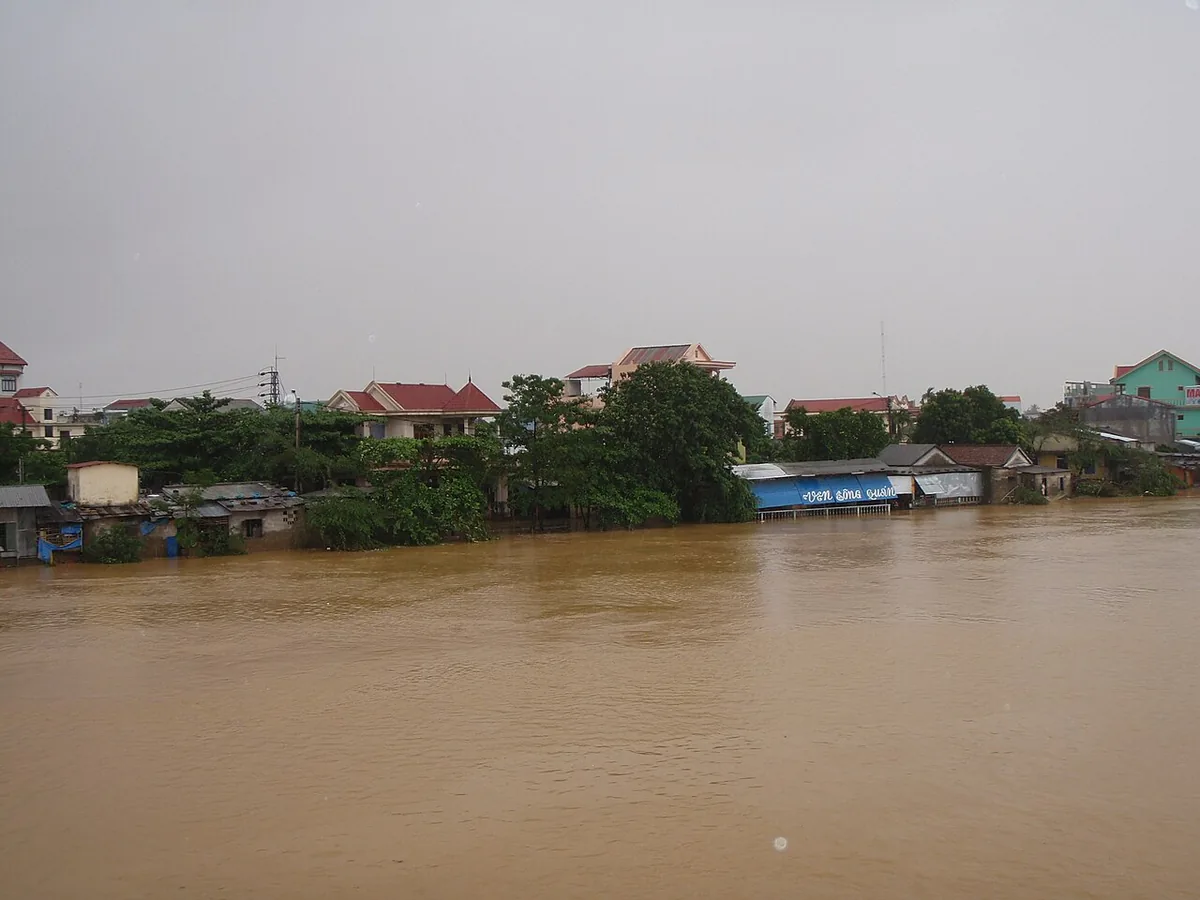
In autumn the year-to-year swing matters more than the average. By the code's probability table, nine Octobers in ten get more than 367 mm, and one in ten gets more than 1,368 mm. The station's wettest single day on record is 977.6 mm, in a November. The code's climate notes say that from October to December the northeast monsoon and disturbances out at sea bring heavy rain in repeated bursts.
October 2025 shows what a bad year looks like. The Perfume River at the Kim Long gauge peaked at 5.05 m at 8 p.m. on 27 October, 1.55 m above the top alarm level (VnExpress); the ASEAN disaster centre called it the highest since 2000, though still below 1999 (AHA Centre). That same day the Luong Dinh pavilion in front of the Imperial City stood in half a metre of water. Up on Bach Ma Peak, in the hills within the same city's boundary, a gauge logged 1,739.6 mm in 24 hours from 7 p.m. on 26 October, the most rain in one day ever recorded in Vietnam. That is a mountain gauge, not the city station, and the city area itself got 450 to 900 mm over the week. Days earlier, on 23 and 24 October, the heritage trains between Hue and Da Nang had already been suspended for the rain.
If your dates fall here, keep a spare day, check the official warning sources we list each morning, and know your way out: our page on Hue's airport covers Phu Bai and when Da Nang is the better door. October across the region is in our central Vietnam in October guide, and storms by month are in our typhoon season guide.
Is the best time to visit Hue different this winter?
Probably a little drier than usual, and still wet. The national forecasting centre's seasonal outlook of 15 October 2026 expects a very strong El Niño to last from November to January, at 96% probability (NCHMF outlook). For the Huế station it forecasts:
This winter's outlook for Huế:
- November 2026: 300 to 600 mm of rain, mean 24.5 to 25.5°C
- December 2026: 200 to 400 mm, mean 21.5 to 22.5°C
- January 2027: 80 to 170 mm, mean 21 to 22°C
All of November's forecast range sits below the station's average for the month. The centre's monthly bulletin of 1 November repeats a 20 to 40% shortfall for central Vietnam from Quảng Trị southwards, Hue included, while the north is forecast wetter and the south near normal, and it warns that moderate and heavy rain will still concentrate in central and southern Vietnam (NCHMF, November bulletin). It also expects fewer storms than usual and later cold spells. Even the dry end of that range is several hundred millimetres in a month, and on 30 October 2026 the centre was already warning of flash floods and landslides in Hue, Da Nang and Gia Lai. We still would not fix a November trip to Hue around outdoor days this year, though the odds look better than in a normal year.
Why weather sites give different rain figures for Hue
Three datasets put Hue's October between 769 and 843 mm, and they disagree more in some other months. Here they are side by side.
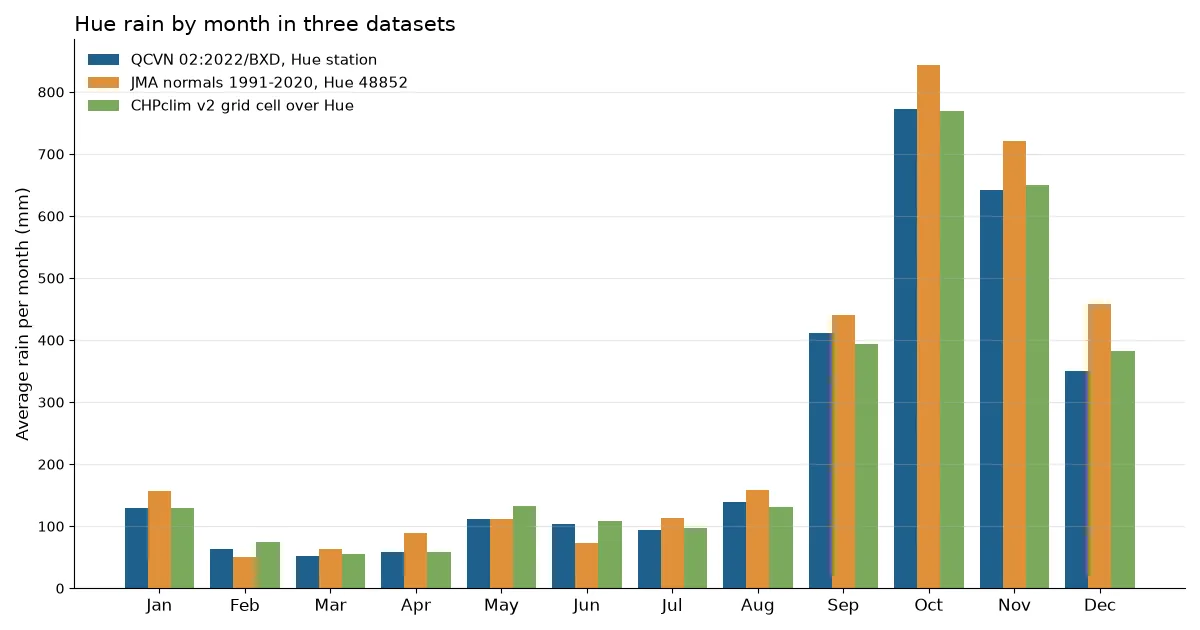
The station figures above come from the building code, which does not say which years they cover. Japan's weather agency publishes normals for the same station, 1991 to 2020, and they run about 12% wetter over the year, with October at 842.7 mm (JMA ClimatView). A third set, the CHPclim climatology, blends satellite readings, terrain and station normals on a grid about 5 km across; the cell over Hue lands within about 2% of the station for the year, though its December is wetter (CHPclim v2).
Individual months shift between the three, but the big picture holds. All three put October first and November second, and March is the driest month or close to it in each (February in JMA), though JMA has June, at 72 mm, drier than April at 89 mm. Plan around the shape of Hue's year, and treat any single monthly figure as a rough guide.
How we checked this
On 1 November 2026 we read the station rows of QCVN 02:2022/BXD from the government PDF, the JMA normals page for station 48852, the CHPclim grid cell over the city and the two NCHMF bulletins. The gauge readings, the rainfall totals and the pavilion flooding each come from two reports. We could not confirm the years behind the code's station tables, or the period and licence of CHPclim version 2.
References
- QCVN 02:2022/BXD, Vietnam building code climate data, tables A.1 to A.33
- JMA ClimatView normals, method notes
- CHPclim README (version 1)
- Người Lao Động: Bach Ma's 1,739.6 mm day
- VnExpress International: Vietnam's 2025 floods in review
- VnExpress: Hue to Da Nang heritage trains suspended, 23 October 2025
- NCHMF warning, 30 October 2026
About the author

Pen name for the weather and climate beat: rain, temperature, typhoons and when to go. Every comparison is built from official station records.
Keep reading

Is there an airport in Hue? Phu Bai, and when Da Nang wins
Guides · 5 min

Hue Imperial City ticket prices and combo routes for 2026
Guides · 5 min
Hue or Da Nang: which to pick for the weather in your month
Guides · 5 min

Best time to visit Hoi An: the dry half and the wet autumn
Guides · 5 min

Central Vietnam in October: Hue, Da Nang and Phong Nha
Guides · 5 min

Ha Giang loop in December and January: worth the cold?
Guides · 5 min
Hottest month in Vietnam: April, June or July, by region
Guides · 5 min

Best time to visit Ninh Binh: clear November, grey March
Guides · 5 min
Disclaimer
This article is general information, not legal, immigration, medical or financial advice. Prices, visa rules and transport schedules change, and each figure shows the month we last verified it. Confirm anything that affects your trip (entry requirements, fees, health rules) with the official government or provider source before you book or travel. The site has no affiliate links today; our affiliate disclosure explains what we will do if that changes.