Festivals in Vietnam

By place

Each place's own guide, the same as on its page, with its sources. North to south, not ranked.

  • Hanoi lakes, parks and flowers: Hoan Kiem, West Lake, Long Bien

    Hoan Kiem sits in the centre of Hanoi, West Lake, the largest, lies to the north-west, and Truc Bach was once a corner of it. Their shores are where the city walks and cycles, and they mark the seasons: flame trees around Hoan Kiem in May, lotus on West Lake in June. Below are the three lakes, a park, the old bridge over the Red River and the riverbank peach gardens, with a flower calendar at the end. For one walk, we'd cross Long Bien Bridge on a weekend afternoon.

    Not ranked.

    The lakes

    • Turtle Tower on its small grassy islet in Hoan Kiem Lake, seen through bare branches with orange-red leaves on a misty day

      Hoan Kiem Lake

      Where:
      Ringed by Dinh Tien Hoang, Le Thai To and Hang Khay streets
      Walking street:
      19:00 Friday to midnight Sunday

      The lake of the returned sword takes its name from the 15th-century legend of King Le Loi giving his sword back to the Golden Turtle. It covers about 12 ha, a remnant of an old channel of the Red River, and the streets around it run for about 1,800 m. Turtle Tower, on a mound in the water, was built around 1884 to 1886 and mixes Gothic arches with a Vietnamese curved roof, and the red The Huc Bridge leads to Ngoc Son Temple. In May the shore turns red and purple with flame trees and crape myrtle.

    • Calm, rippled water of West Lake under an orange and blue sky just after sunset, with a low line of buildings on the far shore

      West Lake

      Where:
      Tay Ho, north-west of the Old Quarter
      Lotus:
      Late May to June; ponds on Trinh Cong Son Street

      Hanoi's largest natural freshwater lake covers more than 526 ha and is about 15 km round, formed from an old channel of the Red River. Locals walk and cycle the shore roads, Thanh Nien, Yen Phu, Nghi Tam and Quang Ba among them. From late May to June the lotus ponds bloom white and pink; pond owners serve tea and rent ao dai for photos, and photographers come at first light. In 2026 the city approved a plan to rebuild 13.5 km of the lakeside road, so expect works on parts of the loop.

    • Grey-green water of Truc Bach Lake with rows of swan pedal boats moored at the far shore below palm trees and white buildings

      Truc Bach Lake

      Where:
      Ba Dinh, across Thanh Nien Road from West Lake

      Truc Bach is a 22 ha corner of West Lake, cut off by the old dyke that has been Thanh Nien Road since 1958. Its name comes from truc bach silk, which palace women exiled here after the time of Lord Trinh Giang are said to have woven. Ngu Xa island, 4.5 ha, was a village of bronze casters, and Than Quang Pagoda there keeps a bronze Amitabha Buddha finished in 1953, the largest bronze statue in the North until 2003. The same village cast the 1677 bronze statue in nearby Quan Thanh Temple.

    Parks and the Red River

    • Red gateway reading Cong Vien Thong Nhat, decorated with flowers and topped by a flag, in front of tall trees at dusk

      Thong Nhat Park

      Where:
      Main gate on Tran Nhan Tong Street, Hai Ba Trung
      Entry:
      Free

      Built from 1958 by volunteers on waste ground of ponds and rubbish, the park opened on 30 May 1961 and was named Thong Nhat, Reunification, while the country was still divided. It covers about 50 ha around the 25 ha Bay Mau lake and its two islands. From 1980 to 2003 it was called Lenin Park. Since December 2022 its fences have been coming down, first on Tran Nhan Tong and in 2025 on Le Duan, making it a free open park, and in March its old sua trees flower white.

    • Long Bien Bridge's steel trusses against an orange sky, with a person in a conical hat among pink flowers in front

      Long Bien Bridge

      Where:
      From Phuc Xa, beside the Old Quarter, across the Red River
      Entry:
      Free to walk; footpaths on both sides

      Begun in 1898 and opened on 28 February 1902 as the Doumer Bridge, Hanoi's first steel bridge over the Red River was renamed Long Bien in 1945. It runs 1,862 m on 19 steel spans, with a single railway track down the middle and paths for motorbikes and pedestrians on both sides. It was bombed 14 times in the war and repaired each time. People walk it at weekends, buying boiled corn and grilled sweet potatoes, and a resident told VietNamNet it has the best view of sunrise or sunset in the city.

    • Rows of young peach trees with pink blossom on bare branches, with flower beds and village houses behind

      Nhat Tan peach gardens and Quang Ba flower market

      Where:
      Lane 264 Au Co, Tay Ho, on the Red River bank; Quang Ba market at lane 238 Au Co
      Best:
      January and February, before Tet
      Quang Ba market:
      About 23:00 to 06:00; from 20:00 before holidays, day and night at Tet

      Nhat Tan is Hanoi's best-known peach-growing area. When the old village land was built over, the growers moved their gardens onto the Red River bank, revived old varieties and trained trees into shapes, and the city's traditional peach contest is held here. Come in January or February, before Tet, when buyers and photographers fill the gardens. In November, daisies bloom between the rows. About 1.4 km away, Quang Ba, one of Hanoi's largest wholesale flower markets, trades through the night.

    Flower calendar

    • January and February: peach blossom in the Nhat Tan gardens, before Tet.
    • February and March: ban (bauhinia) flowers on Hoang Dieu and Bac Son streets in Ba Dinh.
    • March: white sua blossom for about two weeks, on Phan Dinh Phung and Hoang Hoa Tham streets and in Thong Nhat Park.
    • April: white loa ken lilies, grown in gardens around Hanoi.
    • May: red flame trees and purple crape myrtle around Hoan Kiem Lake.
    • Late May to June: lotus on West Lake.
    • September and October: milkwood (hoa sua) on Nguyen Du and Dao Tan streets; in October 2026 the city trimmed 992 trees to tone down the scent.
    • November: white daisies (cuc hoa mi), at their best for two to three weeks.

    Sources

    Checked in October 2026.Show all 24 sources
    • banqldtdthanoi.vn. Lake of about 12 ha, ringed by streets roughly 1,800 m long, the remnant of an old Red River (Nhị Hà) channel.
    • pbgdpl.hanoi.gov.vn. The walking street has run officially since September 2016, from 19:00 Friday to 24:00 Sunday.
    • nguoihanoi.vn. Holiday changes are announced by notice from the ward. For 30/4–1/5/2026 the lake zone opened from 07:00 on 30/4 to 24:00 on 3/5 (notice 317/TB-UBND, 21/4/2026).
    • vnexpress.net. A 2026 low-emission-zone pilot keeps the walking-street rule: no motorbikes or cars of any kind from 19:00 to 24:00 every Fri/Sat/Sun. The pilot runs 1/7–31/12/2026.
    • baodautu.vn. In May the lake is ringed with red phượng (flame trees), purple bằng lăng and yellow muồng hoàng yến.
    • vnexpress.net. Largest natural freshwater lake in Hanoi: more than 526 ha, about 15 km round, formed from an old Red River channel.
    • vietnamplus.vn. Popular lakeside walking/cycling roads: Thanh Niên, Yên Phụ, Nghi Tàm, Quảng Bá, Nguyễn Đình Thi, Trích Sài, Vệ Hồ, Nhật Chiêu, Quảng An.
    • vov.vn. Lotus season: late May to early June, white and pink Bách Diệp lotus. There is a pond on Trịnh Công Sơn street; photographers recommend early morning.
    • vnexpress.net. June is the peak at West Lake's lotus ponds. Pond owners serve tea and rent áo dài, and it is also the harvest for lotus-scented tea.
    • nguoidothi.net.vn. The name comes from "trúc bạch" silk, woven by palace women exiled here after Lord Trịnh Giang's time.
    • vnexpress.net. The VnExpress folk account gives the same silk origin: the women grew mulberry, raised silkworms and wove silk called "trúc bạch".
    • thanhnien.vn. Over 50 ha with the Bảy Mẫu lake and two islands (Hòa Bình, Thống Nhất); multiple gates, main one on Trần Nhân Tông.
    • dantri.com.vn. Built from 1958 by volunteer labour, on a former waste ground of ponds and rubbish; officially opened 30/5/1961. The name expressed the hope for national reunification.
    • vnexpress.net. Thống Nhất Park is listed among Hanoi's sưa (March) spots.
    • nhandan.vn. First stone laid 12/9/1898 and opened 28/2/1902; designed by Daydé & Pillé on the Tolbiac Bridge model.
    • vietnamnet.vn. 1,862 m long with 19 steel spans. A single rail track runs down the middle, with paths for motor vehicles and pedestrians on both sides.
    • nhandan.vn. Growers moved their peach trees from the old village land, lost to urban building, onto the Red River bank. They revived old varieties and trained shaped trees ("đào thế").
    • daibieunhandan.vn. Bãi đá sông Hồng flower garden is at the end of lane 264 Âu Cơ. It has seasonal flowers (spring peach, sunflower, wild daisy; summer cockscomb; autumn reeds), picnics and a small animal farm. The riverbank area is free to enter.
    • baochinhphu.vn. Quảng Bá is one of Hanoi's largest wholesale fresh-flower markets, on Âu Cơ road. It normally runs about 23:00 to 06:00, starts at 20:00–21:00 before holidays, and runs day and night at Tết.
    • vnexpress.net. Nhật Tân growers also plant cúc họa mi daisies among the peach trees. In mid-November 2025 many beds were in bloom, with the rest to open within a month.
    • vietnamtourism.gov.vn. ban: Feb–Mar on Hoàng Diệu & Bắc Sơn; planted in Hanoi since the 1960s; flowered ~3 weeks early in 2021.
    • vnexpress.net. sữa 2026 news: from 16 to 20/10/2026 the city trimmed 992 milkwood trees on 13 streets to cut the scent. Workers on Đào Tấn removed about 70% of the flowers per tree.
    • visitbadinh.com.vn. The bronze statue: 3.72–3.96 m tall, about 3.6–4 tonnes, cast in 1677 by the Ngũ Xã bronze-casting village; the god sits with his sword resting on a turtle's back. Recognised as a National Treasure on 22/12/2016.
    • openstreetmap.org, page 2. Bai da song Hong to Cho hoa Quang Ba: 1.43 km in a straight line and (21.06825, 105.82726)).
    Photo credits

The facts

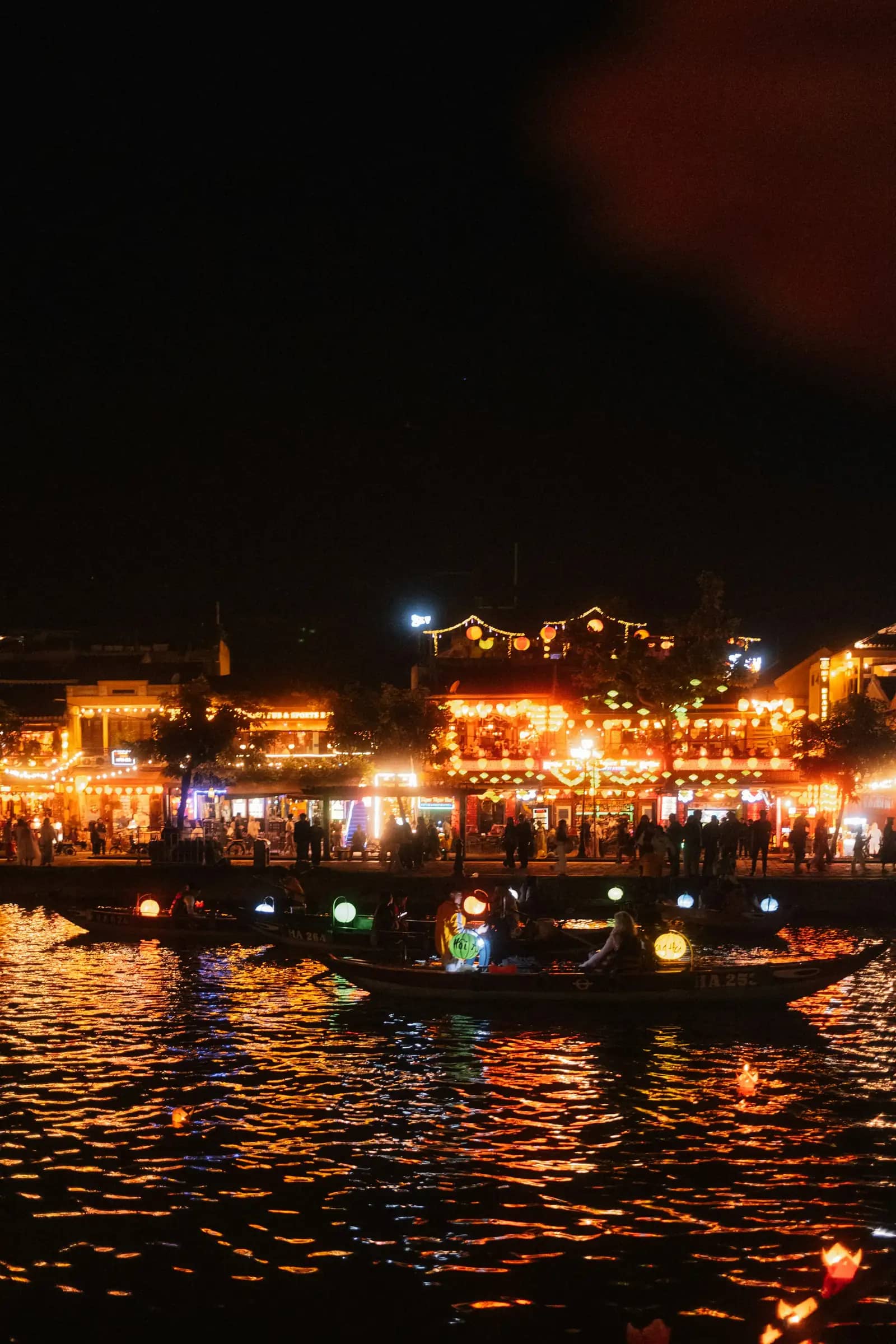
  • Small wooden boats with glowing lanterns on the river at night
    Image: Vincent Yap / Unsplash

    Hoi An & Da Nang

    Once a month, on the 14th day of the lunar month when the moon is full, Hoi An's old town dims its electric lights and glows with lanterns and candles instead.

    Roads close to traffic and the streets are lit by thousands of coloured lanterns, with old-fashioned games, food and music. Find a spot by the river, where people set candle lanterns adrift for luck, or take a boat and drop one yourself. Lanterns have been made and hung here since Chinese and Japanese traders brought them centuries ago.

    Source: Vietnam Tourism, The best ways to explore the ancient town of Hoi An, Hoi An World Heritage (Hoi An Centre for Cultural Heritage Management), Hoi An Lantern Festival. Checked October 2026.
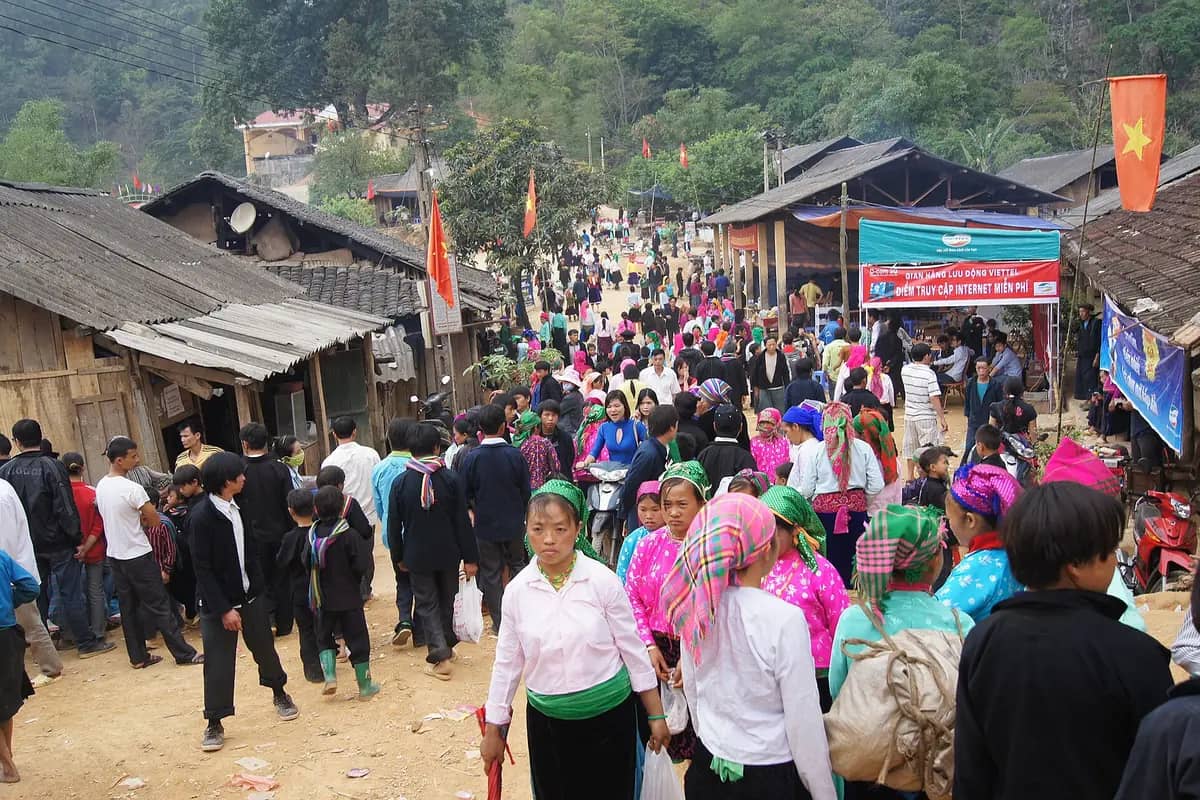
  • Crowds of Hmong and other highland people in bright headscarves filling the street of the Khau Vai love market in Meo Vac
    Image: Hoangvantoanajc / Wikimedia Commons, CC BY-SA 3.0

    Ha Giang Loop

    Once a year, on the 27th day of the third lunar month, the Khau Vai love market lets people meet their former lovers in public, and spouses are not supposed to mind.

    Husbands and wives arrive together and go looking for old partners in the crowd. Folklore says it began with a couple from two feuding groups who parted to stop the bloodshed and promised to meet at Khau Vai once a year. The festival, about 100 years old, now draws thousands of visitors to Meo Vac.

    Source: Viet Nam News, Ha Giang gets ready for love market festival. Checked October 2026.

Guides