Temples and pagodas in Vietnam

Sights

Sights with a page of their own, with hours and fees from official sources. Not ranked.
By place

Each place's own guide, the same as on its page, with its sources. North to south, not ranked.

  • Hanoi temples and pagodas: Ngoc Son, One Pillar and West Lake

    These eight temples and pagodas fall into three clusters you can each walk in a morning: Hoan Kiem Lake and the Old Quarter, Ba Dinh around the mausoleum, and the shore of West Lake. Two of them, Bach Ma and Quan Thanh, are guardian temples of the old capital, Thang Long. Most charge a small fee or none. Dress modestly, take your hat off inside, and expect crowds on the 1st and 15th of each lunar month, when people come to make offerings. If you see only one, we'd pick Quan Thanh for its 1677 bronze.

    Not ranked. Hours of sights with their own page are read from that page.

    Hoan Kiem Lake and the Old Quarter

    • The red The Huc Bridge leading to the tree-covered island and Ngoc Son Temple's gate on Hoan Kiem Lake under a blue sky

      Ngoc Son Temple and The Huc Bridge

      Where:
      Dinh Tien Hoang Street, on an island in Hoan Kiem Lake
      Open:
      Daily, 07:00 to 18:00, to 21:00 at weekends (VnExpress International, January 2025)
      Entry:
      VND 50,000; free for children under 16; the bridge itself is free

      The red The Huc Bridge, 15 spans of ironwood planks, leads across the lake to the island and the temple. It honours Van Xuong De Quan, the god of literature and exams, and General Tran Hung Dao, with altars to the Buddha and the Mother Goddesses beside them. The temple was rebuilt and given its present name in 1843, and the scholar Nguyen Van Sieu added the bridge when he restored it in 1865. The stone Pen Tower at the gate is inscribed "write on the blue sky", and two preserved turtles from the lake are on show inside.

    • Yellow street front of Bach Ma Temple on Hang Buom, with ceramic dragons on the roof ridge and red lanterns along the porch

      Bach Ma Temple

      Where:
      76 Hang Buom, Old Quarter
      Open:
      Daily, 08:00 to 12:00 and 13:30 to 17:30; also 19:00 to 21:00 Friday to Sunday
      Entry:
      VND 20,000 since 8 December 2025; free for children under 16

      The White Horse Temple is the oldest of the four temples that guarded the old capital, dated by tradition to the 9th century, and honours Long Do, the city's guardian spirit. The legend says a white horse walked out of this temple and circled the site, and King Ly Thai To built the walls of his capital along its hoof-prints. Inside are a frame of big ironwood columns, a lacquered and gilded statue of Long Do and 15 stone steles. Xam and ca tru singers often perform here.

    • Yellow arched gate of Quan Su Pagoda with its name and parallel sentences in red Latin-alphabet Vietnamese

      Quan Su Pagoda

      Where:
      73 Quan Su Street
      Busiest:
      Vu Lan, the 15th day of the seventh lunar month, and the lunar new year

      Built in the 15th century as a lodge for envoys from Champa and Laos, which gave it its name, the Ambassadors' Pagoda became the headquarters of the northern Buddhist association in 1934 and is now the seat of the Vietnam Buddhist Sangha. It was rebuilt in 1942: a gate with three tiers of roof and the bell tower in the middle, then 11 steps up to a square main hall, busy with worshippers on festival days. Unusually, its name and many of its parallel sentences are written in the Latin alphabet.

    Ba Dinh

    One Pillar Pagoda is beside Ho Chi Minh's mausoleum; the Temple of Literature and Quan Thanh are each under 1 km from it in a straight line, one south, one north.

    • Stone steps leading up to the One Pillar Pagoda's tiled wooden shrine, strung with Buddhist flags, above its pond

      One Pillar Pagoda

      Where:
      Chua Mot Cot Street, Ba Dinh, next to the mausoleum grounds
      Open:
      Daily, 07:00 to 18:00
      Entry:
      Free for Vietnamese visitors; VND 25,000 for foreigners according to VnExpress International, though the ward's tourism site lists it as free

      King Ly Thai Tong founded this small wooden shrine to Quan Am in 1049, and the legend says it followed a dream in which she handed him a baby son from a lotus throne. It stands on a single stone pillar 1.2 m across and 4 m high in a square pond, the shrine itself 3 m a side. The French blew it up with mines on 11 September 1954, and it was rebuilt to its old design by April 1955. The bodhi tree beside it was India's gift to Ho Chi Minh in 1958.

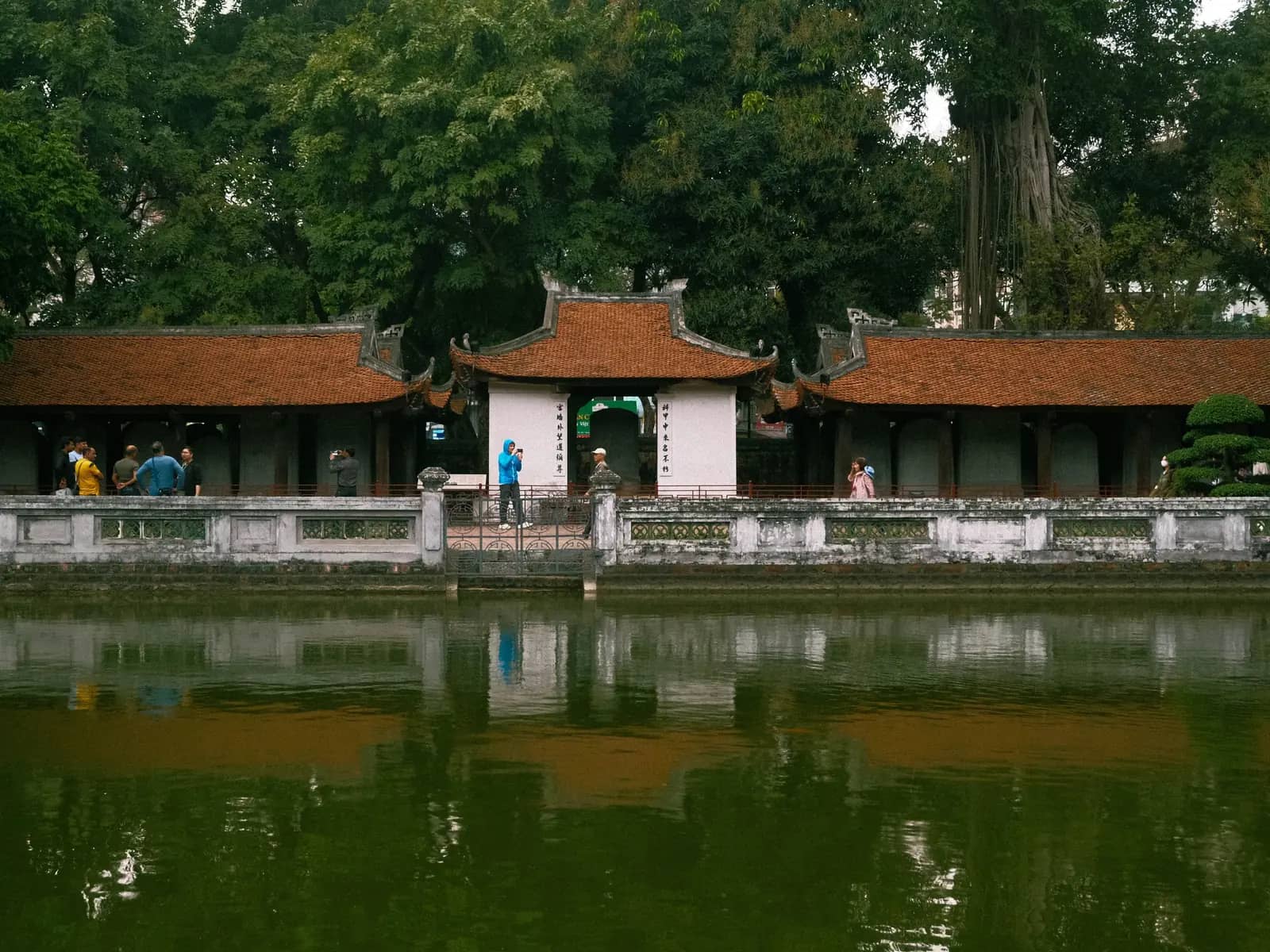
    • A walled pond at the Temple of Literature, the pavilions behind it reflected in the green water

      Temple of Literature (Van Mieu)

      Open:
      Daily, 08:00 to 17:00
      Entry:
      VND 70,000; free for children under 16
      Evenings:
      Wednesday, Saturday and Sunday, 18:00 to 22:00, separate ticket

      Vietnam's great temple to Confucius and to learning was ordered by King Ly Thanh Tong in 1070; the Imperial Academy followed in 1076. You walk through five walled courtyards from Van Lake to the academy. In the Doctoral Stele Garden, the first stone steles were ordered in 1484, and 82 of them are National Treasures. There is an information desk, free Wi-Fi and an audio guide, and you leave by a different gate, on Van Mieu Street.

    • The white ornamental gate of Quan Thanh Temple with red flags beside it and motorbikes blurring past on the street in front

      Quan Thanh Temple

      Where:
      Quan Thanh Street at Thanh Nien Road, by West Lake
      Entry:
      VND 10,000 in the city's 2023 fee schedule
      Festival:
      3rd day of the third lunar month

      The northern guardian of the old capital goes back to the reign of Ly Thai To in the early 11th century and is a Taoist temple to Tran Vu, guardian of the North. Its treasure is his bronze statue, cast in 1677 by the bronze workers of Ngu Xa village: close to 4 m tall, weighing around 4 tonnes, with his sword resting on a turtle's back. It became a National Treasure in 2016. Steles inside record restorations from 1618 to 1941. The temple gets crowded on the 1st and 15th of the lunar month.

    West Lake

    Tran Quoc is on Thanh Nien Road, about 500 m from Quan Thanh; Phu Tay Ho is about 2 km beyond it in a straight line.

    • The red-brick multi-tiered stupa of Tran Quoc Pagoda with white Buddha statues in its arched niches, between two older grey brick towers

      Tran Quoc Pagoda

      Where:
      Thanh Nien Road, on a small island in West Lake
      Note:
      During chanting, visitors are asked to stay out of the inner halls, but may watch and take photos from outside

      Tradition dates the pagoda to the 6th century, under King Ly Nam De, when it stood by the Red River under the name Khai Quoc. In the early 17th century, after the riverbank collapsed, it was moved to its islet in West Lake, and Vietnam's tourism authority calls it the oldest pagoda in Hanoi. The red stupa, 11 storeys and 15 m tall, was built in 1998 and holds a gemstone Amitabha Buddha in each arched niche. Inside is a gilded wooden reclining Buddha, and in the grounds a bodhi tree given by India's president in 1959.

    • Tiled-roof halls of Phu Tay Ho around a brick-paved courtyard with palm trees and a stone gate post

      Phu Tay Ho

      Where:
      52 Dang Thai Mai, on a peninsula in West Lake
      Open:
      From about 05:00 to about 19:00, later on festival days (VietnamPlus, February 2025)
      Festivals:
      3rd day of the third and 13th day of the eighth lunar month

      Hanoi's main shrine to the Mother Goddess Lieu Hanh, one of Vietnam's Four Immortals, marks the place where, the story goes, the scholar Phung Khac Khoan and two friends met her by the lake. No one knows when it was first built; estimates say the 17th century or later, and the halls you see are modern concrete made to look like wood. It's packed on the 1st and 15th of each lunar month, and offering trays of flowers, fruit and votive money cost VND 200,000 to 300,000.

    Tips

    • Dress modestly, take your hat off and do not smoke inside, as Ngoc Son asks of visitors.
    • The 1st and 15th of each lunar month bring the biggest crowds, especially at Phu Tay Ho and Quan Thanh.
    • Ngoc Son is free on Cultural Heritage Day, 23 November, and Ngoc Son and Quan Thanh are free on the last day of the lunar year and the first two days of Tet.

    Sources

    Checked in October 2026.Show all 34 sources
    • banqldtdthanoi.vn. Official classification and location.
    • banqldtdthanoi.vn. Fee of 50,000 VND from 1/1/2024; under-16s free.
    • vnexpress.net. Ngoc Son was among the fee-charging sites opened free on National Day, 2/9/2026.
    • e.vnexpress.net. History: renamed Ngoc Son under the Tran; rebuilt and renamed a temple in 1843; Nguyễn Văn Siêu's 1865 renovation added The Huc Bridge.
    • nhipsonghanoi.hanoimoi.vn. Who is worshipped: Văn Xương Đế Quân (god of literature and exams), Trần Hưng Đạo, plus Buddha and Mother Goddess altars, reflecting "three teachings, one origin".
    • thanglong.chinhphu.vn. Built in the 9th century; the earliest of the four guardian temples; dedicated to Long Đỗ; at 76 Hàng Buồm.
    • nguoihanoi.vn. Legend: in 1010 King Lý Thái Tổ's walls kept collapsing. A white horse came out of the temple, and the king built the walls along its hoof-prints.
    • laodong.vn. Fee of 20,000 VND since 8/12/2025 under Resolution 66/2025.
    • baodanang.vn. Hours and concessions.
    • lang.hanoi.gov.vn. On the Tết 2026 free-entry list.
    • nhandan.vn. Electronic tickets are in use at Bach Ma.
    • tapchinghiencuuphathoc.vn. Address and the envoys origin story.
    • vnexpress.net. Busy at Vu Lan (lunar 15/7); headquarters of the Vietnam Buddhist Sangha.
    • vnexpress.net. 2025: it hosted the Buddha relics during the UN Vesak; a wax statue of the late Most Venerable Thích Thanh Tứ is displayed.
    • visitbadinh.com.vn. Official ward portal: founded in the 10th lunar month of 1049 under Lý Thái Tông; dedicated to Quan Thế Âm; marked free.
    • hoangthanhthanglong.vn. Legend: the king dreamed that Quan Âm, seated on a lotus, handed him a baby son; the queen then bore a son, and he built a lotus-shaped pagoda named Diên Hựu.
    • e.vnexpress.net. Hours and fee.
    • visitbadinh.com.vn. Official ward portal facts: founded under Lý Thái Tổ (1010–1028); Special National Relic as part of the tứ trấn on 18/1/2022.
    • luatvietnam.vn. Fee of 10,000 VND (Resolution 16/2023, fee table) and free days.
    • tienphong.vn. Night tour "Tiếng chuông Trấn Vũ": 90 minutes of staged festival scenes plus a visit, launched on the evening of 28/5/2025.
    • e.vnexpress.net. Gets crowded on the 1st and 15th of each lunar month.
    • baotanglichsu.vn. Founded under Lý Nam Đế (541–547) as Khai Quốc, near the Red River.
    • vietnamtourism.vn. The national tourism authority calls it the oldest pagoda in Hanoi and notes the bodhi tree given by India's President in 1959.
    • tayho360.vn. The stupa: built in 1998, 11 storeys, 15 m, with a gemstone Amitabha statue in each arched niche.
    • vietnamtourism.gov.vn. Daily Mail (2016) listed it among the world's 16 most beautiful pagodas.
    • tayho360.vn. Address, portal hours, and national relic status (13/02/1996).
    • vietnamplus.vn. Date uncertain, probably 17th century or later; Liễu Hạnh is one of the "Four Immortals".
    • vanmieu.gov.vn. (attr-temple-of-literature row 1) Van Mieu ordered built in 1070 by King Ly Thanh Tong; Quoc Tu Giam founded 1076 by King Ly Nhan Tong.
    • vanmieu.gov.vn. (attr-temple-of-literature row 5) Facilities: information desk, free Wi-Fi, audio guide, QR information.
    • vanmieu.gov.vn. (attr-temple-of-literature row 6) Entrance 58 Quoc Tu Giam Street; exit 19 to 21 Van Mieu Street.
    • openstreetmap.org. One Pillar Pagoda to Temple of Literature: 0.83 km in a straight line and (21.02861, 105.83556)).
    • openstreetmap.org. One Pillar Pagoda to Quan Thanh Temple: 0.86 km in a straight line and (21.04303, 105.83659)).
    • openstreetmap.org. Quan Thanh Temple to Tran Quoc Pagoda: 0.54 km in a straight line and (21.0479, 105.83676)).
    • openstreetmap.org. Tran Quoc Pagoda to Phu Tay Ho: 1.96 km in a straight line and (21.05556, 105.81972)).
    Photo credits
  • Ninh Binh temples and history: Hoa Lu, Am Tien, Bai Dinh, Bich Dong, Thai Vi and Phat Diem

    Hoa Lu was Vietnam's capital from 968 to 1010, and the temples around it, the cave pagodas near Tam Coc and the vast new Bai Dinh make Ninh Binh as much about history as scenery. Phat Diem, in Kim Son, is the odd one out: a Catholic cathedral complex built in stone. We'd see Hoa Lu and Am Tien together, 400 m apart, and give Bai Dinh a separate morning.

    Not ranked. Hours of sights with their own page are read from that page. See also our history list for all of Vietnam.

    Around the old capital

    • A paved square leading to the red-roofed gate of Hoa Lu ancient capital, flags on poles and misty limestone hills behind

      Hoa Lu Ancient Capital

      Open:
      No official hours published
      Entry:
      VND 20,000; children 6 to 15 and over-60s VND 10,000

      The capital of Vietnam from 968 to 1010, under the Dinh, Early Le and Ly dynasties, until Ly Thai To moved it to Thang Long. Its centrepiece is King Dinh Tien Hoang's temple, on the old palace ground in Truong Yen, the only place that honours him with his parents and sons; it faces the saddle-shaped Ma Yen hill, where his tomb lies. The Hoa Lu festival runs from the 10th to the 13th of the third lunar month.

    • Narrow valley between steep green limestone cliffs, its floor a pond covered in floating aquatic plants with a thin strip of open water

      Am Tien cave pagoda

      Where:
      About 400 m from the east gate of King Dinh's temple
      Entry:
      VND 100,000; children, pupils and over-65s VND 30,000 (2026)

      Also called Tuyet Tinh Coc, the hidden valley, where King Dinh Tien Hoang is said to have kept tigers and leopards and set his execution ground. Climb 205 stone steps over the cliff to the pagoda, where Queen Duong Van Nga became a nun in her last years. The lake is so clear you can see the moss on its bed, and the cave, shaped like a dragon's mouth, is also called Hang Rong.

    • Aerial view of Bai Dinh's tall multi-storey brick stupa rising above forest and grey-tiled temple roofs, rice fields and karst hills on the horizon

      Bai Dinh pagoda

      Where:
      Highway 38B, Tay Hoa Lu, 15 km from the provincial centre
      Open:
      06:00 to 21:00 (VnExpress, 2025)
      Entry:
      Free; electric car VND 150,000 return (from 15 February 2026)

      Billed as the largest pagoda in Vietnam and the one with the most records, Bai Dinh hosted the United Nations Vesak celebration in 2014. Its Arhat corridor runs in two rows of 117 bays each, 526 m long, and the bronze bell in its tower weighs 36 tonnes. Entry is free; the electric car from the gate costs VND 150,000 return. The pagoda festival falls on the 6th of the first lunar month.

    Near Tam Coc, and Phat Diem

    • Ornate two-storey stone gate of Bich Dong pagoda at the foot of a jungle-covered cliff, a visitor in a red skirt and conical hat under the arch and lotus leaves beside the path

      Bich Dong pagoda

      Where:
      Dam Khe, about 2 km from the Tam Coc landing
      Entry:
      On the VND 350,000 Tam Coc ticket with shuttle

      Three pagodas, Lower, Middle and Upper, climb the Truong Yen limestone, with a water cave 350 m long running under the mountain. Lord Trinh Sam visited in 1774, and it is ranked second in beauty only to Huong Tich cave, hence its title, the second cave of the south. Its founding is told two ways: in 1428, or by two monks who came here in 1695.

    • Grey stone triple-arched gate in front of two rounded green karst hills, with the corner of a red-roofed pavilion on the right

      Thai Vi temple

      Where:
      Van Lam, Nam Hoa Lu, on the Tam Coc shuttle
      Entry:
      On the VND 350,000 Tam Coc ticket with shuttle

      The temple to the Tran kings, Tran Thai Tong and Tran Thanh Tong among them, stands on the ground of the Vu Lam field palace, a base in the Tran's second war against the Mongols. Every column is a single block of green stone, and a bell cast in 1689 hangs inside. The Tam Coc shuttle stops here on the way to Bich Dong.

    • Grey stone front of Phat Diem cathedral with stacked, upturned pagoda-style roofs topped by a cross, a long orange-roofed hall behind and a paved forecourt

      Phat Diem stone cathedral

      Where:
      Phat Diem, Kim Son
      Entry:
      Free

      Built from 1875 to 1898 to the design of Father Peter Tran Luc, the Phat Diem complex covers 30,000 m² with 11 buildings, and its Sacred Heart chapel, the one locals call the stone church, is made entirely of stone. It was made a national monument in 1987 or 1988; the provincial pages give both years. Entry is free.

    Tips

    • Hoa Lu costs only VND 20,000, and Am Tien is 400 m from its east gate.
    • Bai Dinh is free to enter; the electric car is extra.

    Sources

    Checked in October 2026.Show all 24 sources
    • trangandanhthang.vn. Tam Coc (`tam-coc`): Trang An board price list.
    • dulichninhbinh.com.vn. Tam Coc (`tam-coc`): Tourism Promotion Centre 2026 table.
    • trangandanhthang.vn. Tam Coc (`tam-coc`): Trang An board: Tam Coc boat routes.
    • sodulich.ninhbinh.gov.vn. Tam Coc (`tam-coc`): Old provincial list (dated 20/08/2020), boat fee structure, superseded.
    • sodulich.ninhbinh.gov.vn. Hoa Lu ancient capital (`hoa-lu-ancient-capital`): Tourism Department support phone list (01/08/2025).
    • dulichninhbinh.com.vn. Bich Dong pagoda (cave pagoda): Ninh Binh Tourism Promotion Centre (22/03/2023).
    • dulichninhbinh.com.vn. Bich Dong pagoda (cave pagoda): Tourism Promotion Centre (19/11/2024): nickname.
    • trangandanhthang.vn. Bai Dinh pagoda (Buddhist complex): Trang An board: Bai Dinh page.
    • vnexpress.net. Bai Dinh pagoda (Buddhist complex): VnExpress handbook (19/01/2025): hours, free entry.
    • dulichninhbinh.com.vn. Thai Vi temple (Tran-dynasty temple): Ninh Binh Tourism Promotion Centre (18/10/2024).
    • sodulich.ninhbinh.gov.vn. Thai Vi temple (Tran-dynasty temple): Ninh Binh Tourism Dept.
    • sotuphap.ninhbinh.gov.vn. Am Tien cave pagoda (Tuyệt Tịnh Cốc) (cave pagoda / hidden valley): Ninh Binh Dept of Justice (republishing Bao Ninh Binh, 09/4/2024).
    • dulichninhbinh.com.vn. Am Tien cave pagoda (Tuyệt Tịnh Cốc) (cave pagoda / hidden valley): Tourism Promotion Centre (24/06/2022): Dinh execution ground legend.
    • dulichninhbinh.com.vn. Phat Diem stone cathedral (Kim Son) (Catholic cathedral complex): Tourism Promotion Centre (03/10/2024).
    • sodulich.ninhbinh.gov.vn. Phat Diem stone cathedral (Kim Son) (Catholic cathedral complex): Ninh Binh Tourism Dept: architect.
    • trangandanhthang.vn. (attr-hoa-lu-ancient-capital row 1) Capital of Vietnam from 968 to 1010; first capital of a centralised feudal state; home region of Dinh Bo Linh.
    • vietnam.travel. (attr-hoa-lu-ancient-capital row 4) Vietnam National Authority of Tourism: Hoa Lu was the capital in the 10th and 11th centuries.
    • vi.wikipedia.org. (attr-hoa-lu-ancient-capital row 5) Temple of King Dinh Tien Hoang in Truong Yen village, at the center of the old Eastern citadel, on the old palace foundations.
    • wikidata.org, page 2, page 3. (attr-hoa-lu-ancient-capital row 9) Coordinates: Hoa Lu, Trang An, Hoan Kiem Lake (Wikidata); Tam Coc boat landing (OpenStreetMap node).
    • openstreetmap.org. (attr-hoa-lu-ancient-capital row 9) Coordinates: Hoa Lu, Trang An, Hoan Kiem Lake (Wikidata); Tam Coc boat landing (OpenStreetMap node).
    • vi.wikipedia.org. (attr-hoa-lu-ancient-capital row 15) Legend: as a boy Dinh Bo Linh led buffalo herders in mock battles with reed flowers as flags; the chronicle Dai Viet Su Ky Toan Thu says the children crossed hands to carry him and held reed flowers on both sides like royal regalia.
    • en.wikipedia.org. (attr-hoa-lu-ancient-capital row 16) His childhood mock wars as leader of the local children are legendary.
    • english.bvhttdl.gov.vn. (attr-hoa-lu-ancient-capital row 17) Hoa Lu festival at Truong Yen in the third lunar month opens with boys dressed as cowherds holding reed flags (Ministry of Culture, Sports and Tourism).
    • pexels.com. (attr-hoa-lu-ancient-capital row 18) Hero photo: the gate of Hoa Lu ancient capital, Ninh Binh, Frank van Dijk, Pexels License (taken 2018-02-20).
    Photo credits
    • Hoa Lu Ancient Capital: Image: Frank van Dijk / Pexels
    • Am Tien cave pagoda: Image: Kien1980v / Wikimedia Commons, Public domain
    • Bai Dinh pagoda: Image: HONG SON / Pexels
    • Bich Dong pagoda: Image: Saurabh Deshpande / Pexels
    • Thai Vi temple: Image: Shyamal / Wikimedia Commons, CC BY-SA 4.0
    • Phat Diem stone cathedral: Image: Azotour Vietnam / Wikimedia Commons, CC BY-SA 4.0
  • Hue Imperial City, the royal antiquities museum, Thien Mu and Tu Hieu pagodas

    Hue was the Nguyen emperors' capital from the early 19th century, and the Imperial City is its centre: a walled city inside the Citadel, with the court's own treasures in a museum a short walk away. The two pagodas below sit along the Perfume River and in the southern hills, on the way to the tombs. We'd give the Imperial City a morning and ride out to Thien Mu in the late afternoon.

    Not ranked. Hours of sights with their own page are read from that page.

    Inside the Citadel

    • Ngo Mon, the main gate of Hue's Imperial City, its tiered roof pavilions above the stone base and a wide ramp in front

      Hue Imperial City

      Open:
      Daily, 07:00 to 18:00
      Entry:
      VND 200,000; children 7 to 12 VND 40,000; with two tombs VND 420,000

      Building started in 1804 and finished in 1833 under Emperor Minh Mang: a walled city roughly 600 m a side with four gates, where the court held grand audiences on the 1st and 15th of each lunar month. Vietnam Tourism warns that heavy rain and typhoons can hit Hue from September to November. If you're seeing tombs too, buy a combined ticket: every site costs VND 600,000 together.

    • The long, low wooden Long An Palace under a tiled roof behind a formal garden, with old cannons on the lawns

      Museum of Royal Antiquities

      Where:
      3 Le Truc, inside the Citadel
      Entry:
      VND 50,000; children free

      Founded in 1923 as the Musée Khai Dinh, one of Vietnam's first museums, it fills Long An Palace, a wooden hall built in 1845 with 128 columns. The collection is the court's own: porcelain made for Hue, known as Bleu de Hue, cloisonné, court costume, seals and musical instruments, along with more than 80 Cham pieces. The grounds cover 6,330 m², and it opens on the same hours as the Imperial City.

    Pagodas

    • The seven-storey octagonal Phuoc Duyen tower seen from its base, framed by bare frangipani branches

      Thien Mu Pagoda

      Where:
      Kim Long, about 5 km west of the centre on the Perfume River
      Entry:
      Not on the monument centre's ticket list

      Lord Nguyen Hoang founded the pagoda in 1601 on Ha Khe hill above the Perfume River, and its octagonal tower, Phuoc Duyen, seven storeys and 21 m tall, was added in 1844. It keeps two national treasures: a great bell cast in 1710, 2.5 m tall and 2,052 kg, and a stele of 1715. It stands about 5 km west of the centre, on the north bank.

    • A curved stone-rimmed green pond in front of an ornate gate, with tall trees overhead

      Tu Hieu Pagoda

      Where:
      Le Ngo Cat Street, Thuy Xuan, on the road to Tu Duc's tomb
      Entry:
      Not on the monument centre's ticket list

      Begun in 1843 as the hermitage of the monk Nhat Dinh, the pagoda took its name, filial piety, from Emperor Tu Duc, honouring the monk's care of his mother. Its grounds of about 50,000 m² were rebuilt in 1931 with a two-tier gate and a half-moon lake, and they hold the only cemetery of court eunuchs in Vietnam. Thich Nhat Hanh became a monk here in 1942 and came back on 28 October 2018 to live out his life.

    Tips

    • Thien Mu and Tu Hieu are not on the monument centre's ticket; we found no official price or hours for either.
    • Tu Hieu is on the way to Tu Duc's tomb, so pair them.

    Sources

    Checked in October 2026.Show all 18 sources
    • hueworldheritage.org.vn. Per-site fees (adult / child 7–12), "applied from 02.06.2026".
    • hueworldheritage.org.vn. Opening hours, all HMCC sites (page dated 12/03/2024 3:24:40 CH).
    • hue.gov.vn. Address; founded 1923 as Musée Khải Định.
    • hue.gov.vn. Address; founded 1601 by Nguyễn Hoàng.
    • vietnamnet.vn. About 5 km west of the centre; tower built 1844 under Thiệu Trị.
    • hueworldheritage.org.vn. Bell recognised as a National Treasure in 2013 (HMCC English).
    • hue.gov.vn. Location on the road to Tự Đức's tomb; founded as An Dưỡng hermitage; the eunuchs' role; the "Sắc tứ Từ Hiếu Tự" plaque.
    • vov.vn. Founded 1843 under Thiệu Trị; Tự Đức's name honours filial piety; about 7 km south-west of the city.
    • khamphahue.com.vn. The only eunuchs' cemetery in Vietnam, about 5 km from the centre.
    • vnexpress.net. Thích Nhất Hạnh became a monk here in 1942.
    • tuoitre.vn. He returned to Từ Hiếu on 28 Oct 2018 to live out his life.
    • vi.wikipedia.org. (attr-imperial-city row 1) Hoang Thanh, also Dai Noi, is the second ring of walls inside the Hue citadel; it guarded the main palaces, the Nguyen ancestral temples and the Forbidden City reserved for the emperor and royal family.
    • vietnam.travel. (attr-imperial-city row 7) Vietnam Tourism: palaces, pavilions and theatres of the citadel, what survives of the Nguyen reign.
    • hueworldheritage.org.vn. (attr-imperial-city row 8) Ticket sales: summer (16 March to 15 October) 6:30 to 17:30; winter (16 October to 15 March) 07:00 to 17:00.
    • huetourism.gov.vn. (attr-imperial-city row 13) E-tickets: scan the ticket code at the gate; cash or bank card when buying at a counter.
    • wikidata.org, page 2, page 3, page 4. (attr-imperial-city row 15) About 1.4 km (1.44) from Hue railway station, 15.5 km (15.50) from HUI, 8 km (7.95) from Khai Dinh Tomb, 9 km (9.14) from Minh Mang Tomb.
    • ourairports.com. (attr-imperial-city row 15) About 1.4 km (1.44) from Hue railway station, 15.5 km (15.50) from HUI, 8 km (7.95) from Khai Dinh Tomb, 9 km (9.14) from Minh Mang Tomb.
    • pexels.com. (attr-imperial-city row 20) Hero photo: Ngo Mon gate of the Imperial City, Hue, Jeffry Surianto, Pexels License (taken 2020-02-28).
    Photo credits
  • Quy Nhon Cham towers and history: the Twin Towers, Banh It, Duong Long, the Quang Trung Museum and Ong Nui

    Binh Dinh is rich in Cham towers from the 11th and 12th centuries, and Quy Nhon is the base for seeing them: the Twin Towers in town, Banh It 20 km out, and Duong Long, the tallest, 50 km inland, near the Tay Son brothers' home. Tickets at the towers are VND 10,000 to 20,000. We'd see the Twin Towers in town, then drive to Banh It, the Quang Trung Museum and Duong Long in one day.

    Not ranked. See also our history list for all of Vietnam.

    In and near Quy Nhon

    • Two weathered red-brick Cham towers with plants growing from their tops, palms and clipped shrubs on the lawn in front, under a deep blue sky

      Twin Towers (Thap Doi)

      Where:
      Dong Da, about 3 km from the centre
      Open:
      07:00 to 18:00
      Entry:
      VND 20,000

      Two towers from the late 12th century, carved with dancing monkeys, elephants, lions and deer, with Garuda figures at the corners raising their arms as if to hold up the roof. Vietnam's tourism board calls them the best known of the Cham towers, and they have been a national monument since 1980.

    • A white statue of the Virgin Mary on a grey stone plinth carrying a plaque engraved HÀN MẶC TỬ, palms and shrubs behind

      Han Mac Tu's grave

      Where:
      Thi Nhan hill, Ghenh Rang
      Entry:
      Free with Ghenh Rang (VnExpress, 2026)

      The poet Han Mac Tu, born Nguyen Trong Tri in 1912 in Quang Binh, died at 28 in the Quy Hoa leper camp nearby. His grave sits on a rise at Ghenh Rang, its back to the hill and facing the sea. Quy Hoa village is still home to about 250 households, with nearly 500 patients from across the country.

    • Two tall, crumbling red-brick Cham towers on a grassy hilltop under heavy grey clouds, a woman in a red dress standing small at their base

      Banh It towers

      Where:
      Dai Le, Tuy Phuoc Bac, about 20 km from Quy Nhon
      Entry:
      VND 10,000 to 20,000 (VnExpress)

      Four towers from the late 11th and early 12th centuries on a 100 m hill between two branches of the Kon river. The main tower, 29.6 m tall, stands at the top; the Shiva inside is a copy, as the original is in the Guimet museum in Paris. A national monument since 1982, it gained a new exhibition house for Tet 2025.

    • A huge white seated Buddha on a wooded hilltop above a thatched beach hut and sand dunes

      Ong Nui pagoda

      Where:
      Chop Vung peak, Phu Cat, about 30 km from Quy Nhon

      Also called Linh Phong Thien Tu, the pagoda sits on Chop Vung peak with one of the largest seated Buddhas in South-East Asia. Climb more than 600 steps for the Buddha and a view down to the coast, and go early or late in the day to avoid the sun. Lonely Planet points visitors here too.

    Tay Son, inland

    • A bronze statue of Emperor Quang Trung in armour, right hand raised, on a black plinth in front of the museum's red-tiled hall under a grey sky

      Quang Trung Museum

      Where:
      Tay Son commune
      Open:
      07:00 to 11:30 and 13:30 to 17:00 every day
      Entry:
      VND 50,000; martial-arts show VND 20,000 a person

      Built in 1978 on the site of the old house of the Tay Son brothers, Nguyen Hue, Nguyen Nhac and Nguyen Lu, the museum has nine rooms on the Tay Son movement and Emperor Quang Trung. Walk-in visitors can watch a Tay Son martial-arts show for VND 20,000, and groups can book one for VND 400,000.

    • Three tall ochre brick Cham towers with greenery sprouting from their tops, standing in a dry grassy field under a vivid blue sky

      Duong Long towers

      Where:
      Tay Binh, Tay Son, about 50 km from Quy Nhon

      Three late 12th-century towers known as the Ivory Towers; the middle one, 39 m tall, is the tallest brick tower in South-East Asia by the national heritage department's count. It became a special national monument in December 2015. A restoration was approved in 2025, so check before you go, and signs ask visitors to stay 5 m back from the base.

    Tips

    • Tickets at the Cham towers cost VND 10,000 to 20,000.
    • Duong Long was under restoration from 2025; check it is open.

    Sources

    Checked in October 2026.Show all 12 sources
    • dulichquynhon.binhdinh.gov.vn. Twin Towers (Tháp Đôi / Tháp Hưng Thạnh) (Cham towers): Quy Nhơn tourism portal: fee.
    • vietnam.travel. Twin Towers (Tháp Đôi / Tháp Hưng Thạnh) (Cham towers): vietnam.travel (VNAT).
    • vnexpress.net. Twin Towers (Tháp Đôi / Tháp Hưng Thạnh) (Cham towers): VnExpress Quy Nhơn guide (updated 20/4/2026): fees.
    • laodong.vn. Hàn Mặc Tử's tomb (Đồi Thi Nhân) (poet's grave): Lao Động (4/8/2023): who.
    • vnexpress.net. Hàn Mặc Tử's tomb (Đồi Thi Nhân) (poet's grave): VnExpress Bình Định guide (18/4/2024): Quy Hòa leprosy village.
    • vnexpress.net. Bánh Ít towers (Tháp Bạc) (Cham towers): VnExpress (5/8/2025): location.
    • vietnamtourism.gov.vn. Bánh Ít towers (Tháp Bạc) (Cham towers): vietnamtourism.gov.vn (Báo Bình Định, Nov 2024): new display house.
    • vnexpress.net. Dương Long towers (Tháp Ngà) (Cham towers): VnExpress (11/8/2025): height.
    • thanhnien.vn. Dương Long towers (Tháp Ngà) (Cham towers): Thanh Niên (Dec 2024): location and age.
    • baotangquangtrung.com.vn. Quang Trung Museum and Tây Sơn martial arts (museum): Bảo tàng Quang Trung official site: adult fee.
    • dulichquynhon.binhdinh.gov.vn. Quang Trung Museum and Tây Sơn martial arts (museum): Quy Nhơn tourism portal: history.
    • vietnamtourism.gov.vn. Ông Núi pagoda (Linh Phong Thiền Tự) (hilltop pagoda): vietnamtourism.gov.vn (TITC, 22/6/2026): Lonely Planet tip.
    Photo credits
  • Nha Trang culture: Po Nagar Cham towers, Long Son pagoda, the cathedral, Yersin and the Oceanographic Museum

    Nha Trang has been a Cham holy place since the 8th century, a French science town and a seaside city, and its sights cover all three: the Po Nagar towers, Yersin's laboratory and the oceanographic museum, and the pagodas and churches in between. We'd go to Po Nagar early, then Hon Chong in the same ward, and save the museums for the heat of the day.

    Not ranked. See also our culture list for all of Vietnam.

    Temples and churches

    • A small weathered brick Cham tower with a curved saddle roof and a dark doorway on a paved courtyard, trees and potted plants around it

      Po Nagar Cham towers

      Where:
      61 2 Thang 4 Street, Vinh Phuoc
      Open:
      06:00 to 17:30
      Entry:
      VND 30,000 (since 1 January 2023)

      The Cham built these towers between about the 8th and 13th centuries, and the main tower keeps an 11th-century relief of Shiva, one of the finest Cham reliefs left in Vietnam. Thirty-six steep steps climb from the mandapa hall to the towers. The Po Nagar festival, national intangible heritage since 2012, runs from the 20th to the 23rd of the third lunar month.

    • Close view of the pale stone face and resting hand of the reclining Buddha at Long Sơn pagoda

      Long Son pagoda

      Where:
      22 23 Thang 10 Street
      Open:
      07:00 to 17:30

      Founded in 1886 at the foot of Trai Thuy hill, Long Son is known for its white seated Buddha, 24 m tall, built in 1963 and once recognised by Vietnam's book of records as the country's largest outdoor Buddha. Its lotus base carries portraits of Thich Quang Duc and six other monks. At step 44 of the 193 up you pass a reclining Buddha 17 m long, added in 2003.

    • A bride and groom posing below the grey Gothic facade and clock tower of Nha Trang cathedral, clipped shrubs along the stone terrace

      Nha Trang cathedral

      Where:
      31A Thai Nguyen
      Open:
      05:00 to 17:00; free
      Sunday Mass:
      05:00, 07:00, 09:30, 16:30 and 18:30

      Finished in March 1933 after five years of work, the hilltop cathedral is 36 m long, seats more than 600, and its bell tower rises 38 m. It looks like stone but isn't: it was built of cement blocks mixed with crushed rock. On 14 May 1933 Father Vallet chose Christ the King as its patron, and visitors are welcome free of charge.

    Science by the sea

    • A glass display case of Yersin's handwritten papers and microscope slides below French-language panels with old photographs

      Alexandre Yersin Museum

      Where:
      Pasteur Institute, 10 Tran Phu
      Open:
      Monday to Saturday morning, 07:30 to 11:30 and 14:00 to 17:00
      Entry:
      VND 26,000

      Alexandre Yersin found the plague bacillus within three weeks, and it bears his name; in 1895 he set up a laboratory in Nha Trang, now the Pasteur Institute. The museum, rebuilt in 1997, recreates his flat with his own things: an old Leroy clock, the microscope used on the plague, a telescope and a Morse transmitter. The fishermen of Xom Con called him Ong Nam.

    • The cream colonial-era facade of the Oceanographic Institute with a Bảo tàng Hải dương học sign, a double staircase and trees in front

      Oceanographic Museum

      Where:
      The Oceanographic Institute
      Open:
      06:00 to 18:00 every day (the museum's site)
      Entry:
      VND 40,000; students VND 20,000; under 6 free

      The institute began on 14 September 1922 as the Indochina oceanography and fisheries service, and its museum holds about 27,000 specimens of 7,000 species. Look for the 18 m whale skeleton, a dugong caught in a fishing net off Phu Quoc in 2003, and a giant clam that weighs 145 kg.

    Rocks over the bay

    • The stacked granite boulders of Hòn Chồng jutting into turquoise water, green mountains across the bay

      Hon Chong

      Where:
      Pham Van Dong Street, about 3 km from the centre
      Open:
      06:00 to 18:00
      Entry:
      VND 30,000 (since 1 January 2023)

      A spill of granite boulders into the sea, in shapes people have named Heaven's Gate, the Hand on the Rock, the Kiss of the Sea and the Old Man. Hon Chong, Hon Do and the bay clubhouse were listed as a national scenic site in 1998, and the clubhouse itself was put together in 2004 and 2005 from 15 old wooden houses brought from Hue.

    Tips

    • Po Nagar and Hon Chong each cost VND 30,000 and sit in the same ward.
    • The Yersin museum closes on Saturday afternoons, Sundays and holidays.

    Sources

    Checked in October 2026.Show all 16 sources
    • dulichso.khanhhoa.gov.vn. Po Nagar Cham towers (Tháp Bà Pô Nagar) (Cham temple complex): Provincial tourism portal: hours.
    • vnexpress.net. Po Nagar Cham towers (Tháp Bà Pô Nagar) (Cham temple complex): VnExpress: 30,000 fee from 1/1/2023.
    • dsvh.gov.vn. Po Nagar Cham towers (Tháp Bà Pô Nagar) (Cham temple complex): Cultural Heritage Dept (dsvh.gov.vn): festival dates.
    • vietnam.vn. Po Nagar Cham towers (Tháp Bà Pô Nagar) (Cham temple complex): Báo Tổ Quốc via vietnam.vn: night programme.
    • ttdhsdl.khanhhoa.gov.vn. Po Nagar Cham towers (Tháp Bà Pô Nagar) (Cham temple complex): Provincial tourism info centre: address.
    • dulichso.khanhhoa.gov.vn. Long Sơn pagoda (white Buddha) (Buddhist pagoda): Provincial tourism portal: hours and address.
    • vietnamnet.vn. Long Sơn pagoda (white Buddha) (Buddhist pagoda): VietNamNet: founding.
    • dulichso.khanhhoa.gov.vn. Nha Trang (Christ the King) cathedral, Nhà thờ Núi (Catholic cathedral): Provincial tourism portal: hours and address.
    • thanhnien.vn. Nha Trang (Christ the King) cathedral, Nhà thờ Núi (Catholic cathedral): Thanh Niên: built 1928-1933, bell tower.
    • vietnamnet.vn. Nha Trang (Christ the King) cathedral, Nhà thờ Núi (Catholic cathedral): VietNamNet: free entry.
    • nhatrang.khanhhoa.gov.vn. Alexandre Yersin Museum (museum): Ward portal: address and hours.
    • dulichso.khanhhoa.gov.vn. Alexandre Yersin Museum (museum): Provincial tourism portal: plague discovery.
    • baotanghdh.vn. National Oceanographic Museum (Viện Hải dương học) (museum / aquarium): Museum (official): hours.
    • vnexpress.net. National Oceanographic Museum (Viện Hải dương học) (museum / aquarium): VnExpress guide: whale and dugong.
    • dulichso.khanhhoa.gov.vn. National Oceanographic Museum (Viện Hải dương học) (museum / aquarium): Provincial tourism portal: founding.
    • dulichso.khanhhoa.gov.vn. Hòn Chồng promontory (rock formation / viewpoint): Provincial tourism portal: hours.
    Photo credits
  • Da Lat architecture: the railway station, Bao Dai's palace, Domaine de Marie, Linh Phuoc and the Crazy House

    The French built Da Lat as a resort and an administrative centre for Indochina, and their buildings still set its look: a railway station shaped after Langbiang's peaks, a pink convent church, Bao Dai's summer palace. Later buildings are just as unusual, from a pagoda covered in broken bottles to a guesthouse shaped like tree trunks. We'd start at the station and take the train to Trai Mat for Linh Phuoc.

    Not ranked. See also our history list for all of Vietnam.

    French Da Lat

    • Yellow gable of Da Lat railway station trimmed in maroon, with a round white clock above the raised letters DALAT and Vietnamese flags on either side

      Da Lat railway station

      Where:
      1 Quang Trung
      Train:
      Da Lat to Trai Mat; evening runs 18:15 to 21:20 (2024)
      Fare:
      From VND 70,000 one way (2026)

      Built from 1932 to 1938 for the Thap Cham to Da Lat railway, the station was designed by the French architects Moncet and Reveron, its three roof peaks modelled on Langbiang and the communal houses of the Central Highlands. It has been a national monument since 28 December 2001. The heritage train runs the short way to Trai Mat, where Linh Phuoc pagoda stands.

    • Two-storey ochre villa with tiled facade panels, green awnings and long rows of windows, magenta bougainvillea along the front and a cobbled path across a lawn

      Bao Dai's summer palace (Dinh III)

      Where:
      1 Trieu Viet Vuong
      Entry:
      About VND 60,000 (a tour agency's figure; no official list found)

      The palace was begun in 1933 and finished in 1938 to designs by the French architect Paul Veysseyre and Huynh Tan Phat. It has about 1,000 m² on two floors with 26 rooms for living, working and receiving guests, and it was home to Emperor Bao Dai, Empress Nam Phuong and their children from 1938 to 1954.

    • Front of the pink Domaine de Marie church: a steep triangular gable with a cross and a round stained-glass rose window, and twin staircases rising to a red door, under a clear blue sky

      Domaine de Marie church

      Where:
      On a hill above Ngo Quyen Street, Cam Ly

      The convent church on a hill above Ngo Quyen Street, also called Mai Anh, was begun in 1940, when Da Lat was becoming a resort and administrative centre for French Indochina. Its walls have only ever been washed in deep pink lime. The 3 m, one-tonne statue of the Virgin was made in 1943, a gift from Madame Suzanne, who died in 1944 in an accident on the Prenn pass on her way up from Saigon.

    • Pink bell tower of Da Lat cathedral with clock face and white spire, rising above city rooftops in front of a hazy blue mountain, framed by flowering shrubs

      Da Lat Cathedral

      Where:
      Tran Phu Street, about 1 km from Da Lat market
      Entry:
      Free

      Da Lat's cathedral of St Nicholas of Bari was built from 1931 to 1942, 65 m long with a 47 m bell tower. Locals call it the Rooster Church after the 66 cm metal cock on the cross at the top, which doubles as the lightning rod. Under the roof, 70 panes of stained glass made in France show scenes from the Gospels and portraits of saints.

    Pagodas and the Crazy House

    • Gate tower of Linh Phuoc pagoda covered in colourful ceramic mosaic, with mosaic dragons on the eaves, guardian statues, and a sign reading CHUA LINH PHUOC beneath a tiered spire

      Linh Phuoc pagoda

      Where:
      120 Tu Phuoc, Trai Mat
      Open:
      08:00 to 16:00 (travel site)

      Built between 1949 and 1950 and restored from 1990, Linh Phuoc is covered in mosaic, and its 49 m dragon is made from 12,000 bottles and jars. Its bell tower is the tallest in Vietnam, and the Dai Hong bell at the top, cast in 1999, weighs 8,500 kg and stands 4.3 m tall, second in size only to Bai Dinh's. A statue of Quan The Am is made of 600,000 everlasting flowers.

    • Open iron gate onto a stone path leading to a two-tier curved-roof monastery hall among pines, with two monks in saffron robes walking and a sign reading 'Restricted area, please do not enter'

      Truc Lam monastery

      Where:
      Phung Hoang mountain by Tuyen Lam lake, about 6 km from Da Lat market
      Open:
      07:00 to 17:00; free
      Cable car:
      From Robin hill, VND 150,000; 07:30 to 16:45

      The Zen monastery's first stone was laid on 8 April 1993, and it opened on 8 February 1994. Of its 24 ha, only about 2 ha are built on; the rest is trees and gardens. The way to arrive is the cable car from Robin hill, which runs 2,267 m over the pine forest.

    • Looking down on a winding sculpted-concrete staircase at the Crazy House, its walls shaped like twisting grey tree roots around a web-patterned window, with pink bougainvillea at the bottom

      Crazy House (Hang Nga guesthouse)

      Where:
      3 Huynh Thuc Khang
      Open:
      08:30 to 18:00 every day
      Entry:
      VND 80,000; children 1.2 to 1.4 m VND 30,000; under 1.2 m free

      The architect Dang Viet Nga began her house in February 1990, and it has grown into a tangle of rooms inside tree trunks and concrete spider webs. It is still a guesthouse: 11 rooms sit inside the tree-shaped houses, with names such as Honey Moon, Bamboo, Kangaroo and Land Eagle. You can visit every day from 08:30 to 18:00.

    Tips

    • The cathedral and Truc Lam are free; the Crazy House costs VND 80,000.
    • The Truc Lam cable car takes its last passengers at 16:45.

    Sources

    Checked between October and November 2026.Show all 19 sources
    • vov.vn. Dinh III – Bảo Đại Palace (historic palace): VOV 28/07/2026.
    • agotourist.com. Dinh III – Bảo Đại Palace (historic palace): Agotourist (agency).
    • tapchikientruc.com.vn. Ga Đà Lạt & Trại Mát train (railway station / heritage train): Tạp chí Kiến Trúc.
    • tuoitre.vn. Ga Đà Lạt & Trại Mát train (railway station / heritage train): Tuổi Trẻ.
    • baoxaydung.vn. Ga Đà Lạt & Trại Mát train (railway station / heritage train): Báo Xây Dựng 21/09/2026.
    • vnexpress.net. Ga Đà Lạt & Trại Mát train (railway station / heritage train): VnExpress 12/4/2024.
    • agotourist.com. Ga Đà Lạt & Trại Mát train (railway station / heritage train): Agotourist (agency).
    • thanhnien.vn. Nhà thờ Domaine de Marie / Mai Anh (convent church): Thanh Niên 29/03/2026.
    • vnexpress.net. Nhà thờ Domaine de Marie / Mai Anh (convent church): VnExpress 20/3/2014.
    • giaophandalat.com. Nhà thờ Chính tòa Đà Lạt – "Nhà thờ Con Gà" (cathedral): Giáo phận Đà Lạt.
    • danviet.vn. Nhà thờ Chính tòa Đà Lạt – "Nhà thờ Con Gà" (cathedral): Dân Việt.
    • lamdongtours.com. Nhà thờ Chính tòa Đà Lạt – "Nhà thờ Con Gà" (cathedral): Lâm Đồng Tours (operator).
    • crazyhouse.vn, page 2. Biệt thự Hằng Nga – Crazy House (eccentric architecture / guesthouse): Crazy House official.
    • crazyhouse.vn. Biệt thự Hằng Nga – Crazy House (eccentric architecture / guesthouse): Crazy House official, English site room list (Honey Moon, Bamboo, Kangaroo, Land Eagle among the ten named rooms; replaces SGGP on 2026-11-03, whose “Đại bàng đất” we had rendered as Earth Eagle). Checked November 2026.
    • vietgiaitri.com. Biệt thự Hằng Nga – Crazy House (eccentric architecture / guesthouse): Việt Giải Trí 24/08/2026 (aggregator, colour only).
    • vietnamtourism.gov.vn. Chùa Linh Phước – "Chùa Ve Chai" (mosaic pagoda): VNAT 22/12/2024.
    • vietair.com.vn. Chùa Linh Phước – "Chùa Ve Chai" (mosaic pagoda): VietAIR (travel page).
    • giacngo.vn. Thiền viện Trúc Lâm & Robin Hill cable car (Zen monastery): Giác Ngộ 08/03/2026.
    • dalattourist.com.vn. Thiền viện Trúc Lâm & Robin Hill cable car (Zen monastery): Dalattourist (cable-car operator).
    Photo credits
    • Da Lat railway station: Image: Pham Huynh Tuan Vy / Pexels
    • Bao Dai's summer palace (Dinh III): Image: Prenn / Wikimedia Commons, CC BY-SA 3.0
    • Domaine de Marie church: Image: Nam Phong Bùi / Pexels
    • Da Lat Cathedral: Image: Luyên TC / Pexels
    • Linh Phuoc pagoda: Image: quang vinh / Pexels
    • Truc Lam monastery: Image: Serg Alesenko / Pexels
    • Crazy House (Hang Nga guesthouse): Image: Caitlin Childs / Wikimedia Commons, CC BY-SA 2.0
  • Ho Chi Minh City temples and museums: Jade Emperor Pagoda, Cholon and Fine Arts

    The two temples below were built by Chinese communities and are still in daily use: the Jade Emperor Pagoda and Thien Hau in Cholon, the old Chinese quarter. Its museums cover the south's history and art, and two of them share a garden with the zoo. Most museums here raised their adult fee to VND 60,000 in October 2026, and the History Museum closes on Mondays and at lunch. We'd pair the Jade Emperor Pagoda with the History Museum and the zoo, all within a kilometre.

    Not ranked. Hours of sights with their own page are read from that page.

    Temples

    • The pink front of the Jade Emperor Pagoda with its gold-lettered name board and ceramic roof figures, trees around it

      Jade Emperor Pagoda

      Open:
      Daily, 07:00 to 17:30
      Entry:
      No ticket price published
      Lunar 1st and 15th:
      05:00 to 19:00

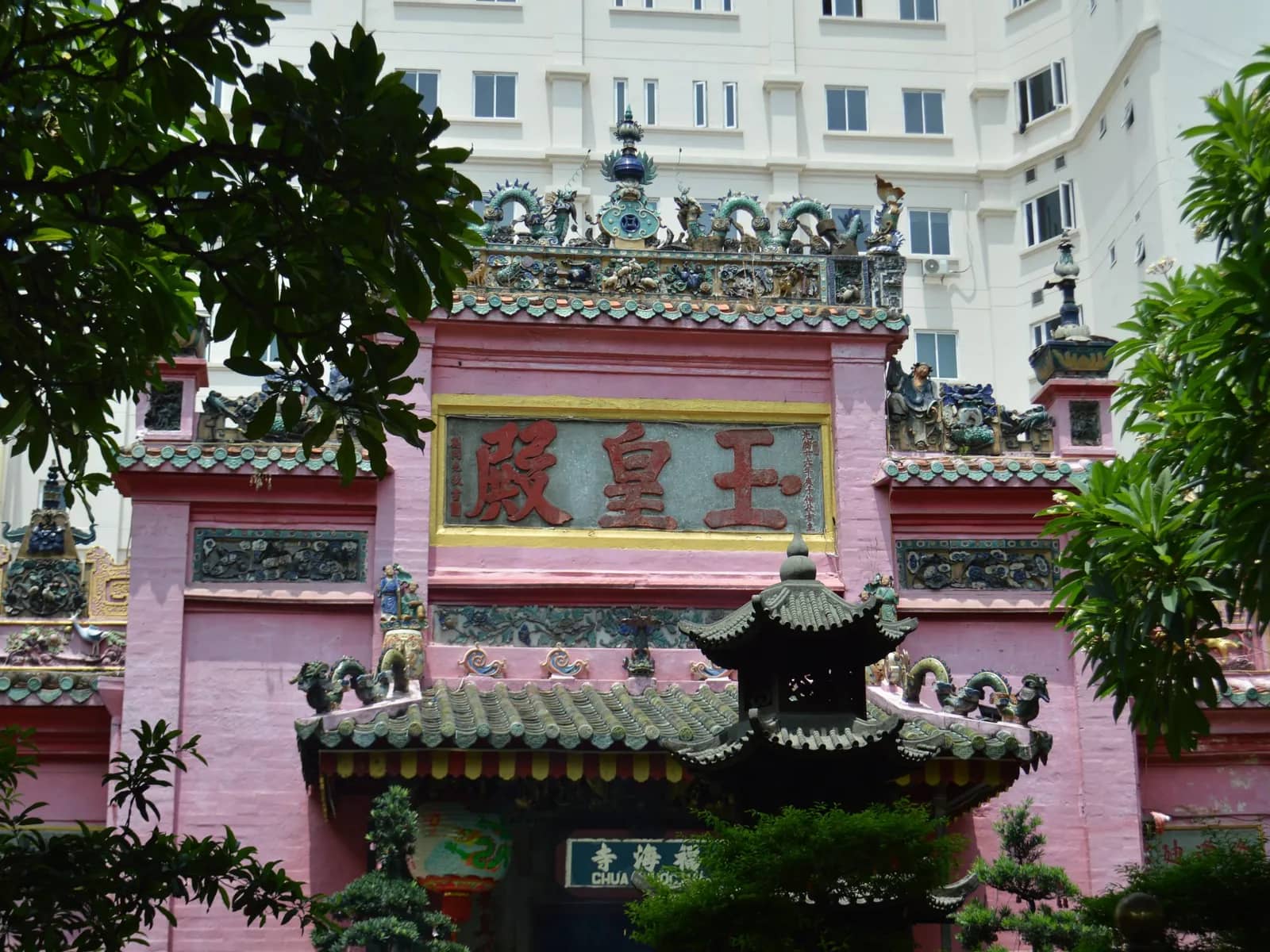
      Built between 1892 and 1900 by Luu Minh, a Cantonese migrant, the pagoda Vietnamese call Chua Ngoc Hoang, or Phuoc Hai Tu, is a working temple. Couples come to pray for a child before the goddess Kim Hoa Thanh Mau and her 12 midwife figures. Barack Obama visited on 22 May 2016. It opens every day, and on the 1st and 15th of the lunar month from 05:00 to 19:00, about 900 m from the zoo and the History Museum.

    • Sunlight through incense smoke in the courtyard of Thien Hau Temple, with red pillars carved with Chinese characters and ceramic figures on the roof

      Thien Hau Temple, Cholon

      Where:
      710 Nguyen Trai, Cholon
      Festival:
      23rd day of the third lunar month

      Cholon's Cantonese community built this temple to the goddess Thien Hau around 1760, and it is one of the oldest temples of the city's Cantonese community, a national relic since 1993. Look up at the ceramic figures crowding the roof, there since 1908, and at the coils of incense hanging from the ceiling: visitors write a wish on paper and the keeper hangs the coil up for the goddess. The temple holds close to 400 antiques, and its festival falls on the 23rd day of the third lunar month.

    Museums and the zoo

    • The tiered roof and white entrance pavilion of the Ho Chi Minh City History Museum

      Ho Chi Minh City History Museum

      Open:
      Tue to Sun, 08:00 to 11:30 and 13:00 to 17:00; closed Mon
      Entry:
      VND 60,000 from 1 October 2026; children and students free

      Founded by the colonial government in 1927 and opened on 1 January 1929, the museum stands inside the grounds of the Saigon Zoo and Botanical Gardens and holds more than 43,000 documents and objects, 12 of them national treasures. It closes on Mondays and from 11:30 to 13:00, so plan a morning or a mid-afternoon visit. The Jade Emperor Pagoda is about 900 m away.

    • Yellow colonial villa of the Ho Chi Minh City Fine Arts Museum behind an iron gate, with palms and exhibition banners

      Ho Chi Minh City Fine Arts Museum

      Open:
      Daily, 08:00 to 17:00
      Entry:
      VND 60,000 from 1 October 2026

      The city's art museum, founded in 1987 and open since 1989, fills a villa the French architect Rivera built between 1929 and 1934 for the Hua family. It holds more than 22,000 objects, with Champa and Oc Eo pieces on the third floor, and it opens every day. It's about 400 m from Ben Thanh Market and 700 m from the City Museum, so it fits a walk round the centre.

    • A bronze elephant statue among palms and shrubs at Saigon Zoo and Botanical Gardens, a tiled temple roof behind

      Saigon Zoo and Botanical Gardens

      Open:
      Daily, 07:00 to 18:30
      Entry:
      VND 60,000 at 1.3 m and over; VND 40,000 from 1 m to 1.3 m

      Founded on 23 March 1864, the zoo and botanical garden calls itself the eighth-oldest zoo in the world, and it is Vietnam's oldest. It keeps more than 120 animal species and more than 320 plant species, and the History Museum stands in its grounds. Tickets go by height, not age, and are sold only at its own gates or as e-tickets on saigonzoo.vn.

    Tips

    • The History Museum closes on Mondays and over lunch; the Fine Arts Museum and the zoo open every day.
    • Thien Hau draws thousands in the last days before Tet, when people queue from 07:00 for the year-end seal ritual.

    Sources

    Checked in October 2026.Show all 27 sources
    • visithcmc.vn. (attr-jade-emperor-pagoda row 1) Other name Phuoc Hai Tu; 73 Mai Thi Luu Street, Tan Dinh; built 1892 to 1900 by Luu Minh; national architectural and artistic relic in 1994 (HCMC Tourism Promotion Centre).
    • en.wikipedia.org. (attr-jade-emperor-pagoda row 4) Taoist, Buddhist and Confucian; founder a Cantonese merchant; Obama visit 22 May 2016.
    • wikidata.org, page 2, page 3, page 4, page 5, page 6. (attr-jade-emperor-pagoda row 5) About 0.9 km from the zoo (0.86 km) and History Museum (0.89 km), 1.5 km from War Remnants Museum (1.49 km), 1.7 km from Independence Palace (1.65 km), 2.5 km from Saigon railway station (2.48 km), 5.8 km from Tan Son Nhat (5.84 km).
    • ourairports.com. (attr-jade-emperor-pagoda row 5) About 0.9 km from the zoo (0.86 km) and History Museum (0.89 km), 1.5 km from War Remnants Museum (1.49 km), 1.7 km from Independence Palace (1.65 km), 2.5 km from Saigon railway station (2.48 km), 5.8 km from Tan Son Nhat (5.84 km).
    • pexels.com. (attr-jade-emperor-pagoda row 11) Hero photo: the front of the Jade Emperor Pagoda, Ho Chi Minh City, Valeria Drozdova, Pexels License (taken 2026-05-06).
    • baotanglichsutphcm.com.vn. (attr-history-museum row 1) Open Tuesday to Sunday, 8:00 to 11:30 AM and 1:00 to 5:00 PM, closed Mondays; fee VND 60,000; half price for Vietnamese seniors among other groups; free for children, students, people with severe disabilities, poor households.
    • baotanglichsutphcm.com.vn. (attr-history-museum row 2) Fee notice of 17 September 2026 under Resolution 29/2026: VND 60,000 from 1 October 2026 for domestic and foreign visitors; half price VND 30,000 (50%); free for children, students, people with severe disabilities, poor and near-poor households; bring ID or proof.
    • baotanglichsutphcm.com.vn. (attr-history-museum row 3) Old French-built building from 1929 in the Indochinese revival style; more than 43,000 documents and objects, 12 national treasures; front building 1927, rear U-shaped wing by architect Nguyen Ba Lang in 1970; national architectural and artistic relic in 2012; from 1956 the National Museum of Vietnam in Saigon, showing old art from Asian countries.
    • vi.wikipedia.org. (attr-history-museum row 4) At 2 Nguyen Binh Khiem, inside the Saigon Zoo and Botanical Gardens grounds; founding decree 28 November 1927, opened 1 January 1929.
    • openstreetmap.org. (attr-history-museum row 5) About 0.9 km from the Jade Emperor Pagoda (0.89 km), 1.6 km from Independence Palace (1.60 km), 3.1 km from Saigon railway station (3.10 km), 6.7 km from Tan Son Nhat (6.72 km), next to the zoo (0.03 km), Wikidata Q6121304, Q933384, Q2673539, Q3162430 and OurAirports VVTS).
    • en.wikipedia.org. (attr-history-museum row 10) Area on the city page: District 1, as it sits inside the zoo grounds.
    • pexels.com. (attr-history-museum row 11) Hero photo: the entrance of the Ho Chi Minh City History Museum, Chungnhutphat, Pexels License (taken 2022-08-13).
    • baotangmythuattphcm.com.vn. (attr-fine-arts-museum row 1) Founded by decision of 5 September 1987, at 97A Pho Duc Chinh, District 1; opened to visitors end of May 1989; more than 22,000 objects in two groups (ancient to early modern, modern), with Indochina and Gia Dinh school painters such as Nguyen Gia Tri, Nguyen Sang, Diep Minh Chau.
    • tuoitre.vn. (attr-fine-arts-museum row 3) City resolution sets VND 60,000 per person from 1 October 2026, same for domestic and foreign visitors; Fine Arts Museum named; children and students free.
    • visithcmc.vn. (attr-fine-arts-museum row 4) Open 8:00 AM to 5:00 PM every day (HCMC Tourism Promotion Centre).
    • en.wikipedia.org. (attr-fine-arts-museum row 5) Main building a villa by French architect Rivera, 1929 to 1934, for the Hua (Hui Bon Hoa) family; sculpture, oil, silk and lacquer painting, Hang Trong, Dong Ho and Kim Hoang woodcuts, ceramics, Buddhist art; Champa and Oc Eo pieces on the third floor.
    • wikidata.org, page 2, page 3. (attr-fine-arts-museum row 6) About 0.4 km from Ben Thanh Market (0.40 km), 0.7 km from the Ho Chi Minh City Museum (0.74 km), 1 km from Independence Palace (0.99 km), 2.9 km from Saigon railway station (2.87 km), 7.6 km from Tan Son Nhat (7.59 km).
    • hcmc-museum.edu.vn. (attr-fine-arts-museum row 12) Two other city museums under the same city fee (resolution 29/2026/NQ-HĐND) list children and students as free from 1 October 2026.
    • saigonzoo.vn. (attr-saigon-zoo row 1) Founded 23 March 1864, eighth-oldest zoo in the world; more than 120 animal species and more than 320 plant species; address No. 2 Nguyen Binh Khiem.
    • saigonzoo.vn. (attr-saigon-zoo row 2) Started as about 12 hectares of wasteland, set aside for a plant nursery and animal pens; name Thao Cam Vien official from 1956 after an overhaul.
    • saigonzoo.vn. (attr-saigon-zoo row 3) Adults VND 60,000 (1.3 m and taller), children VND 40,000 (1 m to under 1.3 m); open Monday to Sunday 7:00 AM to 6:30 PM; tickets only at the gate counters and as e-tickets on saigonzoo.vn.
    • pexels.com. (attr-saigon-zoo row 11) Hero photo: the elephant statue at Saigon Zoo and Botanical Gardens, LE MI, Pexels License (taken 2025-11-22).
    • sodulich.hochiminhcity.gov.vn. HCMC Department of Tourism: national relic 1993. Built around the 18th century by Guangzhou migrants. Festival 23/3 lunar.
    • vietnamtourism.vn. National tourism administration (TITC): founded 1760, three halls, incense burner dated 1886.
    • dantri.com.vn. Dân trí: about 1760. Ceramic roof figures from 1908. Nearly 400 antiques. Hanging coil incense. National relic 1993.
    • thanhnien.vn. Thanh Niên: national relic (1993) at 710 Nguyễn Trãi.
    • thanhnien.vn. Thanh Niên 2026: year-end seal ritual (xin ấn tất niên) draws thousands. People queue from 7:00 and the main rites start around 9:00.
    Photo credits
    • Jade Emperor Pagoda: Image: Valeria Drozdova / Pexels
    • Thien Hau Temple, Cholon: Image: Phan Anh Tuấn / Pexels
    • Ho Chi Minh City History Museum: Image: Chungnhutphat / Pexels
    • Ho Chi Minh City Fine Arts Museum: Image: Phương Huy / Wikimedia Commons, CC BY-SA 4.0
    • Saigon Zoo and Botanical Gardens: Image: LE MI / Pexels
  • Can Tho temples and old houses: Chua Ong, Munirangsyaram, Binh Thuy and Truc Lam Phuong Nam

    Can Tho's temples and houses show who settled the delta: Cantonese traders at Chua Ong, Khmer monks at Munirangsyaram, and Vietnamese families in Binh Thuy's French-style houses. We'd see Chua Ong, the museum and the Khmer pagoda on foot in town, then take a taxi to Binh Thuy for the old house and the communal house.

    Not ranked. See also our history list for all of Vietnam.

    In town

    • Front of Chùa Ông on Hai Bà Trưng street, with green-glazed roof tiles, ceramic figures on the ridge, red lanterns and motorbikes parked outside

      Chua Ong (Cantonese assembly hall)

      Where:
      32 Hai Ba Trung, opposite Ninh Kieu wharf
      Open:
      07:00 to 18:00; free

      Built from 1894 to 1896 by Chinese from Guangzhou and Zhaoqing, with almost all its materials brought from Guangdong, the Cantonese assembly hall honours Quan Cong in its central bay. Coils of incense hang from the roof, and each can take one to two weeks to burn out. It was listed as a national monument on 21 June 1993.

    • Three gilded Khmer-style spires on top of the Munirangsyaram pagoda gate against a cloudy sky

      Munirangsyaram Khmer pagoda

      Where:
      36 Hoa Binh Avenue
      Open:
      08:00 to 18:00

      A Khmer Theravada pagoda founded in 1948 in simple bamboo. Its gates were rebuilt in 1954 on the model of a tower at Angkor Wat, and the new hall followed in 1964. As the city's portal explains, the main hall faces east, because the east is the direction of the gods in Buddhism. It stands on the same avenue as the city museum.

    • The white-columned facade of Cần Thơ Museum behind palm trees and a low cream fence

      Can Tho Museum

      Where:
      1 Hoa Binh Avenue
      Open:
      08:00 to 17:00

      Founded in 1976, the city museum fills nearly 3,000 m² on two floors, and it calls itself the largest general museum in the delta by area. It traces Can Tho's people through time, from the Oc Eo culture to the Kinh, Khmer and Hoa, with an exhibition of photographs of the city then and now.

    Out of the centre

    • Wrought-iron gates numbered 142 and 144 in a cream wall, with the tiled roofs and green shutters of the Bình Thủy ancient house behind

      Binh Thuy old house

      Where:
      144 Bui Huu Nghia, Binh Thuy
      Open:
      08:00 to 16:00
      Entry:
      VND 20,000 to 50,000

      Built in 1870 by the Duong family on nearly 6,000 m², the house has a French-style front over a Vietnamese plan of five bays and two wings, and a great many doors; it is the oldest of more than 30 old houses in Binh Thuy. Under the floor lies a layer of coarse salt about 10 cm deep, against termites and insects. The sixth generation of the family still looks after it.

    • Yellow Bình Thủy communal house with a tiled roof, a stone heritage plaque and potted bonsai in the front courtyard

      Binh Thuy communal house

      Where:
      46/11A Binh Thuy
      Open:
      07:00 to 18:00

      First built of thatch and bamboo in 1844 as Long Tuyen Co Mieu, the dinh was honoured by Emperor Tu Duc in 1852 and rebuilt with a tiled roof in 1909; it has been a national monument since 1989. Its two big festivals, Ky Yen Thuong Dien on the 15th of the fourth lunar month and Ha Dien on the 15th of the twelfth, are national intangible heritage.

    • The red triple gate of Trúc Lâm Phương Nam monastery with curved tiled roofs and two gold guardian statues in front of the arches

      Truc Lam Phuong Nam monastery

      Where:
      Near My Khanh village, about 15 km from the centre
      Open:
      06:00 to 18:00

      Begun on 16 July 2013 and opened on 17 May 2014, this Zen monastery covers 38,016 m², the largest in the delta, and is built in the style of the Ly and Tran dynasties. The main hall stands on 44 ironwood columns around a 3.5-tonne bronze Buddha, and the bell tower holds a 1.5-tonne bronze bell.

    Tips

    • Chua Ong, Munirangsyaram and the museum are all in the centre, near Ninh Kieu.
    • The Binh Thuy old house closes at 16:00.

    Sources

    Checked in October 2026.Show all 16 sources
    • canthotourism.vn. Bình Thủy ancient house (Nhà thờ họ Dương) (French-style family house, national relic): Can Tho tourism portal (Sở VHTTDL Cần Thơ).
    • vietnamtourism.gov.vn. Bình Thủy ancient house (Nhà thờ họ Dương) (French-style family house, national relic): Vietnam National Authority of Tourism (TITC), 2024-12-27.
    • vietnamtourism.gov.vn. Bình Thủy ancient house (Nhà thờ họ Dương) (French-style family house, national relic): Vietnam National Authority of Tourism (TITC), 2023-08-23.
    • canthotourism.vn. Bình Thủy ancient house (Nhà thờ họ Dương) (French-style family house, national relic): Can Tho tourism portal, English (Sở VHTTDL Cần Thơ).
    • mycantho.vn. Chùa Ông (Quảng Triệu Hội Quán) (Cantonese assembly hall and temple): Can Tho tourism portal, mycantho.vn mirror (Sở VHTTDL Cần Thơ).
    • baocantho.com.vn. Chùa Ông (Quảng Triệu Hội Quán) (Cantonese assembly hall and temple): Báo Cần Thơ, 2015-07-25.
    • vietnamnet.vn. Chùa Ông (Quảng Triệu Hội Quán) (Cantonese assembly hall and temple): VietNamNet, 2023-06-25.
    • mycantho.vn. Munirangsyaram (Munir Ansay) Khmer pagoda (Khmer Theravada pagoda): Can Tho tourism portal, mycantho.vn mirror (Sở VHTTDL Cần Thơ).
    • canthotourism.vn. Munirangsyaram (Munir Ansay) Khmer pagoda (Khmer Theravada pagoda): Can Tho tourism portal, English (Sở VHTTDL Cần Thơ).
    • mycantho.vn. Cần Thơ Museum (city history museum): Can Tho tourism portal, mycantho.vn mirror (Sở VHTTDL Cần Thơ).
    • canthotourism.vn. Cần Thơ Museum (city history museum): Can Tho tourism portal, English (Sở VHTTDL Cần Thơ).
    • canthotourism.vn. Cần Thơ Museum (city history museum): Can Tho tourism portal (Sở VHTTDL Cần Thơ).
    • mycantho.vn. Trúc Lâm Phương Nam Zen monastery (Zen monastery): Can Tho tourism portal, mycantho.vn mirror (Sở VHTTDL Cần Thơ).
    • vietnamtourism.gov.vn. Trúc Lâm Phương Nam Zen monastery (Zen monastery): Vietnam National Authority of Tourism (TITC), 2018-09-26.
    • giacngo.vn. Trúc Lâm Phương Nam Zen monastery (Zen monastery): Giác Ngộ, 2014-05-19.
    • canthotourism.vn. Bình Thủy communal house (Đình Bình Thủy / Long Tuyền Cổ Miếu) (communal house, national relic): Can Tho tourism portal (Sở VHTTDL Cần Thơ).
    Photo credits
  • Mekong Delta day trips from Can Tho: Ba Chua Xu temple, Sam mountain, the Bat Pagoda and the Clay Pagoda

    Two trips from Can Tho: Chau Doc in An Giang, with the Ba Chua Xu temple and Sam mountain, and Soc Trang, now part of Can Tho, with its Khmer Bat Pagoda and the Clay Pagoda. We'd give Chau Doc a night, and see Soc Trang's two pagodas together, since both are in the same town.

    Not ranked. See also our culture list for all of Vietnam.

    Chau Doc

    • The three-tier green-roofed Bà Chúa Xứ temple under a blue sky, with crowds of visitors at its entrance

      Ba Chua Xu temple

      Where:
      Nui Sam, Chau Doc, An Giang
      Festival:
      22nd to 27th of the fourth lunar month

      The temple to the Lady of the Realm at the foot of Sam mountain was rebuilt in brick in 1870 and remodelled from 1972 to 1976 by the architects Huynh Kim Mang and Nguyen Ba Lang, with three tiers of curved roofs in jade-green tiles. Its festival draws millions of visitors and was added to UNESCO's intangible heritage list on 4 December 2024.

    • Red cable-car cabins rising over a lantern-lined terrace toward the rocky, wooded slopes of Sam Mountain

      Sam mountain

      Where:
      Chau Doc, An Giang
      Cable car:
      VND 150,000 return (2024)

      Climb on foot by the Bach Van path, ride up the Tao Ngo road, or take the 900 m cable car that opened in 2021, with 37 eight-seat cabins. At the top is the sandstone platform where the Lady sat before the villagers of Vinh Te brought her down 200 years ago, and Linh Son pagoda shows a footprint said to be a fairy's.

    Soc Trang

    • The gilded Khmer main hall of the Bat Pagoda with a blue and yellow balustrade and visitors beneath a leafless frangipani tree

      Bat Pagoda (Chua Doi)

      Where:
      181 Van Ngoc Chinh, about 2.5 km south-west of Soc Trang's centre
      Open:
      07:00 to 18:00

      A Khmer pagoda founded in 1569 by Thach Ut and named for its colony of fruit bats: Lyle's flying foxes of 400 to 450 g and large flying foxes of up to 1.1 kg. The main hall burned in August 2007 and was rebuilt by April 2009, and the pagoda has been a national art monument since 1999.

    • Front of Bửu Sơn Tự (Clay Pagoda) with gold dragons coiled around red pillars, red lanterns and Buddhist flags

      Clay Pagoda (Chua Dat Set)

      Where:
      286 Ton Duc Thang, Soc Trang
      Open:
      07:00 to 18:00

      Ngo Kim Tong spent 42 years, from 1929 to 1970, shaping nearly 2,000 Buddhas, animals and altar pieces from clay. Look for the 13-tier Da Bao tower, about 4 m high, with 208 doors and 208 Buddhas, and a lotus throne of 1,000 petals, each with a small seated Buddha. It is a family pagoda, with no monks and no doctrine of its own.

    Tips

    • The Ba Chua Xu festival, from the 22nd to the 27th of the fourth lunar month, draws huge crowds.
    • Soc Trang's Bat Pagoda and Clay Pagoda both open from 07:00 to 18:00.

    Sources

    Checked in October 2026.Show all 6 sources
    • angiang.gov.vn. Bà Chúa Xứ temple, Sam Mountain (temple, UNESCO-listed festival): An Giang provincial portal, 2024-12-06.
    • bvhttdl.gov.vn. Bà Chúa Xứ temple, Sam Mountain (temple, UNESCO-listed festival): Ministry of Culture, Sports and Tourism (bvhttdl.gov.vn), 2025-11-12.
    • vnexpress.net. Bà Chúa Xứ temple, Sam Mountain (temple, UNESCO-listed festival): VnExpress, 2024-04-22.
    • baoangiang.com.vn. Sam Mountain (Núi Sam) (hill with cable car and shrines): Báo An Giang, 2025-03-19.
    • canthotourism.vn. Bat Pagoda (Chùa Dơi / Mahatup) (Khmer pagoda with fruit-bat colony): Can Tho tourism portal (Sở VHTTDL Cần Thơ).
    • canthotourism.vn. Clay Pagoda (Chùa Đất Sét / Bửu Sơn Tự) (family pagoda of clay statues): Can Tho tourism portal (Sở VHTTDL Cần Thơ).
    Photo credits
  • Con Dao temples, market and town: An Son Mieu, Van Son pagoda, the memorial temple and the seafront

    Con Dao town is small enough to cycle: the seafront road, the market, and a ring of temples tied to the island's history and legends. We'd ride Ton Duc Thang at sunset, eat at the Con Son night market, and give one cool morning to An Son Mieu and Van Son pagoda.

    Not ranked. See also our culture list for all of Vietnam.

    Temples

    • The courtyard of Bà Phi Yến's temple: a low yellow building with three arched doorways and a dark tiled roof, a round yellow-rimmed planter with a small rock garden in front, shaded by large trees

      An Son Mieu (Phi Yen's temple)

      Where:
      About 2 km south-west of the centre

      The small temple, built in 1958, honours Phi Yen, a consort of Lord Nguyen Phuc Anh. The story goes that she was exiled to the islet now called Hon Ba for giving him unwelcome advice, was rescued by a black tiger and a white gibbon, and later took her own life to keep her honour. Her death anniversary, on the 18th of the tenth lunar month, is kept with great ceremony.

    • A two-tiered pavilion with an orange-red tiled roof and upturned eaves on a stone-balustraded terrace at Vân Sơn pagoda, trees and a glimpse of turquoise sea behind under a blue sky

      Van Son pagoda

      Where:
      Nui Mot, on the southern road
      Open:
      07:00 to 18:00

      The only pagoda on Con Dao, founded in 1964 and rebuilt for nearly VND 100 billion, finished on 3 December 2011. Most visitors climb about 200 steps to reach it, past wild monkeys, and below lies An Hai lake, the reservoir that supplies fresh water to the whole island.

    • The two-tiered bell pavilion of Côn Đảo memorial temple, with red tiled roofs and white dragon ridge ornaments on a white stone platform with balustrades, bonsai pots in front and green mountains behind

      Con Dao memorial temple

      Where:
      Nguyen An Ninh Street, beside Hang Duong cemetery

      Opened on 20 November 2011 on 30,040 m² beside the cemetery, the temple holds stone tablets with the names of the prisoners known to rest on Con Dao. Visiting groups ring the bell nine times, and Vo Thi Sau's official death anniversary is held here every 23 January.

    Market and seafront

    • The front of Côn Đảo market under a grey sky: a white facade with red lettering reading CHỢ CÔN ĐẢO, a red banner and coloured flags above rows of stalls, and an empty wet forecourt in front

      Con Dao market and night market

      Where:
      Pham Van Dong Street
      Open:
      Morning 05:00 to 10:00; afternoon 15:00 to 19:00

      The market sells the island's own foods: oc vu nang, a rare shellfish found only here, steamed with lemongrass, grilled with spring-onion oil or made into salad, and roasted bang nuts, salted or flavoured with pineapple or garlic butter. In the evening the Con Son night market sells street food, souvenirs and OCOP products, and on Saturdays at 19:30 there's a culture and arts show.

    • Côn Sơn Bay at dusk seen from the town shore: calm grey-blue water dotted with moored fishing boats, small islands and a dark headland on the horizon under streaked cloud

      Ton Duc Thang seafront

      Where:
      Ton Duc Thang Street

      The seafront road runs past the passenger port and the park's fee office to the French tiger cages, under 45 old bang trees recognised as Vietnamese heritage trees. In late February their leaves turn every colour, the island's most beautiful time by the portal's account. Ride it by bicycle in the cool of the morning or evening.

    Tips

    • The market runs in two sessions: 05:00 to 10:00 and 15:00 to 19:00.
    • Wild monkeys live along the 200 steps up to Van Son pagoda.

    Sources

    Checked in October 2026.Show all 13 sources
    • condao.com.vn. An Sơn Miếu (Bà Phi Yến temple): Côn Đảo tourism portal, An Sơn Miếu (20/06/2020).
    • condao.com.vn. An Sơn Miếu (Bà Phi Yến temple): Côn Đảo tourism portal, An Sơn Miếu (16/12/2025).
    • condao.com.vn. An Sơn Miếu (Bà Phi Yến temple): Côn Đảo tourism portal, October 2026 guide (06/10/2026).
    • condao.com.vn. Vân Sơn Tự (Chùa Núi Một): Côn Đảo tourism portal, Vân Sơn Tự (18/12/2025).
    • condao.com.vn. Vân Sơn Tự (Chùa Núi Một): Côn Đảo tourism portal via Báo Pháp Luật (24/02/2026).
    • condao.com.vn. Đền thờ Côn Đảo (Côn Đảo memorial temple): Côn Đảo tourism portal, Đền thờ (02/08/2020).
    • condao.com.vn. Đền thờ Côn Đảo (Côn Đảo memorial temple): Côn Đảo tourism portal, Hàng Dương (15/12/2025).
    • condao.com.vn. Đền thờ Côn Đảo (Côn Đảo memorial temple): Côn Đảo tourism portal, Võ Thị Sáu anniversary (28/12/2025).
    • condao.com.vn. Tôn Đức Thắng seafront: Côn Đảo tourism portal via Dân Việt (23/02/2026).
    • condaopark.com.vn. Tôn Đức Thắng seafront: Côn Đảo National Park (condaopark.com.vn), tour CDP 008.
    • condao.com.vn. Tôn Đức Thắng seafront: Côn Đảo tourism portal, French tiger cages (02/08/2020).
    • condao.com.vn. Chợ Côn Đảo and Côn Sơn night market (seafood, ốc vú nàng, roasted bàng nuts): Côn Đảo tourism portal, Chợ Côn Đảo (03/06/2026).
    • condao.com.vn. Chợ Côn Đảo and Côn Sơn night market (seafood, ốc vú nàng, roasted bàng nuts): Côn Đảo tourism portal, Chợ Côn Đảo (03/11/2025, source Vietnam Airlines).
    Photo credits
    • An Son Mieu (Phi Yen's temple): Image: ChieuTimViet / Wikimedia Commons, CC BY 3.0
    • Van Son pagoda: Image: Tuderna / Wikimedia Commons, CC BY 3.0
    • Con Dao memorial temple: Image: Tuderna / Wikimedia Commons, CC BY 3.0
    • Con Dao market and night market: Image: Phương Huy / Wikimedia Commons, Public domain
    • Ton Duc Thang seafront: Image: Tuderna / Wikimedia Commons, CC BY 3.0
Photo credits