Crafts and villages in Vietnam

Sights

Sights with a page of their own, with hours and fees from official sources. Not ranked.
By place

Each place's own guide, the same as on its page, with its sources. North to south, not ranked.

  • Hanoi shopping: Dong Xuan, the Old Quarter streets and craft villages

    In the Old Quarter, many streets still carry the name of the trade once done on them: Hang Gai for hemp, Hang Bac for silver, Hang Ma for votive paper goods. Dong Xuan Market anchors the north end, and on Friday to Sunday evenings a night market runs from Hoan Kiem Lake to its gate. For international brands, go to the malls south of the lake; for pottery and silk at the source, give half a day to Bat Trang or Van Phuc. With one afternoon, we'd walk Hang Gai, Hang Bac and Hang Ma and finish at Dong Xuan.

    Not ranked.

    Old Quarter markets

    • Two women at a Dong Xuan Market stall stacked with toothbrushes, packaged household goods and bundled paper products

      Dong Xuan Market

      Where:
      Dong Xuan Street, Old Quarter, about 800 m from Hoan Kiem Lake
      Open:
      Daily, 06:00 to 18:00; to 22:30 Friday to Sunday (the market company's site, 2022)

      Hanoi's big covered market went up in 1889, near the old Cau Dong market and the Red River wharf, and became the largest trading centre in Tonkin. It was rebuilt in 1995 behind its French facade, cut from five arched gates to three, and now holds about 2,000 stalls on three floors. It is mainly a wholesale market, with bolts of fabric and stacks of dry goods, but retail stalls sell clothes, shoes, toys, souvenirs and sweets at fair prices, and the lanes around it, selling everything from bedding to glassware, are part of the market too.

    • Shoppers walk between lit market stalls at night as a vendor grills skewers under a white umbrella

      Old Quarter weekend night market

      Where:
      Hang Dao, Hang Ngang and Hang Duong to the gate of Dong Xuan Market
      Open:
      Friday to Sunday, 18:00 to 23:00

      Every Friday, Saturday and Sunday evening since 2003, about 4,000 stalls fill some 3 km of streets from Hang Dao, at the north end of Hoan Kiem Lake, to the gate of Dong Xuan Market. Expect clothes, shoes, hats, sunglasses, handicrafts and snacks: the operator listed sweaters and jeans at VND 90,000 to 150,000 in 2023. It is busiest from 20:00 to 22:00, and xam singers perform at the market gate on Saturday evenings. Since July 2026 the streets are closed to all motor traffic on those nights. Keep a close eye on your belongings in the crowd.

    Craft streets

    All three are in the Old Quarter, a few minutes' walk apart. Shops set their own hours.

    • Yellow shophouses with balconies, ground-floor shops, trees and parked motorbikes on Hang Gai Street

      Hang Gai (silk)

      Where:
      Hang Gai Street, from Hang Dao to Hang Hom and Hang Trong
      Buy:
      Silk, tailored clothes

      The street of hemp once sold rope, cord and hammocks, and from the 19th century printers and booksellers moved in. Today Hang Gai is Hanoi's silk street, 273 m of tailors and boutiques selling some of the finest silk in the city. In 2017 Khaisilk, which started with a shop at No. 113 and claimed to have created the silk street, faced a scandal over selling silk made in China for 30 years. Buy from a shop that tells you where its cloth was woven.

    • Hang Bac shopfronts: silk lanterns and souvenirs hanging outside one shop, a gold-shop sign beside it

      Hang Bac (silver)

      Where:
      Hang Bac Street; Kim Ngan communal house at No. 42
      Entry:
      Street free; Kim Ngan communal house VND 20,000 since December 2025

      Silver Street had three trades: casting silver ingots, making jewellery and changing money, which is why the French called it the rue des Changeurs. Under King Le Thanh Tong in the 15th century, Luu Xuan Tin of Chau Khe village set up a silver mint here, at what is now No. 58. The Kim Ngan communal house at No. 42 was restored for Hanoi's thousandth anniversary. Artisans have hammered silver into jewellery on the street for hundreds of years, and old pagodas and red-roofed communal houses still line its 280 m.

    • Blue Pho Hang Ma street sign among red-and-gold hanging decorations, tassels and lanterns for sale

      Hang Ma (paper goods and lanterns)

      Where:
      Hang Ma Street, from Hang Duong to Phung Hung, beside Dong Xuan Market
      Best:
      Before the Mid-Autumn Festival, and from late December for Tet

      The street is named for votive paper goods, made here for worship, and its 380 m still sell them, but its stock follows the calendar. Before the Mid-Autumn Festival the shopfronts fill with lanterns, papier-mache masks, lion heads and rice-dough figures; in 2026 small lanterns cost VND 30,000 to 70,000. As soon as Christmas is over, the traders take the decorations down and the street turns red for Tet, with couplets, lanterns and lucky-money envelopes.

    Malls

    • Cream facade and dark dome of Trang Tien Plaza with its red sign, partly framed by trees

      Trang Tien Plaza

      Where:
      24 Hai Ba Trung Street

      Hanoi's first luxury shopping centre, with Rolex, Cartier, Burberry, Gucci and Versace among its brands, stands where a French trading company opened Maison Godard, selling imported goods, at the start of the 20th century. In 1959 it became the General Department Store, the first state-owned store in Hanoi and the biggest in the North. The present building is by the French architect Claude Cuvelier, and in 2013 an investor spent USD 45 million to turn it into Trang Tien Plaza.

    • Two mall towers joined by a glass skyway over the street, with taxis and motorbikes in front

      Vincom Center Ba Trieu

      Where:
      191 Ba Trieu Street, about 2 km south of Hoan Kiem Lake
      Open:
      Monday to Friday 10:00 to 22:00; Saturday and Sunday 09:30 to 22:00

      A mall of 101 shops in 14 categories, with the international brands you know from home: Zara, Uniqlo, Tommy Hilfiger, Hugo Boss, Calvin Klein, Polo Ralph Lauren, Levi's and Nike among them. There is a WinMart supermarket, a Fahasa bookshop, a CGV cinema and a children's play area. Vietnam's tourism board calls it a good default for an in-and-out shopping trip, and the mall is easy to find your way around.

    Craft villages

    Half a day each, outside the centre.

    • Curved, layered brown walls of the Bat Trang pottery museum building under a blue sky

      Bat Trang pottery village

      Where:
      About 15 km south-east of Hoan Kiem Lake; bus 47A from Long Bien stops at the pottery market
      Open:
      Pottery market 07:30 to 17:30 in summer, 08:30 to 17:30 in winter
      Entry:
      Pottery museum VND 60,000

      Records name Bat Trang as a pottery village from the end of the Tran dynasty, founded by potters who came from Bo Bat in Ninh Binh, and VnExpress puts the craft here at over 700 years. The pottery market covers 6,000 m² with about 300 stalls of vases, bowls, plates and cups, and you can bargain. Check the base and rim of every piece for chips before you pay. The pottery museum, Trung tam Tinh hoa Lang nghe Viet, is the building with curving, layered walls; one ticket covers three of its floors.

    • Ornate Lang Van Phuc village gate with pink blossoms, green electric shuttle carts and visitors in front

      Van Phuc silk village

      Where:
      Van Phuc, Ha Dong, about 10 km from central Hanoi

      Silk weaving here is said to go back more than 1,000 years, and the village holds a national record as the oldest silk-weaving village still working. Under the Nguyen dynasty, Ha Dong silk was chosen for the court's dress, and the village's most prized cloth is lua van, a patterned pure silk. Walk the silk street for scarves, ao dai, ties, bags and wallets, and look into the workshops. The craft became national intangible heritage in 2023, and in August 2026 the city recognised the village as an official tourist site.

    Tips

    • Bargaining is normal at the Bat Trang pottery market; check every piece for chips first.
    • On the night market streets, motor vehicles are banned from 19:00 to midnight on Friday, Saturday and Sunday, so walk in.
    • Bach Ma Temple, two streets from Hang Bac, and the Kim Ngan communal house each charge VND 20,000.

    Sources

    Checked in October 2026.Show all 29 sources
    • dongxuancorp.com. Dong Xuan is about 800 m from Hoan Kiem Lake, near Hang Ma street and Long Bien station; bounded by Dong Xuan lane (E), Dong Xuan street (W), Hang Khoai (N), Cau Dong (S).
    • dongxuancorp.com. Rebuilt 1995 (VND 68 billion): three floors, ~14,000 m2, ~2,000 stalls; facade kept French style but cut from 5 to 3 arched gates.
    • archives.org.vn. Built in 1889, near the old Cau Dong market and the Red River wharf (National Archives Centre I).
    • vietnam.travel. What to buy: fabric, shoes, clothes, toys, souvenirs, candies; surrounding alleys sell bedding to glassware (VNAT).
    • dongxuancorp.com. Officially opened 2003; runs 18:00-23:00 on weekend evenings (Fri, Sat, Sun).
    • dongxuancorp.com. Busiest 20:00-22:00; stalls start setting up ~17:00; thins out from 22:30 (conflicts with 23:00 end above).
    • hanoionline.vn. Also called Dong Xuan night market; Hang Dao-Hang Ngang-Hang Duong to the Dong Xuan gate; food, crafts and performances (Hanoi radio-TV, 30/08/2026).
    • nguoihanoi.vn. 273 m long, 11 m wide; runs from Hang Dao (by Dong Kinh Nghia Thuc square) to Hang Hom/Hang Trong.
    • vnexpress.net. Khaisilk (first shop 113 Hang Gai, late 1980s) helped make it a silk street; in 2017 it faced a scandal over selling 'made in China' silk for 30 years -> buy from shops that state origin.
    • nguoihanoi.vn. 280 m long; French called it rue des Changeurs (money-changers' street).
    • baotanglichsu.vn. Kim Ngan communal house at No. 42 (restored for Hanoi's 1000th anniversary); under Le Thanh Tong (1460-1497) Luu Xuan Tin of Chau Khe village set up a silver-ingot mint here; the mint ('Tràng') was at today's No. 58.
    • nguoihanoi.vn. 380 m long, 8 m wide, from Hang Duong to Phung Hung.
    • vnexpress.net. Before Mid-Autumn 2026: lanterns, papier-mâché masks, lion heads fill shopfronts; busy afternoons to late night, especially weekends.
    • baotintuc.vn. After Christmas the street switches overnight to red Tết decorations: couplets, lanterns, lucky-money envelopes (26/12/2025).
    • trangtienplaza.net. Address: 24 Hai Ba Trung Street, Cua Nam Ward.
    • trangtienplaza.net. First high-end luxury shopping centre in Hanoi; brands incl. Rolex, Cartier, Burberry, Gucci, Versace.
    • vincom.com.vn. Address 191 Ba Trieu; hours Mon-Fri 10:00-22:00, Sat-Sun 09:30-22:00 (WinMart 08:00-22:00).
    • vnexpress.net. Pottery village with 700+ years of ceramics, ~15 km SE of Hoan Kiem Lake.
    • dsvh.gov.vn. History: named as a pottery village from the late Trần dynasty; founders migrated from Bồ Bát (Ninh Binh) (Department of Cultural Heritage).
    • vietnamtourism.gov.vn. About 10 km from central Hanoi; record 'oldest silk-weaving village still operating'.
    • nvsk.vnanet.vn. Silk weaving said to be 1,000+ years old, taught by Lã Thị Nương; Nguyễn court used Hà Đông silk for royal dress.
    • vietnamtourism.gov.vn. What to buy: scarves, ao dai, ties, bags, wallets, clothes; see weaving workshops (2022).
    • sovhttdl.hanoi.gov.vn. Recognised as an official tourist site by Hanoi People's Committee Decision 3971/QĐ-UBND, 03/08/2026.
    • scov.gov.vn. The market runs Friday, Saturday and Sunday evenings, roughly 6–11 PM, on Hàng Ngang, Hàng Đào and Hàng Đường, and has expanded into Hàng Khoai and Hàng Giầy. (scov.gov.vn, the State Committee for Overseas Vietnamese; the page shows 21/07/2017).
    • vnexpress.net. In 2026 the streets inside the walking-street and night-market ring (including Hàng Đào and Hàng Ngang) are closed to all motor vehicles from 7 PM to midnight Fri–Sun.
    • nguoihanoi.vn. The Old Quarter walking space keeps its regular Fri/Sat/Sun schedule even over holidays (2026 notice). Dong Xuan JSC helps run it.
    • nhandan.vn. (history, context only) Nhân Dân wrote in 2006 that the Đồng Xuân night market had launched about two years earlier, alongside the Hàng Ngang – Hàng Đào walking street.
    • laodong.vn. Fee of 20,000 VND since 8/12/2025 under Resolution 66/2025.
    • openstreetmap.org, page 2. Hoan Kiem Lake to Vincom Center Ba Trieu: 1.99 km in a straight line and (21.01119, 105.84947)).
    Photo credits
  • Sa Pa villages and treks: Cat Cat, Ta Phin, and the Muong Hoa valley walk to Lao Chai and Ta Van

    Sa Pa's villages sit in the valleys below town, home to Hmong, Dao and Giay families, and the classic walk runs down the Muong Hoa valley from Y Linh Ho through Lao Chai to Ta Van, 7 to 12 km. Vietnam's tourism board says Cat Cat and Ta Phin can be seen without a guide. We'd walk the valley in mid-September for the golden rice, or in May and June, when the terraces are flooded.

    Not ranked. See also our culture list for all of Vietnam.

    Near town

    • Wooden two-storey house with a red-lettered Bản Cát Cát – Cat Cat Village sign over its terrace, wrapped in bamboo and green forest

      Cat Cat village

      Where:
      About 2 km from Sa Pa town
      Open:
      05:00 to 22:00 (Vietnam Airlines guide)
      Entry:
      VND 150,000; children 1 to 1.4 m VND 70,000 (2024)

      A Hmong village at the foot of the Hoang Lien Son range, about 2 km from town, where families still weave hemp, dye with indigo, forge tools and make silver jewellery. Past the Si bridge you reach the heart of the village, where three streams meet: Tien Sa, Vang and Bac. From Gate 2 an electric car takes you down for VND 10,000 more.

    • Unpaved main street of Tả Phìn lined with low red-roofed houses and a fenced garden, a large billboard on the left and green mountains behind

      Ta Phin and the Red Dao herbal bath

      Where:
      12 to 14 km from Sa Pa, towards Lao Cai
      Entry:
      VND 40,000; children VND 20,000 (March 2024)
      Bath:
      VND 100,000 to 120,000 a tub (about 2023)

      A Red Dao village that holds seven items of national intangible heritage, best known for its herbal baths: each uses at least ten kinds of medicinal leaves, and special ones up to 120. Soak for 15 to 20 minutes and no longer, or the herbs can make you dizzy. In 2015 Tan Ta May and 120 women of Ta Phin set up a Red Dao community cooperative here.

    The Muong Hoa valley walk

    • Curved yellow-green rice terraces on a hillside above a narrow concrete path, forested mountains and white clouds behind

      Y Linh Ho village

      Where:
      Muong Hoa valley, about 7 km south-west of Sa Pa

      The first village on the classic walk down the Muong Hoa valley, home to Hmong and Dao families whose traditional houses have kept their old, plain look. The trek from Sa Pa through Y Linh Ho and Lao Chai to Ta Van runs 7 to 12 km. The best months are May and June, when the flooded terraces become mirrors, and September and October, when the rice ripens.

    • Bright green rice terraces filling the valley floor at Lao Chải, a few houses under tall trees and terraced hills behind

      Lao Chai village

      Where:
      About 7 km south-east of Sa Pa
      Rice:
      Ripe from mid-September

      A Black Hmong and Giay village on the walk from Y Linh Ho to Ta Van, which takes 2 to 5 hours depending on your pace. Its terraces usually ripen from mid-September; in 2024 Typhoon Yagi sent the streams over the fields, broke some terraces and flattened rice, and farmers rushed the harvest. Much of the path is dirt, steep and slippery in rain, so wear shoes with grip.

    • A woman in a turquoise-and-pink checked headscarf sews at a Tả Van craft stall hung with embroidered bags and hats, red flowers in the foreground

      Ta Van village

      Where:
      About 11 km from Sa Pa, on the Muong Hoa stream
      Homestay:
      From VND 200,000 a person in a shared room; from VND 700,000 a double (2026)

      A Giay and Hmong village of stilt houses, backed by the Hoang Lien Son range and facing the Muong Hoa stream, and the usual place to spend the night on the walk. The South China Morning Post named it one of Asia's six most beautiful villages in July 2025. Cross Cau May, the rattan bridge, whose planks are about 20 cm apart. A checkpoint stands about 10 km out of town.

    • Green rice terraces sloping down to the pale stony bed of the Mường Hoa river, village houses on the far slopes under low cloud

      Muong Hoa valley rice terraces

      Where:
      About 6 km south-east of Sa Pa
      Rice:
      Green until the end of August; golden from about mid-September

      The valley's terraces were cut and farmed by Hmong, Dao, Xa Pho and other peoples over hundreds of years, and Travel + Leisure named Sa Pa's terraces among the seven most impressive in Asia. Boulders of strange shapes lie scattered across the valley, the field of ancient rocks. Vietnam's tourism board suggests autumn for golden rice and clear skies, and March to May for mild weather and flowers.

    Tips

    • The valley paths are dirt and get slippery in rain; wear shoes with grip.
    • Golden rice comes around mid-September; the terraces are flooded in May and June.

    Sources

    Checked in October 2026.Show all 16 sources
    • baolaocai.vn. Cat Cat village (Bản Cát Cát) (Hmong village): Báo Lào Cai, 12 May 2026 (location, people).
    • dulichlaocai.vn. Cat Cat village (Bản Cát Cát) (Hmong village): Lao Cai tourism portal dulichlaocai.vn, 2024 price list (fee).
    • vietnamairlines.com. Cat Cat village (Bản Cát Cát) (Hmong village): Vietnam Airlines travel guide, undated (hours).
    • vnexpress.net. Cat Cat village (Bản Cát Cát) (Hmong village): VnExpress Sa Pa guide, first published 4 Jun 2020, updated 16 Apr 2026 (three streams).
    • vietnam.travel. Cat Cat village (Bản Cát Cát) (Hmong village): Vietnam National Authority of Tourism, vietnam.travel (no guide needed).
    • sunworld.vn. Lao Chải village (Black Hmong and Giáy village, trek route): Sun World Fansipan Legend (operator) Lao Chai page, 30 Oct 2025 (location, people).
    • vnexpress.net. Lao Chải village (Black Hmong and Giáy village, trek route): VnExpress Tả Van guide, 15 Aug 2026 (trek length and time).
    • vnexpress.net. Lao Chải village (Black Hmong and Giáy village, trek route): VnExpress, 20 Sep 2024 (harvest timing).
    • sunparadiseland.com. Ý Linh Hồ village (Hmong and Dao village, trek start): Sun Paradise Land (Sun Group), 26 Nov 2025 (location).
    • sunworld.vn. Mường Hoa valley rice terraces (Valley, rice terraces, carved rock field): Sun World Mường Hoa page, 29 Oct 2025 (location).
    • dulichlaocai.vn. Mường Hoa valley rice terraces (Valley, rice terraces, carved rock field): Lao Cai tourism portal, 22 Apr 2020 (who built the terraces).
    • dulichlaocai.vn. Tả Phìn village and Red Dao herbal bath (Red Dao village, herbal bath): Lao Cai tourism portal, c. 2023 (location, people).
    • dulichlaocai.vn. Tả Phìn village and Red Dao herbal bath (Red Dao village, herbal bath): Lao Cai tourism portal, c. 2025 (conflicting distance).
    • dantocphattrien.vietnamnet.vn. Tả Phìn village and Red Dao herbal bath (Red Dao village, herbal bath): Dân tộc & Phát triển, 15 Jun 2026 (cooperative).
    • baochinhphu.vn. Tả Phìn village and Red Dao herbal bath (Red Dao village, herbal bath): Báo Điện tử Chính phủ, 14 Feb 2024 (heritage).
    • sunworld.vn. Tả Phìn village and Red Dao herbal bath (Red Dao village, herbal bath): Sun World Tả Phìn page (village fee, Mar 2024 figure).
    Photo credits
    • Cat Cat village: Image: Haneul Trac / Pexels
    • Ta Phin and the Red Dao herbal bath: Image: Christophe95 / Wikimedia Commons, CC BY-SA 4.0
    • Y Linh Ho village: Image: Can Pham / Unsplash
    • Lao Chai village: Image: Christophe95 / Wikimedia Commons, CC BY-SA 4.0
    • Ta Van village: Image: Extrovert Traveler / Pexels
    • Muong Hoa valley rice terraces: Image: Christophe95 / Wikimedia Commons, CC BY-SA 4.0
  • Ha Giang villages and markets: Dong Van old quarter, the Vuong mansion, Lung Cam, Lo Lo Chai and Sunday markets

    The plateau's villages are Hmong, Lo Lo, Tay and Chinese, and the best time to meet the people who live in them is at the weekly markets: Dong Van and Meo Vac meet on Sundays, smaller ones by the lunar calendar. VnExpress suggests leaving Hanoi on Friday evening to reach Dong Van's Sunday market. We'd stay two nights in Dong Van and see Lung Cam and the Vuong mansion on the way in.

    Not ranked. See also our culture list for all of Vietnam.

    Dong Van

    • A stone stairway and wall carrying a yellow "Phố cổ Đồng Văn – Dong Van Old Town" sign, with a bare tree and a misty limestone crag behind

      Dong Van old quarter

      Where:
      Dong Van, about 150 km north of Ha Giang city

      Dong Van village was founded on 3 June 1905, and its old quarter is three rows of houses in a U, roofed with curved tiles, around the market. A fire at the lunar new year of 1923 burned every thatched house and stall, and the U-shaped market was rebuilt from 1925 to 1928. More than 40 rammed-earth houses, some of them a century old or more, still stand.

    • A brown cow held on a rope in front of a dense crowd of shoppers, many women in pink and green Hmong clothes and headscarves, at Đồng Văn market

      Dong Van Sunday market

      When:
      Sunday morning

      On Sundays people come in from the villages to trade linen, brocade, buckwheat cakes and thang co, and to sit round the thang co pans with corn cakes, five-colour sticky rice and men men. The market has moved to a bigger site and now trades every day, but Sunday is the big one. Smaller markets at Sa Phin, Lung Phin and Pho Cao meet by the lunar calendar.

    Around Sa Phin

    • The whitewashed front gate of the Vương mansion, with carved dark-wood eaves, vertical boards of Chinese characters on stone pillars and a curved stone step in front

      Vuong family mansion

      Where:
      Sa Phin, about 13 km from Dong Van
      Entry:
      VND 30,000; children VND 10,000 (from 1 December 2022)

      Built from 1898 to 1907 by craftsmen from Yunnan working with Hmong builders, the Vuong family mansion covers about 3,000 m² in three parts: front, middle and rear. Look for the stone columns carved with opium poppies. It has been a national monument since 1993.

    • Yellow rammed-earth houses with dark yin-yang tiled roofs behind a dry-stone wall, set against a densely forested hillside in Lũng Cẩm

      Lung Cam village and Pao's house

      Where:
      Sa Phin
      Entry:
      VND 10,000

      A Hmong community tourism village of more than 70 households, best known for Pao's house, built in 1947 by Mua Sua Pao, who grew rich trading opium, and used as the set of a film that won the Golden Kite in 2005. A small cemetery of French Foreign Legion soldiers once lay beside it. Come in October and November for the buckwheat flowers.

    Further out

    • View down from the flag tower over a village of grey tiled roofs and a few blue-roofed buildings among small terraced fields, with steep terraced slopes rising behind

      Lo Lo Chai village

      Where:
      About 1 km from Lung Cu flag tower

      A Black Lo Lo village 1 km from the flag tower, named one of the world's best tourism villages by UN Tourism in 2025. Families still keep and use paired bronze drums, male and female, and nearly 70 households now run homestays and services, some in houses shaped like the drums. Cafe Cuc Bac serves dishes for VND 20,000 to 40,000 from 10:00 to 16:00.

    • Inside a huge covered market hall under a steel roof, rows of food stalls and long tables packed with diners, with haze from cooking fires

      Meo Vac Sunday market

      When:
      Sunday, busiest from 07:30 to early afternoon
      Food:
      About VND 40,000 a dish

      Every Sunday people from within 10 km come to Meo Vac's market, which has three parts: fresh food and farm tools outside, a food section, and a cattle market. Stalls cook over wood fires, so smoke always hangs over the thang co, pho, men men and banh cuon. VnExpress finds it less touristy than other markets in the region.

    • A yellow rammed-earth house with a deep tiled eave, rough wooden pillars, a ladder and a bucket under the veranda on a quiet lane in Phó Bảng

      Pho Bang old town

      Where:
      Less than 5 km off the Yen Minh-Dong Van road

      A small frontier town of about 11 km² and some 3,000 people, mostly Han Chinese and Hmong, less than 5 km off the main road. Its old street is two rows of rammed-earth houses whose curved tiles have faded in the sun and rain. Its market moves with the lunar calendar, meeting once every six days.

    Tips

    • Dong Van and Meo Vac markets are on Sunday mornings.
    • Smaller markets, Pho Bang among them, follow the lunar calendar; ask locally for the day.

    Sources

    Checked in October 2026.Show all 17 sources
    • vietnamtourism.gov.vn. Đồng Văn old quarter (historic town quarter): VNAT (Jan 2026): 40+ houses.
    • vnexpress.net. Đồng Văn old quarter (historic town quarter): VnExpress Đồng Văn guide: layout.
    • dongvangeopark.com. Đồng Văn old quarter (historic town quarter): Geopark board: village founded 1905.
    • dongvangeopark.com. Đồng Văn Sunday market (weekly ethnic market): Geopark board: Sunday market.
    • vnexpress.net. Đồng Văn Sunday market (weekly ethnic market): VnExpress Hà Giang guide: timing.
    • dongvangeopark.com. Vương family mansion (Nhà Vương), Sà Phìn (historic mansion): Geopark board: official fee (from 1 Dec 2022).
    • baotuyenquang.com.vn. Vương family mansion (Nhà Vương), Sà Phìn (historic mansion): Báo Tuyên Quang (27/03/2026): built.
    • dongvangeopark.com. Lũng Cẩm village and Pao's house (Hmong culture village): Geopark board: Lũng Cẩm.
    • en.nhandan.vn. Lũng Cẩm village and Pao's house (Hmong culture village): Nhân Dân (15 May 2025): households.
    • baotuyenquang.com.vn. Lô Lô Chải village (Lô Lô culture village): Báo Tuyên Quang (10/05/2025): location.
    • dongvangeopark.com. Lô Lô Chải village (Lô Lô culture village): Geopark board: UN Tourism award.
    • baotuyenquang.com.vn. Lô Lô Chải village (Lô Lô culture village): Báo Tuyên Quang (11/08/2026): homestays.
    • baotuyenquang.com.vn. Lô Lô Chải village (Lô Lô culture village): Báo Tuyên Quang (30/11/2025): drum-shaped homestay record.
    • dongvangeopark.com. Lô Lô Chải village (Lô Lô culture village): Geopark board: Cà Phê Cực Bắc hours & prices.
    • vnexpress.net. Mèo Vạc Sunday market (weekly ethnic market): VnExpress (16/3/2026): Sunday.
    • dongvangeopark.com. Phó Bảng old town (frontier market town): Geopark board: Phó Bảng size.
    • dongvangeopark.com. Phó Bảng old town (frontier market town): Geopark board: market days.
    Photo credits
    • Dong Van old quarter: Image: HuangWending18072009 / Wikimedia Commons, CC0
    • Dong Van Sunday market: Image: Zennysmile / Wikimedia Commons, CC BY-SA 4.0
    • Vuong family mansion: Image: Benjamin Smith / Wikimedia Commons, CC BY-SA 4.0
    • Lung Cam village and Pao's house: Image: NKSTTSSHNVN / Wikimedia Commons, CC BY-SA 4.0
    • Lo Lo Chai village: Image: NKSTTSSHNVN / Wikimedia Commons, CC BY-SA 4.0
    • Meo Vac Sunday market: Image: Benjamin Smith / Wikimedia Commons, CC BY-SA 4.0
    • Pho Bang old town: Image: Duong Nguyen / Pexels
  • Hoi An craft villages: Thanh Ha pottery, Kim Bong carpentry, Tra Que and the coconut forest

    The villages around Hoi An built the old town and still feed it: potters at Thanh Ha, carpenters and boatbuilders at Kim Bong across the river, herb growers at Tra Que, and the basket-boat rowers of the coconut forest at Cam Thanh. All are 3 km or so from the centre, an easy bicycle ride. We'd cycle to Tra Que early in the morning and keep the coconut forest for late afternoon, when the midday crowds have gone.

    Not ranked. Hours of sights with their own page are read from that page.

    Craft villages

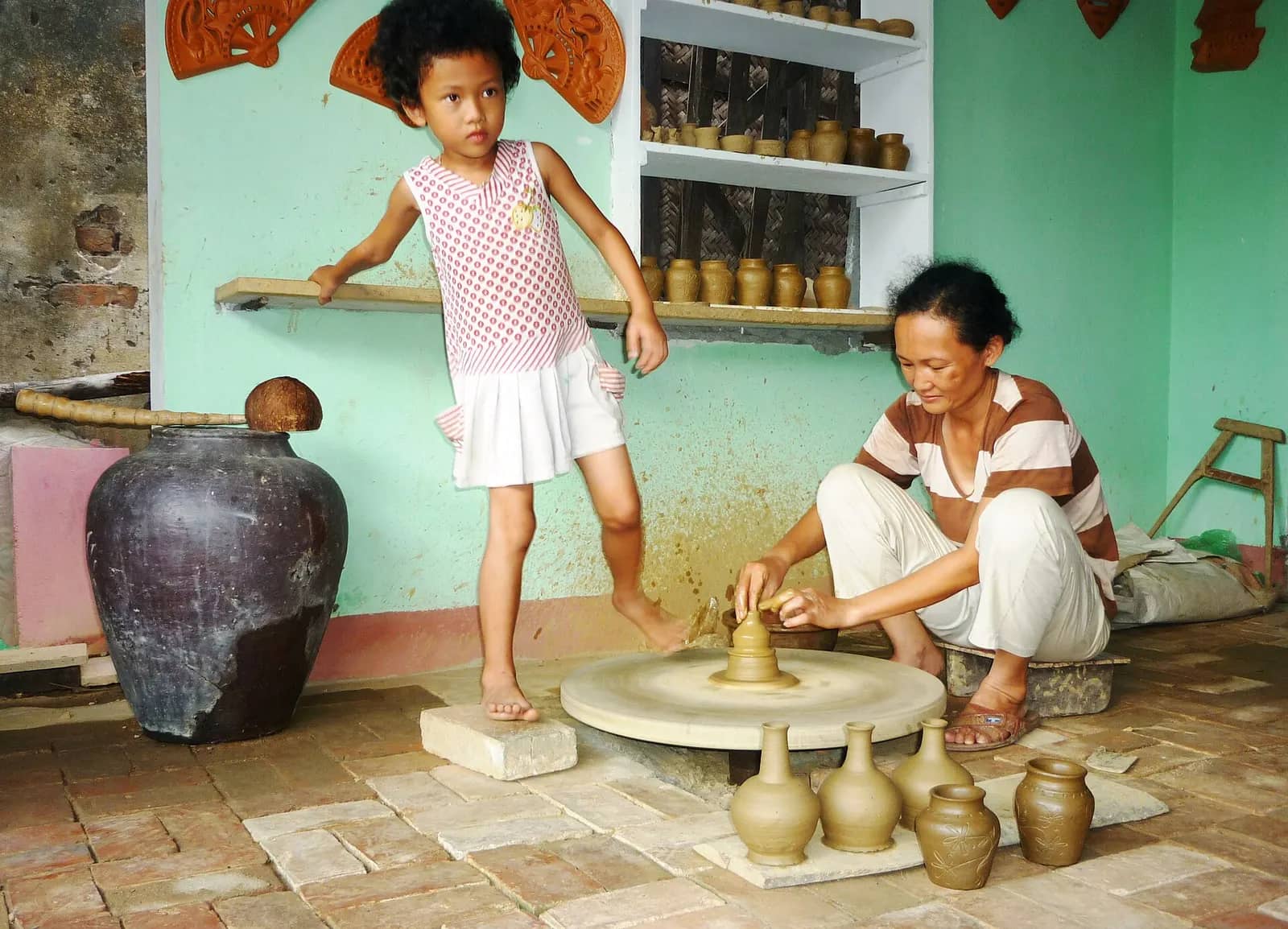
    • A woman shaping a small pot on a low potter's wheel while a young girl stands on the wheel's edge turning it with her foot, finished pots around them

      Thanh Ha Pottery Village

      Open:
      About 08:00 to 17:30; guides give slightly different times
      Entry:
      VND 35,000; children VND 15,000; Terracotta Park VND 50,000 extra

      Potters have worked at Thanh Ha for more than 500 years, and the craft has been national intangible heritage since 2019; today 33 households and 68 workers keep it going, and in September 2025 the village was named a best community-based tourism destination. It is about 3.2 km from the old town. Arrive by mid-afternoon, try a workshop at the wheel, and skip the Terracotta Park unless you want its museums.

    • A woodcarver on a bench chisels a small wooden pot held between his feet, with carving tools and a half-carved panel beside him

      Kim Bong carpentry village

      Where:
      Cam Kim, across the Thu Bon River from the old town
      See:
      Woodcarving workshops and boatyards by the river

      Woodcarvers, house carpenters and boatbuilders have worked in Kim Bong since the 16th century, and its carpenters built and restored much of Hoi An's old town; the craft has been national intangible heritage since 2016. Riverside workshops and boatyards are open to visitors, where you may see the painting of a boat's eyes before launch, and you can have your name carved in wood to take home. Training a carpenter here takes three to five years.

    • Women assembling silk lanterns in a workshop, surrounded by heaps of flat-packed lanterns, with lit lanterns hanging from the roof

      Lantern makers

      Where:
      Workshops around the old town; festival hub at An Hoi Sculpture Garden
      Festival:
      International Lantern Festival, 3 to 6 December 2026

      Silk stretched on bamboo, in nine standard shapes, Hoi An's lanterns were revived after the town joined the UNESCO list in 1999, and more than ten workshops now make them; the name has been a collective trademark since 2008, and they fold flat to carry home. The town's first International Lantern Festival runs from 3 to 6 December 2026, with lantern-making sessions for visitors and about 15 large installations left up until the 15th of the first lunar month in 2027.

    Herbs and the river

    • Long rows of spring onions and low leafy herbs with sprinkler posts, village houses and palm trees behind

      Tra Que vegetable village

      Where:
      About 3 km north of the old town
      Entry:
      VND 35,000, valid 24 hours, with a basil-seed drink

      The herb gardens that supply Hoi An's kitchens have been farmed since the 16th century on a river island between the Co Co River and the Tra Que lagoon, fertilised with seaweed from the lagoon instead of chemicals. Growing vegetables here became national intangible heritage in April 2022, and in 2024 UN Tourism named Tra Que one of its Best Tourism Villages, Vietnam's only one that year. Walk or cycle between the plots, early in the morning or late in the afternoon.

    • Round blue basket boats on a river beside a bank of nipa palms, a rower in a conical hat under an orange parasol in the nearest boat

      Bay Mau coconut forest

      Where:
      Cam Thanh, about 3 km east of the old town
      Price:
      No fixed tariff: from VND 180,000 for two adults and a child (2026); agree the price before you board

      About 100 ha of nipa palms grow where the Thu Bon meets the sea, and locals row visitors through the creeks in round bamboo basket boats, with spins, net-casting and crab-fishing on the way. The forest was a wartime base and has been a provincial relic since 2008. Boat prices are agreed with each operator, and VnExpress warns of charges up to VND 400,000; buy at the official counters opened in June 2026, and avoid 10:00 to 11:00, the busiest hour.

    Tips

    • Thanh Ha and Tra Que each charge VND 35,000, valid for 24 hours.
    • At the coconut forest, agree the full price before the boat leaves.

    Sources

    Checked in October 2026.Show all 31 sources
    • hoianworldheritage.org.vn. Official village ticket prices (Thanh Hà and Trà Quế), with children's rules, 24-hour validity and e-tickets from 1/7/2022 (page dated 24/02/2020, updated with the 2022 e-ticket line).
    • english.bvhttdl.gov.vn. (2026 context) Thanh Hà has 32 workshops and a new waterway pier.
    • hoianworldheritage.org.vn. Location opposite the Old Town, formed in the 16th century, four branches of carpentry, what a visitor can do.
    • hoianworldheritage.org.vn. Boatbuilding and the "painting of the boat's eyes" ritual. Riverside workshops are open to visitors.
    • hoianworldheritage.org.vn. Traditional craft village since 2005, national intangible heritage since 2016. Kim Bồng carpenters' work is all over the Old Town.
    • hoiancreativecity.com. Visitors can carve their name on wood as a souvenir. Cẩm Kim also has the Kim Hà organic farm and a 100-year-old house built by Kim Bồng carpenters.
    • dantocphattrien.vietnamnet.vn. 2026 profile: artisan Huỳnh Sướng, 13th generation of a carving family, workshop on the Thu Bồn.
    • hoianheritage.danang.gov.vn. Village dated to the 16th century by the Hội An heritage authority. Boatbuilding yards. 3–5 years to train a carpenter.
    • tourism-villages.unwto.org. UN Tourism Best Tourism Villages 2024: 3 km north of the Old Town, 202 households, 18 ha, seaweed and organic fertiliser only.
    • vnexpress.net. Award day and practical details: walk or cycle, 35,000 đ, best early or late.
    • hoianworldheritage.org.vn. Ministry decision of 4 April 2022. Name origin (Emperor Gia Long). Over 40 ha.
    • hoianworldheritage.org.vn. What the visitor ticket covers: farmer experience, Five Elements shrine, stone well.
    • baodanang.vn. 2026 state of the site: 5,000–6,000 visitors a day, 64 businesses, about 1,400 boats, price problems, new ticket counters from 1/6/2026.
    • hoianworldheritage.org.vn. Forbes 2025 ranking #20. Cẩm Thanh now in Hội An Đông ward, 937 ha.
    • vnexpress.net. 2026 practical: 3 km from the centre, crowd times, package price from 180,000 đ, overcharging warning, where to buy.
    • en.vietnamplus.vn. History: named for an original 7 mẫu of palms, wartime base, provincial relic since 2008, coconuts brought from the south over 200 years ago.
    • tuoitre.vn. Size (over 100 ha, three rivers), tourism since 2017, boat capacity and 2024 price.
    • vietnamplus.vn. What the boat ride involves (VNA, 2026): bamboo boats, nearly 100 ha, two or three passengers, "múa thúng", coconut-leaf souvenirs.
    • hoiancreativecity.com. More than 10 traditional workshops. Revival after the World Heritage listing. Artisan Huỳnh Văn Ba. 2008 collective trademark.
    • vietnamtourism.gov.vn. Lanterns fold flat to carry home. Honoured as a model Vietnamese craft village in 2011.
    • thanhnien.vn. First International Lantern Festival: Da Nang plan, dates and venues.
    • hoianworldheritage.org.vn. (attr-thanh-ha-pottery-village row 1) Village in Hoi An Tay ward, Da Nang City; more than 500 years old (500-year-old); won "Best Community-Based Tourism Destination" at the Vietnam Tourism Awards on 27 September 2025.
    • hoianworldheritage.org.vn. (attr-thanh-ha-pottery-village row 3) 2019 (23/09/2019): Ministry of Culture, Sports and Tourism lists Thanh Ha pottery as national intangible cultural heritage; village on the Thu Bon River; two kinds of product, brown earthenware and red pottery; craft anniversary on the 10th day (July 10) of the 7th lunar month.
    • thanhhaterracotta.com. (attr-thanh-ha-pottery-village row 4) Village formed in the 16th century, most glorious in the 17th and 18th centuries (17th - 18th); made bricks and tiles for Hoi An's old houses; yin-yang tiles still on Old Town roofs.
    • thanhhaterracotta.com. (attr-thanh-ha-pottery-village row 5) Terracotta Park: Thanh Ha Pottery Village Museum; open every day 8:00 to 17:30 (8:00 AM to 5:30 PM); Pham Phan Street, Nam Dieu Block, Hoi An Tay Ward.
    • thanhhaterracotta.com. (attr-thanh-ha-pottery-village row 8) Construction began 2011; opened 2015 after nearly 3 years of building; national architecture award 2017.
    • vinwonders.com. (attr-thanh-ha-pottery-village row 9) VinWonders (Vietnamese): adults VND 35,000 (35.000), children VND 15,000 (15.000); ticket covers village, Nam Dieu temple, Xuan My communal house, watching artisans, trying the wheel; hours 8:00 to 17:30 (8h00 – 17h30).
    • vinwonders.com. (attr-thanh-ha-pottery-village row 10) VinWonders (English): 8:30 to 16:30 (8:30 AM – 4:30 PM) every day; VND 35,000 (35,000) per person; about 3 km west.
    • hoianlocal.com. (attr-thanh-ha-pottery-village row 11) Hoi An Local: adults VND 35,000 (35,000), children VND 15,000 (15,000); covers village, Nam Dieu Temple, Xuan My communal house, a turn at the wheel; 8:30 to 17:00 (8:30 a.m. to 5 p.m.); 3 km west; riverside bike about 20 minutes.
    • openstreetmap.org, page 2. (attr-thanh-ha-pottery-village row 12) Distances: Ancient Town about 3.2 km (3.17 km), Japanese Covered Bridge 2.9 km (2.89 km), Hoi An Memories Show 4.4 km (4.39 km), Da Nang airport 21 km (21.38 km); our haversine arithmetic from OSM node 4171964390 (15.8771257, 108.2989875) to Wikidata Q5965459, Q1091054, OSM way 14131302, Wikidata Q773330; "16:30" in Our take is the earliest closing time in rows 10, 9, 11.
    • wikidata.org, page 2, page 3. (attr-thanh-ha-pottery-village row 12) Distances: Ancient Town about 3.2 km (3.17 km), Japanese Covered Bridge 2.9 km (2.89 km), Hoi An Memories Show 4.4 km (4.39 km), Da Nang airport 21 km (21.38 km); our haversine arithmetic from OSM node 4171964390 (15.8771257, 108.2989875) to Wikidata Q5965459, Q1091054, OSM way 14131302, Wikidata Q773330; "16:30" in Our take is the earliest closing time in rows 10, 9, 11.
    Photo credits
    • Thanh Ha Pottery Village: Image: LÊ TẤN LỘC / Wikimedia Commons, CC BY-SA 3.0
    • Kim Bong carpentry village: Image: Dragfyre / Wikimedia Commons, CC BY-SA 3.0
    • Lantern makers: Image: Xuân Anh Nguyễn / Pexels
    • Tra Que vegetable village: Image: Christophe95 / Wikimedia Commons, CC BY-SA 4.0
    • Bay Mau coconut forest: Image: Christian / Unsplash
  • Phu Quoc food and markets: fish sauce, pepper, herring salad, bun quay, Duong Dong market and Ham Ninh crab

    Phu Quoc is known in Vietnam for its fish sauce and its black pepper, and you can see both where they are made. The Michelin Guide will publish its first Phu Quoc selection in 2027, so for now the dishes and shops below come from the island's own guides and the press. We'd visit a fish-sauce barrel house in Duong Dong, have bun quay near Dinh Cau, and eat crab at Ham Ninh.

    Not ranked.

    Made on the island

    • Rows of tall rope-bound wooden fish-sauce vats inside a Phu Quoc barrel house, a walkway down the middle

      Fish-sauce barrel houses

      Where:
      Duong Dong: Hung Thanh on 30 Street, Thinh Phat on Nguyen Trung Truc
      Entry:
      Free (the island's tourism portal)

      Phu Quoc fish sauce is anchovy sauce aged for 12 months in wooden barrels, and in 2012 the EU registered it as a protected origin; the craft became national intangible heritage in 2021. The oldest of the houses that welcome visitors was founded in 1895, and they show you the barrel house, the works and the bottling line.

    • A sandy path between tall rows of green pepper vines on a Phu Quoc pepper farm

      Pepper gardens

      Where:
      Khu Tuong, Cua Duong, about 15 km north of Duong Dong

      Pepper grows all over the island, 470 ha by a 2007 count, but most of all at Khu Tuong, on the road to Bai Thom. Farms show you how it is grown, picked and dried for at least ten days, and how the ripe berries are sorted into three kinds: white, black and red.

    Dishes

    • A plate of gỏi cá trích: raw herring tossed with shredded coconut, herbs and fried shallots, a bowl of peanut dipping sauce behind

      Goi ca trich (herring salad)

      Season:
      May to November is the best time for the island's food

      VnExpress puts herring salad first on its list: raw herring cured in lime, rolled with herbs in rice paper brushed with coconut oil rather than dipped in water, and dipped in fish sauce. Mid-sized herring, about 60 to the kilo, is the one to choose, and the island's portal says it should be eaten with Phu Quoc sim wine.

    • A bowl of rice noodles topped with spring onion and herbs beside a bowl of red chilli dipping sauce and a basket of lettuce

      Bun quay

      Try it at:
      Kien Xay, 28 Bach Dang, near Dinh Cau
      Open:
      07:00 to 23:45
      Price:
      From VND 35,000 a bowl

      Bun quay grew out of the shrimp noodles of Binh Dinh. You order, mix your own dip from salt, sugar, MSG, kumquat and chilli, and wait for the bell; then you stir the bowl so the hot broth cooks the shrimp and fish. Kien Xay, near Dinh Cau, is the name VnExpress gives.

    • A woman in a conical hat weighing vegetables at a street stall piled with herbs and greens in Duong Dong

      Duong Dong market

      Where:
      The centre of Duong Dong, on the river
      Open:
      From about 04:00

      The island's biggest market fills from about 04:00 on the bank of the Duong Dong river, next to the fishing harbour. Eat breakfast there, banh canh with fish cake, chao cha or bun rieu, and buy dried fish, dried squid and fish sauce to take home.

    • The main street of Hàm Ninh market with stalls under green and yellow umbrellas and restaurant signs

      Ham Ninh crab

      Where:
      Ham Ninh fishing village
      Price:
      VND 200,000 to 500,000 a kg depending on season (VnExpress)

      Ham Ninh's crabs are small but sweet and fresh, at their best boiled and dipped in salt, pepper and lime; choose ones that run six or seven to the kilo. The village also sells live seahorses steeped in rice wine, fried seahorse, and sea pineapple. Prices move with the season.

    Tips

    • Duong Dong market starts at about 04:00; go early for breakfast.
    • The fish-sauce barrel houses in Duong Dong are free to visit.

    Sources

    Checked in October 2026.Show all 18 sources
    • moit.gov.vn. Fish-sauce barrel houses (nhà thùng): Hưng Thành, Thịnh Phát (nước mắm Phú Quốc): MOIT (2012-10-16): EU PDO.
    • dsvh.gov.vn. Fish-sauce barrel houses (nhà thùng): Hưng Thành, Thịnh Phát (nước mắm Phú Quốc): Cục Di sản văn hóa: national heritage 2021.
    • dulich.phuquoc.gov.vn. Fish-sauce barrel houses (nhà thùng): Hưng Thành, Thịnh Phát (nước mắm Phú Quốc): old Phú Quốc tourism portal: Hưng Thành, since 1895, address.
    • dulich.phuquoc.gov.vn. Fish-sauce barrel houses (nhà thùng): Hưng Thành, Thịnh Phát (nước mắm Phú Quốc): old portal: Thịnh Phát welcomes visitors.
    • vnexpress.net. Pepper gardens at Khu Tượng (Cửa Dương) (Phú Quốc black pepper): VnExpress guide: Khu Tượng.
    • dulich.phuquoc.gov.vn. Pepper gardens at Khu Tượng (Cửa Dương) (Phú Quốc black pepper): old Phú Quốc tourism portal: Khu Tượng garden, address.
    • dulich.phuquoc.gov.vn. Pepper gardens at Khu Tượng (Cửa Dương) (Phú Quốc black pepper): old portal: Nhân Kiệt farm, guided.
    • dulich.phuquoc.gov.vn. Pepper gardens at Khu Tượng (Cửa Dương) (Phú Quốc black pepper): old portal: Đức Thạnh, 3 kinds.
    • vietnam.travel. Pepper gardens at Khu Tượng (Cửa Dương) (Phú Quốc black pepper): vietnam.travel (VNAT).
    • dulich.phuquoc.gov.vn. Gỏi cá trích (raw herring salad) (dish): old Phú Quốc tourism portal: island speciality.
    • visitphuquoc.com.vn. Bún quậy Kiến Xây (bún quậy): VisitPhuQuoc (Sun Group portal): address, hours.
    • vov.gov.vn. Bún quậy Kiến Xây (bún quậy): VOV: origin.
    • dulich.phuquoc.gov.vn. Chợ Dương Đông (Dương Đông market) (morning market): old Phú Quốc tourism portal: biggest market, on the river.
    • dulich.phuquoc.gov.vn. Chợ Dương Đông (Dương Đông market) (morning market): old portal (2018): near Dinh Cậu harbour.
    • dulich.phuquoc.gov.vn. Hàm Ninh crab and seafood (ghẹ Hàm Ninh): old Phú Quốc tourism portal (2018): older price.
    • dulich.phuquoc.gov.vn. Hàm Ninh crab and seafood (ghẹ Hàm Ninh): old portal: village specialities.
    • tourism.angiang.gov.vn. Hàm Ninh crab and seafood (ghẹ Hàm Ninh): Sở Du lịch An Giang portal: seafood source.
    • guide.michelin.com. Michelin: Phu Quoc's first selection to be revealed in 2027.
    Photo credits
    • Fish-sauce barrel houses: Image: Quang Nguyen Vinh / Pexels
    • Pepper gardens: Image: Alex-st16 / Wikimedia Commons, CC BY-SA 4.0
    • Goi ca trich (herring salad): Image: OlBoes / Wikimedia Commons, CC BY-SA 4.0
    • Bun quay: Image: Phương Huy / Wikimedia Commons, CC BY-SA 4.0
    • Duong Dong market: Image: Evgeny Matveev / Unsplash
    • Ham Ninh crab: Image: trungydang / Wikimedia Commons, CC BY 3.0
  • Phu Quy harbour and village life: Linh Son pagoda, Tam Thanh, the port, Lach Du rafts and Long Hai

    About 30,000 people live on Phu Quy, mainly in Tam Thanh, Ngu Phung and Long Hai, and around 60% of them live from fishing, seafood processing and fish farming. Island life is the sight: the morning fish landings, the drying racks, the raft farms. Van An Thanh shrine keeps the skeleton of a whale over 17 m long that washed up in 1941; phone ahead, as it isn't always open. We'd be at Long Hai for the boats in the morning and eat lunch on a raft at Lach Du.

    Not ranked. See also our culture list for all of Vietnam.

    Tam Thanh and the north

    • A red and white striped beacon on a grey tetrapod breakwater with waves breaking against it, seen between two concrete blocks

      Phu Quy port

      Where:
      Tam Thanh, in the north-east

      Five fast ferries run between Phan Thiet and the port; in the first nine months of 2026 they made 864 trips with 386,455 passengers, and 169,266 tourists came to the island, 5,076 of them from abroad. Motorbike-rental and homestay owners wait at the gate with name boards, and Phu Quy market is right beside the port.

    • Two women in conical hats and masks lay split fish on wooden drying racks beside a village street, shop signs and a green bin behind

      Tam Thanh village

      Where:
      Around the port, in the north-east

      Tam Thanh is the island's busiest settlement, and its Trieu Duong communal house was first built in 1773. Fish and squid dry on racks along the lanes. A visiting writer kept hearing that prices are the same for islanders and tourists, and noticed the bang trees along the sea wall leaning hard to one side, like long hair blown by the wind.

    • View from the Linh Sơn hillside over dry fields, a white-roofed fishing village and a windswept turquoise bay with a rocky islet

      Linh Son pagoda

      Where:
      On the slope of Cao Cat, 61 m up

      Founded as a small hermitage by the nun Tran Thi Tan, in 1848 or 1866 depending on the source, Linh Son sits on the slope of Cao Cat and is known for a majestic Buddha statue. Its 110 m² hall has three tiers of roofs stacked like an old tower, and though it is more than a century old it has no resident abbot. Stop on the way up to Cao Cat.

    • Dozens of wooden fish-farm rafts and huts floating on a calm blue bay beyond a rocky reef flat

      Lach Du raft farms

      Where:
      Lach Du, Tam Thanh

      Fish farming on Phu Quy began in 1992, and Lach Du is where the raft farms gather; there are more than 70 on the island. VnExpress suggests eating on a raft such as Dai Nam, Anh Sang, Hai Thien, Hai Phat or Ba Sinh. Since 2019 raft owners have had to keep lifebuoys and life jackets for their guests.

    On the shore

    • Two islanders bent over a strip of exposed brown reef in shallow turquoise water, gathering seafood at low tide

      The reef flat

      Where:
      Around the island; widest off the far west

      The island is ringed by a thick belt of coral, 42 m at its deepest point, and off the far west a flat reef up to 600 m wide forms a lagoon carpeted with seagrass. Watch the fishermen untangle their nets after a day at sea. The island's shellfish dishes include melo melo snail salad and steamed conch.

    • A yellow-and-blue fishing boat and a red-and-white one sailing on a deep blue sea under puffy white clouds

      Long Hai fish landing

      When:
      Mornings; May is the peak season for seafood

      In the morning the fish market at Long Hai is busy with boats coming in, carrying rare catches and snails bigger than your hand. May is the peak season for seafood. Local fishermen believe the whale is a sacred spirit that helps them at sea, which is why the island honours whales in its shrines. Hon Hai is home to Phu Quy's shark-fishing boats.

    Tips

    • Phone Van An Thanh shrine before you go; it isn't always open.
    • Raft restaurants must provide life jackets; ask for one on the boat out.

    Sources

    Checked in October 2026.Show all 16 sources
    • baodanang.vn. Linh Sơn pagoda (Buddhist pagoda): Báo Đà Nẵng, Đảo ngọc giữa trùng dương (11/10/2026).
    • vietnam.travel. Linh Sơn pagoda (Buddhist pagoda): Vietnam National Authority of Tourism (vietnam.travel), Phu Quy guide.
    • vinpearl.com. Linh Sơn pagoda (Buddhist pagoda): Vinpearl (commercial guide), Chùa Linh Sơn (25/08/2025).
    • vnexpress.net. Linh Sơn pagoda (Buddhist pagoda): VnExpress, Cẩm nang du lịch đảo Phú Quý (pub. 29/5/2022, updated 7/5/2026).
    • phuquy.lamdong.gov.vn. Linh Sơn pagoda (Buddhist pagoda): Phu Quy special-zone portal, Du lịch xanh launch (12/06/2026).
    • phuquocexpress.com. Tam Thanh village and its drying racks (village life): Phu Quoc Express (ferry operator), Cảng Phú Quý page (modified 21/10/2026).
    • phuquy.lamdong.gov.vn. Tam Thanh village and its drying racks (village life): Phu Quy special-zone portal, Đền thờ Công chúa Bàn Tranh (11/03/2026).
    • phuquy.lamdong.gov.vn. Tam Thanh village and its drying racks (village life): Phu Quy special-zone portal, Giới thiệu các di tích lịch sử - văn hoá (11/10/2019).
    • moc.gov.vn. Phú Quý port and breakwater (harbour): Ministry of Construction, Cảng Phú Quý 9 tháng đầu năm 2026 (Oct 2026).
    • baolamdong.vn. Lạch Dù raft farms (aquaculture / floating village): Báo Bình Thuận (now Báo Lâm Đồng), Nuôi hải sản lồng bè kết hợp du lịch (22/05/2022).
    • baolamdong.vn. Lạch Dù raft farms (aquaculture / floating village): Báo Bình Thuận (now Báo Lâm Đồng), Phú Quý: Cần tạo nên sản phẩm du lịch khác biệt (16/12/2024).
    • baolamdong.vn. The reef flat at low tide (island life / reef): Báo Bình Thuận (now Báo Lâm Đồng), Phát triển du lịch trong các khu bảo tồn biển (24/06/2021).
    • phuquy.lamdong.gov.vn. The reef flat at low tide (island life / reef): Phu Quy special-zone portal, 2026 tourism plan (09/03/2026).
    • vietnamnews.vn. The reef flat at low tide (island life / reef): Việt Nam News, Sea-ing and tasting something special on Phú Quý Island (21/5/2024).
    • e.vnexpress.net. Long Hải fish landing (fishing harbour / market): VnExpress International, Phu Quy travel guide (31/12/2022).
    • phuquy.lamdong.gov.vn. Long Hải fish landing (fishing harbour / market): Phu Quy special-zone portal, khai quật bộ xương cá Ông 17m (08/10/2021).
    Photo credits

The facts

Photo credits